The hidden galaxy in the zone of avoidance
August 11, 2011 By Jon Voisey, Universe Today

The hidden galaxy in the zone of avoidance

Enlarge

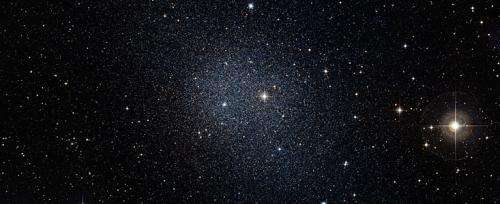
The Fornax dwarf galaxy is one of our Milky Way’s neighbouring dwarf galaxies, similar to the one discovered. Credit: ESO

There are some places astronomers dare not tread. One of the prime places is beyond the disk of our own galaxy where the numerous stars and clouds of dust along the line of sight make observations messy to say the least. This obscured portion of the sky is known as the Zone of Avoidance. But despite the challenges, one team of astronomers has searched through it and found a previously undiscovered galaxy lurking not too far from our own.

To discover this galaxy, the team, lead by graduate student Travis McIntyre at the University of New Mexico, used the gigantic Arecibo radio telescope. This telescope is adept at finding emission at the 21 centimeter wavelength emitted by cool, atomic hydrogen. This long wavelength is relatively immune to the diminishing effects of gas and dust within our galaxy.

After the initial discovery, the team followed up with further observation using the Expanded Very Large Array, which also operates in the radio, as well as the 0.9 meter Southeastern Association for Research in Astronomy telescope, which is an , in hopes of peering through some of the muck.

While the galaxy was easily recovered in the second radio search, and the showed a faint clump, the centers of the two did not appear to line up. The visual and radio components seemed not to overlap almost at all. A portion of the reason for this is that the team was unable to image the faint galaxy out to its full extent before the contamination from our own galaxy overwhelmed the signal. As such, the two likely overlap more than is indicated by the study, but this would still indicate that the distribution of within it is severely lopsided.

Another possibility is that the object detected isn’t really a galaxy at all and is a coincidence of an alignment between a high velocity cloud and an independent cluster of stars. However, such clouds of gas tend to travel in packs and no others are known in the area, making this possibility unlikely.

If the object is a galaxy, it is likely a blue dwarf galaxy with some 10 million solar masses. The team expects that, while the galaxy is relatively nearby, this galaxy is not likely to bea member of the local group because, were it that close, it would be unprecedentedly small. As such, they applied Hubble’s Law to give a rough distance of 22 million light years but caution that at such distances, there is a large velocity dispersion and this estimate may be unreliable.

Searching for like this one in the Zone of Avoidance are important to astronomers because the mass of such undiscovered galaxies may help to resolve the unexpected “discrepancy between the cosmic microwave background dipole and what is expected from gravitational acceleration imparted on the Local Group by matter in the local universe.”

Source: Universe Today

4.8 /5 (5 votes)  

Filter


Move the slider to adjust rank threshold, so that you can hide some of the comments.


Display comments: newest first

that_guy
Aug 11, 2011

Rank: not rated yet
but this would still indicate that the distribution of hydrogen gas within it is severely lopsided.


well, wouldn't that be expected of a small galaxy interacting with a much larger one??? We've seen plenty of pictures of colliding galaxies, and the stretched out forms of the magellanic clouds...
DavidMcC
Aug 12, 2011

Rank: 5 / 5 (1)
That guy, the Large Magellanic cloud is only ~160Klyr from the Milky Way. This object is at ~22Mlyr, about 100 times the distance, so the gravitational interactions are much weaker.
yyz
Aug 15, 2011

Rank: not rated yet
There are several notable (and nearby) galaxies hidden behind the dusty veils of the Northern Milky. IC 10, IC 342, NGC 6946 and Maffei I & II come to mind. Some would be fine naked-eye objects for fortuitously situated naked-eye observers.

Well worth the time to locates these faint, *nearby* galaxies. Many even fainter samples of obscured nearby dwarf galaxies are found all along the Milky Way. Quite a dynamic space around the MWG over long timescales.
yyz
Aug 16, 2011

Rank: not rated yet
"well, wouldn't that be expected of a small galaxy interacting with a much larger one??? We've seen plenty of pictures of colliding galaxies, and the stretched out forms of the magellanic clouds..."

As DavidMcC pointed out, this dwarf galaxy, ALFA ZOA J1952 1428, appears to be an isolated system. According to the discovery paper, this is likely a small Blue Compact Dwarf galaxy lying approx. 7Mpc from us and is apparently unconnected with the Local Group or any other known nearby galaxy group.

It appears to be 1300 x 1400pc across and contains a paltry 10E7 solar masses of HI.

The McIntyre et al paper with additional details here: http://arxiv.org/...43v1.pdf
Rank 4.8 /5 (5 votes)
Relevant PhysicsForums posts
  • revamping general concept and cosmological principle
    createdMay 25, 2012
  • Transiting Exoplanet Light Curve
    createdMay 25, 2012
  • Math behind Theoretical Physics
    createdMay 24, 2012
  • Do we know whats at the center of galaxies yet?
    createdMay 23, 2012
  • Structure of the Milky Way?
    createdMay 20, 2012
  • What would it take to terraform Pluto and Charon?
    createdMay 19, 2012
  • More from Physics Forums - General Astronomy

More news stories

Sophisticated simulations predict future warming

The chances of our planet being hit by a global warming of 3 degrees Celsius by 2050 is as likely as it being hit by an increase of 1.4 degrees, new research shows. Presented in the journal Nature Geoscience, the British study ...

Space & Earth / Earth Sciences

created May 22, 2012 | popularity 4.4 / 5 (9) | comments 51

Kyoto Protocol architect 'frustrated' by climate dialogue

UN climate talks are going nowhere, as politicians dither or bicker while the pace of warming dangerously speeds up, one of the architects of the Kyoto Protocol told AFP.

Space & Earth / Environment

created May 23, 2012 | popularity 3.7 / 5 (7) | comments 39

Aliens don't want to eat us, says former SETI director

Alien life probably isn’t interested in having us for dinner, enslaving us or laying eggs in our bellies, according to a recent statement by former SETI director Jill Tarter.

Space & Earth / Space Exploration

created May 25, 2012 | popularity 4.4 / 5 (13) | comments 37

Dragon arrives at space station in historic 1st (Update 2)

The privately bankrolled Dragon capsule made a historic arrival at the International Space Station on Friday, triumphantly captured by astronauts wielding a giant robot arm.

Space & Earth / Space Exploration

created May 25, 2012 | popularity 5 / 5 (10) | comments 19

What's the big deal about private space launches?

(AP) -- The first private spaceship is headed to the International Space Station. Some questions and answers about the cargo mission by Space Exploration Technologies, known as SpaceX:

Space & Earth / Space Exploration

created May 22, 2012 | popularity 5 / 5 (6) | comments 35


Nvidia trumpets Tegra 3 phone design wins for 2012

(Phys.org) -- Nvidia’s competitive war paint has a name, Tegra 3. On the heels of Nvidia announcements about lowering costs of its Tegra 3 processors and Nvidia-enabled tablets running Android Ice Cream ...

Browser wars flare in mobile space

The browser wars are heating up again, but this time the fight is for dominance of the mobile Internet.

Scientist: Evolution debate will soon be history

(AP) -- Richard Leakey predicts skepticism over evolution will soon be history. Not that the avowed atheist has any doubts himself.

Dell tablet leak: 10.1-inch display, two-battery choice

(Phys.org) -- Headline after headline talks about vendors’ tablets in the wings as likely number-one contenders for the iPad. Such claims have justifiably been taken with a grain of salt, considering ...

Keep food safety in mind this memorial day weekend

(HealthDay) -- Picnics, parades and cookouts are as much a part of Memorial Day weekend as tributes to the United States' war veterans.

Social welfare cuts ultimately come with heavy price, researchers say

(Phys.org) -- Slashing government funding for Medicaid, food stamps and other programs that serve the poor – while politically popular with some lawmakers and many conservatives – may do more harm ...