Cassini closes in on Saturn's tumbling moon Hyperion
Aug 26, 2011
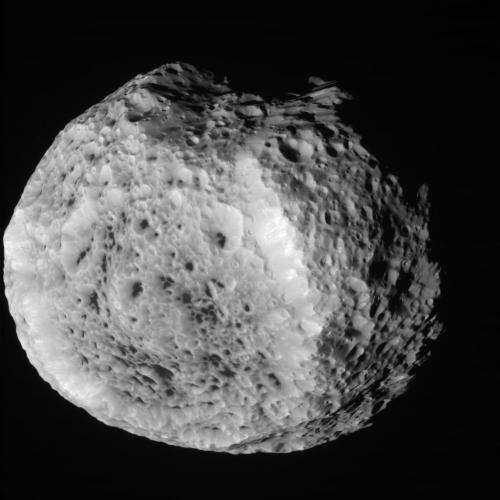
NASA's Cassini spacecraft obtained this unprocessed image of Saturn's moon Hyperion on Aug. 25, 2011. Image credit: NASA/JPL-Caltech/Space Science Institute

(PhysOrg.com) -- NASA's Cassini spacecraft captured new views of Saturn's oddly shaped moon Hyperion during its encounter with this cratered body on Thursday, Aug. 25. Raw images were acquired as the spacecraft flew past the moon at a distance of about 15,500 miles (25,000 kilometers), making this the second closest encounter.

Hyperion is a small moon -- just 168 miles (270 kilometers) across. It has an irregular shape and surface appearance, and it rotates chaotically as it tumbles along in orbit. This odd rotation prevented scientists from predicting exactly what terrain the spacecraft's cameras would image during this flyby.

However, this flyby's closeness has likely allowed Cassini's cameras to map new territory. At the very least, it will help scientists improve color measurements of the moon. It will also help them determine how the moon's brightness changes as lighting and viewing conditions change, which can provide insight into the texture of the surface. The color measurements provide additional information about different materials on the moon's deeply pitted surface.
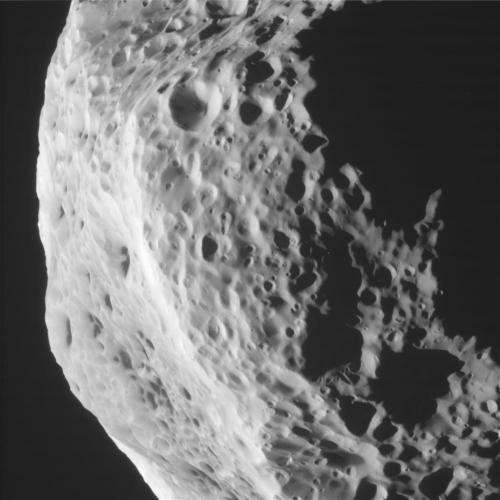
Side view taken by NASA's Cassini spacecraft of Saturn's moon Hyperion. Image credit: NASA/JPL-Caltech/Space Science Institute

The latest raw images of Hyperion are online at: http://.jpl..gov/photos/raw/ .

Cassini's closest encounter with Hyperion was on September 26, 2005, when the spacecraft flew approximately 310 miles (500 kilometers) above the moon's surface.

Cassini's next of Hyperion will be on Sept. 16, 2011, when it passes the tumbling moon at a distance of about 36,000 miles (58,000 kilometers).

Explore further: US space chief updates on asteroid lasso mission (Update)

Related Stories

Cassini's Doubleheader Flybys Score Home Run

Sep 30, 2005

Cassini performed back-to-back flybys of Saturn moons Tethys and Hyperion last weekend, coming closer than ever before to each of them. Tethys has a scarred, ancient surface, while Hyperion is a strange, spongy-looking body ...

Cassini's Photo Album From a Season of Icy Moons

Dec 07, 2005

Wrapping up a phenomenally successful year of observing Saturn's icy moons, the Cassini mission is releasing a flood of new views of the moons Enceladus, Dione, Rhea, Hyperion and Iapetus.

Cassini captures ice queen Helene

Jun 21, 2011

(PhysOrg.com) -- NASA's Cassini spacecraft has successfully completed its second-closest encounter with Saturn's icy moon Helene, beaming down raw images of the small moon. At closest approach, on June 18, ...

Recommended for you

Forecast for Titan: Wild weather could be ahead

May 22, 2013

(Phys.org) —Saturn's moon Titan might be in for some wild weather as it heads into its spring and summer, if two new models are correct. Scientists think that as the seasons change in Titan's northern hemisphere, ...

SDO observes mid-level solar flare

May 22, 2013

UPDATE 16:30 p.m. EDT: The M7-class flare was also associated with a coronal mass ejection or CME, another solar phenomenon that can send billions of tons of particles into space. While this CME was not Ea ...

User comments : 0

More news stories

A hidden population of exotic neutron stars

(Phys.org) —Magnetars – the dense remains of dead stars that erupt sporadically with bursts of high-energy radiation - are some of the most extreme objects known in the Universe. A major campaign using ...

Century-old science helps confirm global warming

(Phys.org) —Ocean measurements taken more than 135 years ago during the scientific expedition of HMS Challenger have provided further confirmation of human-produced global warming over the past century.

Hubble reveals the ring nebula's true shape

(Phys.org) —The Ring Nebula's distinctive shape makes it a popular illustration for astronomy books. But new observations by NASA's Hubble Space Telescope of the glowing gas shroud around an old, dying, ...

Spheres can form squares

Everybody who has tried to stack oranges in a box knows that a regular packing of spheres in a flat layer naturally leads to a hexagonal pattern, where each sphere is surrounded by six neighbours in a honeycomb-like ...