Zubrin claims VASIMR is a hoax
July 13, 2011 By Nancy Atkinson, Universe Today
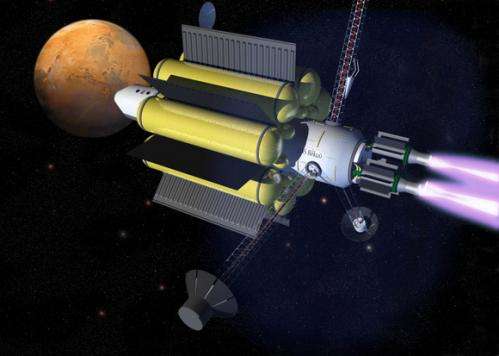
Artist rendering of the VASIMR powered spacecraft heading to Mars. Credit: Ad Astra
A next-generation plasma rocket being developed by former NASA astronaut Franklin Chang Diaz called the Variable Specific Impulse Magnetoplasma Rocket (VASIMR) has been touted as a way to get astronauts to Mars in weeks rather than months, as well as an innovative, cheap way to re-boost the International Space Station. But in a biting commentary posted on Space News and the Mars Society website, Mars Direct advocate Robert Zubrin calls VASIMR a hoax saying the engine is neither revolutionary nor particularly promising. Rather, it is just another addition to the family of electric thrusters, which convert electric power to jet thrust, but are markedly inferior to the ones we already have, adding, There is thus no basis whatsoever for believing in the feasibility of Chang Diazs fantasy power system.
The VASIMR uses plasma as a propellant. A gas is ionized using radio waves entering into a plasma state. As ions the plasma can be directed and accelerated by a magnetic field to create specific thrust. The purported advantage of the VASIMR lies in its ability to change from high impulse to low impulse thrust as needed, making it an ideal candidate for a mission beyond low Earth orbit.
Chang Diaz company, the Ad Astra Rocket Company successfully tested the VASIMR VX-200 plasma engine in 2009. It ran at 201 kilowatts in a vacuum chamber, passing the 200-kilowatt mark for the first time. Its the most powerful plasma rocket in the world right now, said Chang-Diaz at the time. Ad Astra has signed a Space Act agreement with NASA to test a 200-kilowatt VASIMR engine on the International Space Station, reportedly in 2013.
The tests would provide periodic boosts to the space station, which gradually drops in altitude due to atmospheric drag. ISS boosts are currently provided by spacecraft with conventional thrusters, which consume about 7.5 tons of propellant per year. By cutting this amount down to 0.3 tons, Chang-Diaz estimates that VASIMR could save NASA millions of dollars per year.
For the engine to enable trips to Mars in a reported 39 days, a 10- to 20-megawatt VASIMR engine ion engine would need to be coupled with nuclear power to dramatically shorten human transit times between planets.
Zubrin is the president of the Mars Society and author of the book The Case for Mars: The Plan to Settle the Red Planet and Why We Must. He has long touted the Mars Direct approach of getting humans to Mars to create a sustainable human settlement. The plan includes a series of unmanned and human flights to Mars using existing technology, as well as living off the land on Mars by creating rocket fuel to return to Earth, and using underground reservoirs of water on Mars.
In his commentary on VASIMR, Zubrin says, existing ion thrusters routinely achieve 70 percent efficiency and have operated successfully both on the test stand and in space for thousands of hours. In contrast, after 30 years of research, the VASIMR has only obtained about 50 percent efficiency in test stand burns of a few seconds duration.
On the 39 days to Mars claim, Zubrin says VASIMR would need to couple with a nuclear reactor system with a power of 200,000 kilowatts and a power-to-mass ratio of 1,000 watts per kilogram, while the largest space nuclear reactor ever built, the Soviet Topaz, had a power of 10 kilowatts and a power-to-mass ratio of 10 watts per kilogram.
More information: Read Zubrins commentary on Space News or the Mars Society website.
Source: Universe Today
-
From lemons to lemonade: Reaction uses carbon dioxide to make carbon-based semiconductor,
32 comments
-
Thioridazine kills cancer stem cells in human while avoiding toxic side-effects of conventional cancer treatments,
3 comments
-
SpaceX private rocket blasts off for space station (Update),
42 comments
-
Climate scientists say they have solved riddle of rising sea,
31 comments
-
SpaceX capsule has 'new car' smell, astronauts say (Update),
2 comments
-
revamping general concept and cosmological principle
May 25, 2012
-
Transiting Exoplanet Light Curve
May 25, 2012
-
Math behind Theoretical Physics
May 24, 2012
-
Do we know whats at the center of galaxies yet?
May 23, 2012
-
Structure of the Milky Way?
May 20, 2012
-
What would it take to terraform Pluto and Charon?
May 19, 2012
- More from Physics Forums - General Astronomy
More news stories
Sophisticated simulations predict future warming
The chances of our planet being hit by a global warming of 3 degrees Celsius by 2050 is as likely as it being hit by an increase of 1.4 degrees, new research shows. Presented in the journal Nature Geoscience, the British study ...
Space & Earth / Earth Sciences
May 22, 2012 |
4.4 / 5 (9) |
51
Kyoto Protocol architect 'frustrated' by climate dialogue
UN climate talks are going nowhere, as politicians dither or bicker while the pace of warming dangerously speeds up, one of the architects of the Kyoto Protocol told AFP.
May 23, 2012 |
3.7 / 5 (7) |
39
Aliens don't want to eat us, says former SETI director
Alien life probably isnt interested in having us for dinner, enslaving us or laying eggs in our bellies, according to a recent statement by former SETI director Jill Tarter.
Space & Earth / Space Exploration
May 25, 2012 |
4.4 / 5 (13) |
37
Dragon arrives at space station in historic 1st (Update 2)
The privately bankrolled Dragon capsule made a historic arrival at the International Space Station on Friday, triumphantly captured by astronauts wielding a giant robot arm.
Space & Earth / Space Exploration
May 25, 2012 |
5 / 5 (10) |
19
What's the big deal about private space launches?
(AP) -- The first private spaceship is headed to the International Space Station. Some questions and answers about the cargo mission by Space Exploration Technologies, known as SpaceX:
Space & Earth / Space Exploration
May 22, 2012 |
5 / 5 (6) |
35
Browser wars flare in mobile space
The browser wars are heating up again, but this time the fight is for dominance of the mobile Internet.
Nvidia trumpets Tegra 3 phone design wins for 2012
(Phys.org) -- Nvidias competitive war paint has a name, Tegra 3. On the heels of Nvidia announcements about lowering costs of its Tegra 3 processors and Nvidia-enabled tablets running Android Ice Cream ...
Scientist: Evolution debate will soon be history
(AP) -- Richard Leakey predicts skepticism over evolution will soon be history. Not that the avowed atheist has any doubts himself.
Dell tablet leak: 10.1-inch display, two-battery choice
(Phys.org) -- Headline after headline talks about vendors tablets in the wings as likely number-one contenders for the iPad. Such claims have justifiably been taken with a grain of salt, considering ...
Keep food safety in mind this memorial day weekend
(HealthDay) -- Picnics, parades and cookouts are as much a part of Memorial Day weekend as tributes to the United States' war veterans.
Social welfare cuts ultimately come with heavy price, researchers say
(Phys.org) -- Slashing government funding for Medicaid, food stamps and other programs that serve the poor while politically popular with some lawmakers and many conservatives may do more harm ...
Jul 13, 2011
Rank: 4.5 / 5 (6)
Jul 13, 2011
Rank: 3.5 / 5 (13)
Jul 13, 2011
Rank: 2.3 / 5 (4)
Mars in 39 days isn't going to happen with any current tech.
I would like to point out one idea that 'could' hold promise, IF someone figures out how to do it. Beamed power would kill two birds with one stone, supplying power and eliminating the above concerne about power to weight ratio of the power supply and fuel. You could station any number of different power generators at Lagrange points along whatever path you choose to reach Mars. Size and efficiency cease to matter that way. Solar panels with onboard kinetic storage could collect and store power for months prior to when the energy is needed to be beamed to the spacecraft. As unlikely as it may seem, due to how logistically complicated it would be, beamed power may be more likely than interplanetary shuttles with conventional on-board power supplies.
Jul 13, 2011
Rank: 3 / 5 (4)
When pontificating against ideas he doesn't like, Zubrin likes to run the numbers on strawman designs, bad implementations, then claim he proved their impossibility.
Jul 13, 2011
Rank: 4.3 / 5 (17)
Yep, the Pioneers, Voyagers, Galileo and Cassini have failed so badly because of all that nasty nu-cu-lar power.
Jul 13, 2011
Rank: 5 / 5 (8)
What about SAFE-400? 100 kWe at 1200 kg, that makes it almost 0,1 kW/kg. We have hardly scratched the surface of what is possible with nuclear in space, and I dont think any other energy source will have the energy density to get us further than Mars and/or count travel time in weeks instead of years than nuclear (fission or possibly fusion).
http://en.wikiped...n_Engine
Jul 13, 2011
Rank: 4.3 / 5 (8)
1)Solar power is fine to an extent, but it would be difficult to get enough solar power for that kind of need. Plus, it becomes less and less feasable as you go out. Very few, if any, spacecraft past the asteroid belt have used solar power.
2) It's ridiculously ludicrous to compare the nuclear power plant needed with current spacecraft nuclear plants. They all use radioactive decay generators, rather than a full nuclear heat reactor, like this would require.
3) Shielding on the nuclear reactor? Are you stupid? The only part that would need to be shielded would be a small cross section between the reactor and the crew cabin - the rest of the radiation is fine just going off into space. But consider that they will already need to have shielding in place for space radiation...
As for Vasimir...it seems like it is valid. However, if he's right and it can't sustain power, then too bad :(
Jul 13, 2011
Rank: 5 / 5 (2)
Also, there will be lots of fuel, and possibly quite long distance between the crew and the reactor. I would be more concerned about the mass of the radiators than the shielding, tough. That may prove to be a problem, may it not?
Jul 13, 2011
Rank: 3.8 / 5 (4)
Perhaps a fuel efficient thorium design would be a good compromise, but it doesn't fully alleviate either of the two issues I just stated above.
Jul 13, 2011
Rank: 1 / 5 (9)
"Yep, the Pioneers, Voyagers, Galileo and Cassini have failed so badly because of all that nasty nu-cu-lar power." - ShootisTard
Jul 13, 2011
Rank: 5 / 5 (5)
http://slasr.com/...IF04.pdf
Hundreds of watts/kg now, detailed designs for 1000W/kg by 2022.
Jul 13, 2011
Rank: 5 / 5 (2)
Jul 13, 2011
Rank: 4.6 / 5 (10)
But he didn't say nuclear reactor. He said nuclear power. Which all of them use. Please vendicar, reading. comprehension. skills.
Jul 13, 2011
Rank: 5 / 5 (5)
Note that he said thrusters, not kW of electric power.
That's where the problem starts.
but that isn't what you need for space
Jul 13, 2011
Rank: 5 / 5 (6)
So, you end up needing a much larger and more complicated system than just the basic need for 100-400 kW of thrust. There is efficiency loss from the reactor to the generator. Then there is additional loss from the generator to the engine. You must produce much more power at the reactor than you end up with at the thrust nozle. The waste power which is lost between the reactor and the thrust nozle must be radiated somehow or the whole thing melts. He goes on to explain that the idea is feasable, but will require substantial research into system components such as an ideal gas turbine which operates at a much higher temperature than what we currently have. Here's a link to the MIT paper I quoted:
http://web.mit.ed...ianr.pdf
Jul 13, 2011
Rank: 4.5 / 5 (4)
It's easier to just use chemical rockets.
Jul 13, 2011
Rank: 4.8 / 5 (6)
Moon first. Then Mars and beyond.
Jul 13, 2011
Rank: 5 / 5 (5)
Jul 13, 2011
Rank: 1 / 5 (2)
Jul 13, 2011
Rank: 5 / 5 (2)
Jul 13, 2011
Rank: 3.4 / 5 (5)
No electric/ion/plasma thruster has the power to launch anything. Their advantage is that they are efficient. They have no where near the power needed to overcome the earth's gravity. They are meant for space travel only.
Jul 13, 2011
Rank: 3.3 / 5 (3)
If you know of a way of getting substantial amounts of power from nuclear reactions without using a nuclear reactor, tell us about it....
Jul 13, 2011
Rank: 1.9 / 5 (18)
In my opinion, government science has been seriously compromised by those who are willing to report anything that grant officer wants in exchange for grant funds.
I suspect that is the basis for the entire scandal about CO2-induced global warming.
Perhaps budget negotiations in Washington DC will restore sanity to government science.
Eisenhower warned of this potential problem in his farewell address on 17 Jan 1961:
www.youtube.com/w...ld5PR4ts
With kind regards,
Oliver K. Manuel
Former NASA Principal
Investigator for Apollo
Jul 13, 2011
Rank: 4.2 / 5 (6)
Vasimir will require a nuclear reactor. shootist was just saying that nuclear power has been used before. I was pointing out that what he said was correct.
Voyager and the other craft that use nuclear power currently use radioisotope thermoelectric generators. They use a direct electric conversion of the heat put off by radioactive decay through the use of thermocouples.
Jul 13, 2011
Rank: 4 / 5 (1)
http://www.coloss...sics.pdf
If I've violated the rules for posting, sorry.
Jul 13, 2011
Rank: 1 / 5 (1)
http://citeseerx....type=pdf
Jul 13, 2011
Rank: 2 / 5 (1)
There is the Magnetoplasmadynamic (MPD) Thruster that can be powerful enough to launch spacecraft, but it has a problem with degradation of cathodes. Hence, the Phase-shift Turbine can be equally powerful without problems.
Jul 14, 2011
Rank: 5 / 5 (2)
Jul 14, 2011
Rank: 1.6 / 5 (5)
Jul 14, 2011
Rank: 1 / 5 (4)
Jul 14, 2011
Rank: 5 / 5 (3)
The problem is: Lagrange points aren't on that path.
Solar constant for Mars is less than half than what it is on Earth.
To be fair: these probes took a godly amount of time to get anywhere and didn't use the nuclear power for movement. A largish spacecraft (with humans aboard) that wants to use nuclear power in the megawatt range to get anywhere in an appreciable amount of time will probably need susbstantial shielding (albeit only in direction of the living quarters)
Jul 14, 2011
Rank: 4.3 / 5 (3)
I suppose it could be:
1) Phase-shift Turbine to take off;
2) Chemical rocket aligned with Turbine to get into space; and
3) VASIMR to run away into deep space;
all that powered by clean and dense source of energy, He3 or p-B11 aneutronic fusion reaction.
Jul 14, 2011
Rank: not rated yet
Which path? Huh? The choices are nearly infinite. The L2 lagrange point is just outside earth's position, so you'll ALWAYS start near that one, unless YOU don't think you live on Earth? Then, depending on whether you are taking a leading or trailing trajectory, you will ALWAYS pass nearby either the L4 or L5 point. Then, if you decide that you want to loop around the Sun, you can also pass near the L3 lagrange. Your statement is complete incorrect.
Jul 14, 2011
Rank: not rated yet
Yeah, they should be able to solve things, Definitely. Perhaps you should go begging in Bejing for your Mars project funding?
Jul 14, 2011
Rank: 5 / 5 (1)
Jul 14, 2011
Rank: 4.8 / 5 (4)
To get a very rough idea how much power we are talking about look at the amount of power used to send out messages from Mars and the amount of power received by dishes here on Earth (I just found the numbers for the Mariner probe (1965). Couldn't find exact numbers for more current craft). The difference then was 20 orders of magnitude(!)
If we (naively) use the same figure for power transmissions then we'd need to send out 100 quintillion Watts here to receive 1 Watt of power on Mars. That's about 100 million times what we currently produce on Earth (total).
So you see: Even if we shave a few orders of magnitude off that through more efficient transmission modes we're still far, far, FAR in the realm of fantasy when talking about 'beamed power' over interplanetary distances.
Jul 14, 2011
Rank: 5 / 5 (3)
Look at the wikipedia site on lagrangian points. The only relevant points for the 'beaming stations' you are proposing are the 5 Lagrangian points of Earth/Sun and Mars/Sun system. The former all about as far away to the Sun as Earth is and the latter are about as far away from the Sun as Mars is. But you always have the need to get from Earth orbit to Mars orbit. So no matter which path you choose The space between earth orbit and Mars orbit must always be traversed.
Even IF there were any stable points to put beaming stations at: I'd say it's easier to get one craft to Mars and back instead of putting a number of huge power plants into space and then having a slightly smaller craft travel the distance.
Jul 14, 2011
Rank: 4.3 / 5 (4)
One trip to Mars every two years might be satisfying for the first trip but it's much too drawn out.
Jul 14, 2011
Rank: 1 / 5 (2)
Jul 14, 2011
Rank: 3 / 5 (2)
Jul 14, 2011
Rank: 4 / 5 (1)
The idea is not to completely replace the onboard fuel of the spacecraft. The power beaming ideas they are toying with would be more like an assist at the start (and maybe the end) of the journey. You would still have some kind of ion engine or something on the spacecraft, but you could significantly reduce the feul you would need. Clearly, such a system would only make sense if you planned regular trips, rather than a one shot deal. DARPA is already investigating an orbital system to beam power down to Earth, so the technology is already somewhat researched. A moon based linear accelerator launch assist might also be used for non-human spacecraft.
Jul 14, 2011
Rank: 5 / 5 (2)
Obviously somebody thinks its feasible. Many variations. R&D is ongoing.
"A beam could also be used to provide impulse by directly "pushing" on the sail.
One example of this would be using a solar sail to reflect a laser beam. This concept, called a laser-pushed lightsail, was analyzed by physicist Robert L. Forward in 1989 as a method of Interstellar travel that would avoid extremely high mass ratios by not carrying fuel. His work elaborated on a proposal initially made by Marx. Further analysis of the concept was done by Landis, Mallove and Matloff, Andrews and others." -etc.
http://en.wikiped...opulsion
Jul 14, 2011
Rank: 4.8 / 5 (5)
Sounds a tad expensive.
Oops.
Oh my. Yep. Realistic.
Not.
Jul 14, 2011
Rank: 4.5 / 5 (4)
His work reads better than most science fiction - I have to give him that.
Then we run up against another fundamental problem: How do you brake a craft that is pushed by a lightsail? How do you reaccelerate it for the trip home? How do you immunize a flimsy light sail against microdebris?
And why the heck don't we spend a thousandth of that cost for some tech we already have to get humans there instead of a small cannister full of instruments?
I'm all for neat, new technology - but only the type that is even remotely realistic/sensible.
Jul 14, 2011
Rank: 5 / 5 (3)
New metamaterials could actually improve that somewhat but they'd make for a slightly smaller, but MUCH heavier lens.
Jul 15, 2011
Rank: 5 / 5 (2)
http://www.aleph....aser.txt
-is talking about interstellar distances, not inner system distances, which is what we were talking about, isn't it? I used the Forward article to indicate that the possibility had been explored.
For a mars trip your mirrors would be much smaller and your power needs much less, would they not? And additional options like capture/conversion for powered maneuvering and braking would make sense.
And it looks like their 1995 power gen $$ were for earth-based supply, not orbital. Am I missing something here auntialias?
Jul 16, 2011
Rank: not rated yet
I don't know about the 'much' since we were also talking about:
- manned flight
- with the ability to stop/land
- with return capability
and not
- a 1000kg probe
- one shot flyby (or at best orbital insertion - which is all that solar sails are good for ... at best)
How do you brake with a solar sail?
Even if you reduce the needed materials by a factor of 10 it's still ridiculously expensive and you'd need to put an enormous amount of material into earth orbit first instead of just doing it the conventional way.
Yes. He notes that to set up 1W production capacity is about 2$ on earth. He also notes that to get the same production capacity in space costs about 1000$ which makes the problem even worse.
Jul 16, 2011
Rank: not rated yet
While at PPL I remember a post doc was working on a paper that described using a pellet stream. These pellets would be filled with fusion fuel for capture and use.
Jul 16, 2011
Rank: not rated yet
Hardly. Current power plants do not pay for themselves 500 times over (which is how good space based power plants would need to do to just break even with ground based counterparts - let alone be cost effective). We're already facing a multi trillion investment in converting from fossil/nuclear to alternative energy sources. If we do this with space based solar we'd be in the quadrillion range.
PV material gives you the ability to convert the beam to electricity. It does not give you the ability to magically shift about the impulse of the photons. For that you need another type of drive.
Jul 16, 2011
Rank: not rated yet
This seems marginally more workable. But the fuel for fusion plants is actually very little compared to the weight of the fusion reactor.
From here: http://www.ccfe.a...aspx#Day
With just over 3 and a half tonnes of fuel you could keep going for a decade. (For comparison: A craft the size of the space shuttle weighs about 100 tonnes - and for a 10 year journey you'd likely want to travel insomething substantially bigger)
Jul 16, 2011
Rank: 1 / 5 (3)
Oliver, this isnt about global warming. You go off topic so do i.
Dr. Oliver Manuel Sr., Professor Emeritus of Chemistry and former chair of the UMR Chemistry Department, was arrested Tuesday, May 30 in his office at UMR for two felony counts of rape, four counts of sodomy, and one count of attempted sodomy. The crimes allegedly occurred from 1967 to 1990 at various locations in Phelps County. Some of the acts allegedly occurred on University property.
Jul 16, 2011
Rank: not rated yet
Your conceptionism seems to be stuck in the past. Although you do use the 'metamaterials' buzzword so you do have the idea at least that things can and will change. They will be cheaper and better for the most part.
Or we can wait for the japan and california projects can provide some numbers.Correct.With current tech. And factoring in the momentum gained from the pellets.
cont
Jul 16, 2011
Rank: not rated yet
'A microwave beam could be used to send power to a rectenna"
-or even:
"A variation, developed by brothers James Benford and Gregory Benford [excellent scifi author], is to use thermal desorption of propellant trapped in the material of a very large microwave-sail. This produces a very high acceleration compared to microwave pushed sails alone."
-You know I bet if we looked we could find more recent proposals for interplanetary travel using these variations. You think?
Jul 16, 2011
Rank: 5 / 5 (2)
Ah, sorry. I was under the impression we were talking about workable technology available now (i.e. something that could get us to Mars in teh next 2 decades) - not some pipe dream yet to be developed. If we're talking future developments then I'll drop out of this discussion...including stuff that may be developed in the futire one can argue anything.
Sure, but having been a scientist I know how long it takes for stuff that is a lab prototype (like what is reported on physorg) to reach any kind of serious application - especially for space based ventures. We're talking 10-15 years minimum.
Jul 16, 2011
Rank: 5 / 5 (3)
Well, the article also mentions the need for 65000GW of power for the 1000kg probe (that's roughly 5 times the world consumption today). This doesn't leave a lot of room for being optimistic about 'only putting a little bit in space'. We're talking serious power needs, here. And currently we aren't even able to put a 1GW reactor into orbit unless we do it over a few decades - let alone a good fraction of those 65TW. The numbers are, for the moment and the foreseeable future, just way too big to take this seriously.
No.
For the simple reason: The numbers just don't add up when compared to simple chemical rockets (at least for the trip to Mars).
As I said: I love nifty tech. It piques a sense of aestehtics in me. But this...well...its just unworkable.
Jul 17, 2011
Rank: 5 / 5 (2)
http://www.reuter...p;rpc=22
Jul 17, 2011
Rank: 1 / 5 (4)
Now this Chang, a scientist of Chinese origin will go back to China. Bu-bye American superiority, hello Chinese supremacy!
Stupid idiots attacking Ching, I mean Chang.
Perhaps it's destiny that China take supremacy and become a free and democratic country in the very near future.
Jul 17, 2011
Rank: 5 / 5 (2)
Hate to burst your bubble HTK, but Franklin Chang-Diaz was born in San Jose, Costa Rica (and has never lived in China!): http://en.wikiped...ang-Diaz
Jul 17, 2011
Rank: 5 / 5 (2)
However, if we're going to settle space, the logical place to start is the moon. And the logical method is to first send robitic systems capable of building a sustainable infrastructure, before the first human arrives.
With only a couple of seconds lag in comunications between the earth and moon, you could (on a relatively large scale) virtually colonize and develop it with remotes, safely operated by humans on Earth.
Paying for it though... there's the rub. The investment isn't likely to pay off in spades, now is it? How do you justify the expense?
Jul 17, 2011
Rank: 5 / 5 (1)
http://inhabitat....0-homes/
-I think teh vessel pictured at the beginning of teh article above probably represents teh result of -what- 30 years of R&D? Second gen solar power stations should be online by then, dont you think doctor?.-For INTERSTELLAR travel. "...the VASIMR powered spacecraft heading to Mars." -is the topic. I must say for a Scientist you do seem to be very selective in your interpretationisms. Doctor.
Jul 17, 2011
Rank: not rated yet
:) -Well- Heres a serious study already underway for launching spacecraft to orbit:
"Instead of explosive chemical reactions onboard a rocket, the new concept, called beamed thermal propulsion, involves propelling a rocket by shining laser light or microwaves at it from the ground. The technology would make possible a reusable single-stage rocket that has two to five times more payload space than conventional rockets, which would cut the cost of sending payloads into low-Earth orbit.
"NASA is now conducting a study to examine the possibility of using beamed energy propulsion for space launches. The study is expected to conclude by March 2011."
'But - this is not interplanetory excursionisms!' -says the good doctor. NASA says of this:
"But the technology could in the future be used to send missions to the Moon or to other planets..."
Jul 17, 2011
Rank: not rated yet
http://www.space....ogy.html
"...laser relay stations in space. Powering missions over interplanetary distance would require even bigger lasers and telescopes, as well as different propulsion techniques using propellants easier to store than liquid hydrogen.
"Sending a spacecraft to a moon of Jupiter, for instance, would require a laser that gives billions of watts of power. "You'd have to have another couple generations of space-based telescopes to do something like that," Kare says."
'Billions' Hmmm lets see...
"PowerSat Corp. has filed a provisional patent for two technologies called BrightStar and Solar Power Orbital Transfer, that are expected make the transmission of space solar power more cost-effective by reducing the price for launch and operation of systems as large as 2,500 megawatts by about $1 billion."
Jul 17, 2011
Rank: not rated yet
"Later hopes are to launch a $100 million, low-earth-orbit project by 2015 and then partner with a utility or government agency on a utility-scale project of 2.5 gigawatts, at a cost of $4-to-$5 billion, between 2019 and 2021. This is cheaper than nukes or clean coal."
"That makes the first of PowerSats breakthroughs of cost cutting technologies is called BrightStar important. It reduces the single big, array-carrying satellite into a cluster of hundreds of small satellites that work together with wireless electronic connectivity to broadcast a single beam to the earth receiving station, called a "rectenna."
-So many others. I enjoy fiddling with your myopia anitaliens. Its funny how you keep confusing interSTELLAR with interPLANETARY. Why is that?? Odd for a scientist to do that.
Jul 17, 2011
Rank: not rated yet
"Only in the last few years have beam-riding sails fully emerged as a valuable addition to conventional solar sails. Robert Forwards prescient 1985 paper led to work by James Benford. and Richard Dickenson, in 1995. Under the leadership of Henry Harris and Neville Marzwell, JPL began experiments in beam-riding sails in 2000...
"One may ask why a simple chemical rocket kick-stage could not be used, rather than a beam. Although at a seeming disadvantage to sails, (which require no overhead mass for engines, nozzle or propellants) a comparison of the relative merits of both approaches must proceed using the equivalent Isp of the arrangement, as well as cost. Liquid boosters are expensive and have a lower payload mass ratio. High impulse solid rockets exceed the structural strength of a deployed sail with concentrated points of thrust. Microwave powers ~ kW/cm2 can give sails exhaust velocities at > 5 m/ssec, competitive with chemical rockets."
cont
Jul 17, 2011
Rank: not rated yet
"Laboratory sail flights can test acceleration & stability of carbon sails now."
-Beam stations in place and craft built within the same timeframe as chemical rocket programs. To mars. Beam stations can serve double-duty as domestic power stations, offsetting their cost and making them cheaper than chem missions.
Similar power stations can be placed in mars orbit for surface-to-orbit and return trips, reducing the need to produce fuel from martian materials.
Jul 17, 2011
Rank: not rated yet
As noted before: we're upping the mass quite substantially if we want to send people to mars - something like three orders of magnitude. (And the interstellar probe was only to be accelerated for 900 hours by the laser). Feel free to do the math on that, but I'm not optimistic that the required power will be much less.
I hope it works. But if it's as 'cost reductive' as the space shuttle was supposed to be...remember it was supposed to get us a flight at 20 million per go because it was reusable? It cost nearly 450 million per flight when all was said and done. (and if you take the entire program cost then each launch was 1.5 billion dollars worth)
If they manage to make it as cheap as you say: more power to 'em.
Jul 17, 2011
Rank: 5 / 5 (3)
I'm betting we'll do it the old fashioned way first. Let's first see if there is any point in going to Mars or not by sending two or three astronauts/comsmonauts/taikonauts there and getting them back.
The first one will be a race. I can't see lasers/powerstations and sails winning that one when everything has yet to be developed while the alternative is all ready to go. But we'll see.
It takes a special kind of person to do that. One who realizes their life's dream. That's not for everyone. (I'd volunteer, though. Sounds like the adventure of a lifetime to me)
Jul 17, 2011
Rank: 5 / 5 (2)
If you investigate the VASIMR concept it is notably different from other ion thrusters in several ways, magnetic containment of the plasma being a significant and important difference. With regard to efficiency read AAIA 2011-1071 technical paper presented Jan 2011 which states: "Recent results at 200 kW coupled RF power have shown a thruster efficiency of 72% at a specific impulse of 5000 s and a thrust of 5.7 N." (I don't know where Zurbin got his 50% efficiency number but I suspect a body orifice.)
This engine has promise, it should be developed, & NASA has agreed to an ISS test. The power supply problem for an electric based rocket motor is solvable.
Jul 19, 2011
Rank: not rated yet
The idea being looked at by DARPA isn't expected to be economical. It would be an emergency power source for front line troops at the tip of the spear, so they wouldn't need to take generators and fuel with them. They would use it for critical things like communication and field hospitals. The capacity would be relatively small, but could allow a much lighter assault force to do a lot more in less time. Reducing the need for logistics is always a key military advantage over an opponent.
The beamed power idea for reaching Mars is viable if you plan to use the system multiple times. You would use it to help get the mission started, when the craft is heavy with fuel. The craft would still be a conventional craft, but would receive a power boost when leaving Earth, when it needs the most help. You probably wouldn't need them at the Mars end of the trip
Jul 19, 2011
Rank: not rated yet
If you plan the trip such that the craft heads towards the Sun first and then loops around towards Mars, then you could have solar power beaming stations in orbit around the Sun. You could also possibly use a solar sail near the sun. For a manned flight you wouldn't want to do that, but if we're going to put people on Mars then we're going to need lots of supply ships, even before they get there.
Jul 19, 2011
Rank: 5 / 5 (1)
Though to get the same amount of power out of a laser you have to put a lot more kg into space than if you just launch a fuel container. The cost for the laser solution will be much higher than for the conventional craft and i doubt it will ever pay for itself. Orbital installations DO have a limited lifetime.
But we'll pobably not launch a manned Mars mission directly fom earth. Likely we'll launch it into LEO in modules (much like with the ISS) and dock them. Then fuel the whole contraption up by launching a couple of ATVs with the fuel on board.
Possibly we could even send out an unmanned fuel carrying vehicle after the launch of the Mars mission to dock upon arrival on Mars. That way the initial mass of the large craft is lower.(And the fuel carrier could be very efficient because it has no other payload)
Jul 20, 2011
Rank: 5 / 5 (1)
Mining helium-3 might well eventually justify the cost. We'll need the fusion plants first of course, and that's already at least 25yrs out. So I don't plan on seeing this before at least the 2nd half of the 21st century. Which is to say that I don't really plan on seeing this as all, unfortunately. Mortal coil and all that.
Jul 20, 2011
Rank: not rated yet
California and japan probably have other intentions.Absolutely. The establishment of a fledgling system to provide power for transport and utility throughout the inner system, not unlike the alaska and siberian railways.
Rail transportation truly made the US a nation, just as it did russia. The inner system can be settled in the same manner.
Jul 21, 2011
Rank: 5 / 5 (3)
http://www.adastr...2011.pdf
Aug 14, 2011
Rank: not rated yet