Vikings in English grave had filed teeth
July 8, 2011 by Bob Yirka report

Vikings

Enlarge

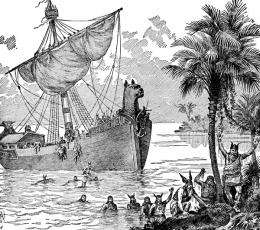
An illustration of Vikings on a boat. (Image via Wikipedia)

(PhysOrg.com) -- In what is believed to be a gravesite filled with thousand year old Viking bodies along with separated heads, in southern Britain, a new artifact has been discovered; one of the slain Vikings had his two front teeth filed horizontally. Though it’s not known exactly why, whether to instill fear in victims, to impress comrades or even to show rank, the filing of the teeth, likely a painful process, is a unique find, in that it is something that is rarely seen in early European history.

The gravesite, or burial pit, found in Weymouth, Dorset, on the southern coast of England two years ago, was filled with the bodies of 54 headless skeletons along with 51 skulls, all of whom are believed to be the remains of marauding from northern Europe during the time period 970 to 1025, which would make it just before the infamous Norman conquest of 1066 that transformed England from a mostly Anglo-Saxon civilization to one dominated by the French Normans.

The bodies in the pit all show evidence of a mass execution, in that most had multiple cut wounds, and of course, the fact that their heads were cut off. Radio carbon dating was used to determine how long the bodies have been there and isotope analysis of showed that the bodies were all men from the north of Europe, one even from above the Arctic Circle. The late 900s would place the time of death in the same time frame as Viking raids on the Anglo-Saxons that lived there at the time. Also, the fact that Weymouth is a port city on the English Channel would have made it a prime target for such raids.

The teeth filings appeared to be the work of a skilled craftsman, according to Oxford Archaeology project manager David Score, who spoke with the BBC about the find. He suggested the filings were likely made to frighten opponents, though in this case, it appears the ploy failed, as he and his party wound up in the pit with their heads sliced off.
The pit was discovered in 2009 by a road crew, and a team of archeologists has been studying the remains since that time. The scientists are quick to point out that research is still ongoing, and while the evidence is strong that the remains are those of early Vikings, it still hasn’t been proven definitively, thus far. Complicating the case is the fact that no clothing, buttons or any other artifacts were found in the pit, which means the victims were stripped naked before their execution.

© 2010 PhysOrg.com

Filter


Move the slider to adjust rank threshold, so that you can hide some of the comments.


Display comments: newest first

antonima
Jul 08, 2011

Rank: not rated yet
Clearly, the guy was evading the NRA and didn't want them to get his dental-work identified
Rank 5 /5 (3 votes)
Relevant PhysicsForums posts

More news stories

Change in developmental timing was crucial in the evolutionary shift from dinosaurs to birds: study

At first glance, it's hard to see how a common house sparrow and a Tyrannosaurus Rex might have anything in common. After all, one is a bird that weighs less than an ounce, and the other is a dinosaur that ...

Other Sciences / Archaeology & Fossils

created 35 minutes ago | popularity 5 / 5 (1) | comments 0 | with audio podcast

Social welfare cuts ultimately come with heavy price, researchers say

(Phys.org) -- Slashing government funding for Medicaid, food stamps and other programs that serve the poor – while politically popular with some lawmakers and many conservatives – may do more harm ...

Other Sciences / Social Sciences

created May 24, 2012 | popularity 4.3 / 5 (16) | comments 149

Ancient Bethlehem seal unearthed in Jerusalem

Israeli archaeologists have discovered a 2,700-year-old seal that bears the inscription "Bethlehem," the Israel Antiquities Authority announced Wednesday, in what experts believe to be the oldest artifact ...

Other Sciences / Archaeology & Fossils

created May 23, 2012 | popularity 3.5 / 5 (14) | comments 23

Oldest Jewish archaeological evidence on the Iberian Peninsula

German archaeologists of the Friedrich Schiller University Jena found one of the oldest archaeological evidence so far of Jewish Culture on the Iberian Peninsula at an excavation site in the south of Portugal, ...

Other Sciences / Archaeology & Fossils

created May 25, 2012 | popularity 4.3 / 5 (4) | comments 12

Dollars and sense: Why are some people morally against tax?

As the U.S. presidential election campaigns heat up, the economic debate is dominated by bailouts, austerity and, inevitably, taxation. Now a new study published in Symbolic Interaction asks why tax is such an important issue ...

Other Sciences / Social Sciences

created May 23, 2012 | popularity 3 / 5 (2) | comments 12


Computer model used to pinpoint prime materials for efficient carbon capture

When power plants begin capturing their carbon emissions to reduce greenhouse gases – and to most in the electric power industry, it's a question of when, not if – it will be an expensive undertaking.

'Unzipped' carbon nanotubes could help energize fuel cells, batteries

Multi-walled carbon nanotubes riddled with defects and impurities on the outside could replace some of the expensive platinum catalysts used in fuel cells and metal-air batteries, according to scientists at ...

T cells 'hunt' parasites like animal predators seek prey, study shows

By pairing an intimate knowledge of immune-system function with a deep understanding of statistical physics, a cross-disciplinary team at the University of Pennsylvania has arrived at a surprising finding: T cells use a movement ...

Manufacturing genes to attack flu virus

An international research team has manufactured a new protein that can combat deadly flu epidemics.

Yale study concludes public apathy over climate change unrelated to science literacy

Are members of the public divided about climate change because they don't understand the science behind it? If Americans knew more basic science and were more proficient in technical reasoning, would public consensus match ...

Same gene that stunts infants' growth also makes them grow too big: research

UCLA geneticists have identified the mutation responsible for IMAGe* syndrome, a rare disorder that stunts infants' growth. The twist? The mutation occurs on the same gene that causes Beckwith-Wiedemann syndrome, which makes ...