Tropical Storm Don analyzed in 3 NASA satellite images
July 30, 2011

Tropical Storm Don analyzed in 3 NASA satellite images

Enlarge

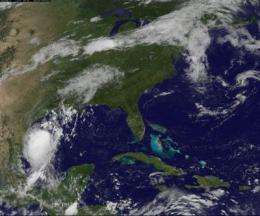
This visible image from the GOES-13 satellite, captured at 1402 UTC (10:02 a.m. EDT) shows the fringes of Tropical Storm Don's western edge just brushing coastal Texas. Credit: Credit: NASA/NOAA GOES Project

NASA is analyzing Tropical Storm Don from all angles, inside and out, using three different satellites. Don is expected to make landfall in southeastern Texas tonight or early Saturday.

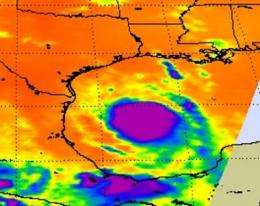
NASA's Aqua satellite passed over Tropical Storm Don at 8:17 UTC (4:17 a.m. EDT) on July 29. The instrument called the Atmospheric Infrared Sounder (AIRS) took the temperature of Don's clouds in an . AIRS data revealed a large area of powerful, high thunderstorms with cold cloud tops surrounding Don's center where cloud temperatures were colder than -63 Fahrenheit (-52 Celsius). The higher the thunderstorm cloud-top, the colder it is, and the more powerful they are.
Tropical Storm Don analyzed in 3 NASA satellite images
Enlarge

NASA's Aqua satellite passed over Tropical Storm Don at 8:17 UTC (4:17 a.m. EDT) on July 29. The infrared image revealed a large area of powerful, high thunderstorms with cold cloud tops (purple) surrounding the center where cloud temperatures were colder than -63 Fahrenheit (-52 Celsius). Credit: Credit: NASA JPL, Ed Olsen

When the GOES-13 satellite passed over Don at 1402 UTC (10:02 a.m. EDT) this morning, July 29, it captured a picture that showed the fringe of the tropical storm's western edge was just brushing coastal Texas on its approach to landfall. The GOES-13 satellite is managed by NOAA and keeps an eye on all weather in the eastern half of the U.S. The NASA/NOAA GOES Project at NASA's Goddard Space Flight Center in Greenbelt, Md. created the image that showed the strongest thunderstorms around the center of circulation. In the image, the highest thunderstorms around the storm's center cast small shadows on the lower clouds.

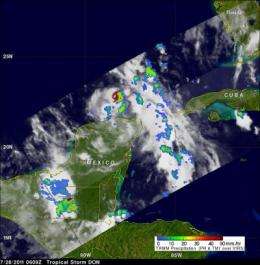
Those high thunderstorms around the center have been dropping heavy rainfall since July 28, when the Measuring Mission satellite (TRMM) passed overhead. TRMM can measure rainfall from its orbit in space and passed over Don at 0609 UTC (1:09 a.m. CDT). At that time, Don's center was north of Mexico's Yucatan peninsula, where Don was located at that time. A TRMM showed Don was dropping moderate to heavy rainfall of up to 2 inches/50 mm per hour in the eastern side of the small storm. Most of the other rainfall was moderate, falling between .78 to 1.57 inches (20 to 40 mm) per hour.
Tropical Storm Don analyzed in 3 NASA satellite images
Enlarge

The TRMM satellite had a fairly good view of tropical Storm Don when it passed over on July 28, 2011 at 0609 UTC (1:09 a.m. CDT). A red tropical storm symbol shows the position, north of Mexico's Yucatan peninsula, where Don was located at that time. A TRMM rainfall analysis showed Don was dropping moderate to heavy rainfall (red) of up to 2 inches/50 mm per hour in the eastern side of the small storm. The yellow and green areas indicate moderate rainfall between .78 to 1.57 inches (20 to 40 mm) per hour. Credit: NASA/SSAI, Hal Pierce

With NASA and NOAA satellites confirming that Don is bringing heavy rainfall and gusty winds, a tropical storm warning is in effect for the Texas coast from the mouth of the Rio Grande to Matagorda as tropical storm-force conditions are expected within the warning area by late today.

According to NOAA's National Hurricane Center, at 11 a.m. EDT (1500 UTC) on July 29, 2011, Tropical Storm Don's maximum sustained winds were near 50 mph (85 km/h) with higher gusts. Tropical storm force winds extend outward up to 105 miles (165 km) from the center, so Don has expanded to 210 miles, since yesterday when the storm was 180 miles in diameter.

The center of Don was located near latitude 26.2 North and longitude 94.9 West. Don is moving toward the west-northwest near 14 mph (22 km/h) and is expected to continue moving on that track for the next day or two. The estimated minimum central pressure is 1002 millibars.

So what can residents of southern Texas and northern Mexico expect from Don? According to the National Hurricane Center (NHC), storm surge will make water levels rise as much as 2 feet above ground level, mostly along the immediate coast and to the northeast of where Don's center makes landfall. Regardless, all residents in the warning area can expect rough surf and damaging waves.

The that NASA's TRMM satellite saw on July 28 within Don will bring 3 to 5 inches in south Texas and extreme northeastern Mexico. The NHC noted that isolated totals to 7 inches are even possible. Residents should also be prepared for the tropical storm-force winds and the possibility of isolated tornadoes over south Texas today and tonight as Don begins making landfall.

Provided by NASA's Goddard Space Flight Center search and more info website


Rank not rated yet
Relevant PhysicsForums posts

More news stories

Yale study concludes public apathy over climate change unrelated to science literacy

Are members of the public divided about climate change because they don't understand the science behind it? If Americans knew more basic science and were more proficient in technical reasoning, would public consensus match ...

Space & Earth / Environment

created 32 minutes ago | popularity not rated yet | comments 2 | with audio podcast

10 million years needed to recover from mass extinction

It took some 10 million years for Earth to recover from the greatest mass extinction of all time, latest research has revealed.

Space & Earth / Earth Sciences

created 33 minutes ago | popularity not rated yet | comments 0 | with audio podcast

Sophisticated simulations predict future warming

The chances of our planet being hit by a global warming of 3 degrees Celsius by 2050 is as likely as it being hit by an increase of 1.4 degrees, new research shows. Presented in the journal Nature Geoscience, the British study ...

Space & Earth / Earth Sciences

created May 22, 2012 | popularity 4.4 / 5 (9) | comments 51

Aliens don't want to eat us, says former SETI director

Alien life probably isn’t interested in having us for dinner, enslaving us or laying eggs in our bellies, according to a recent statement by former SETI director Jill Tarter.

Space & Earth / Space Exploration

created May 25, 2012 | popularity 4.4 / 5 (13) | comments 39

Kyoto Protocol architect 'frustrated' by climate dialogue

UN climate talks are going nowhere, as politicians dither or bicker while the pace of warming dangerously speeds up, one of the architects of the Kyoto Protocol told AFP.

Space & Earth / Environment

created May 23, 2012 | popularity 3.7 / 5 (7) | comments 39


Change in developmental timing was crucial in the evolutionary shift from dinosaurs to birds: study

At first glance, it's hard to see how a common house sparrow and a Tyrannosaurus Rex might have anything in common. After all, one is a bird that weighs less than an ounce, and the other is a dinosaur that ...

Computer model used to pinpoint prime materials for efficient carbon capture

When power plants begin capturing their carbon emissions to reduce greenhouse gases – and to most in the electric power industry, it's a question of when, not if – it will be an expensive undertaking.

'Unzipped' carbon nanotubes could help energize fuel cells, batteries

Multi-walled carbon nanotubes riddled with defects and impurities on the outside could replace some of the expensive platinum catalysts used in fuel cells and metal-air batteries, according to scientists at ...

T cells 'hunt' parasites like animal predators seek prey, study shows

By pairing an intimate knowledge of immune-system function with a deep understanding of statistical physics, a cross-disciplinary team at the University of Pennsylvania has arrived at a surprising finding: T cells use a movement ...

Manufacturing genes to attack flu virus

An international research team has manufactured a new protein that can combat deadly flu epidemics.

Same gene that stunts infants' growth also makes them grow too big: research

UCLA geneticists have identified the mutation responsible for IMAGe* syndrome, a rare disorder that stunts infants' growth. The twist? The mutation occurs on the same gene that causes Beckwith-Wiedemann syndrome, which makes ...