Last space shuttle aims for Thursday landing (Update)
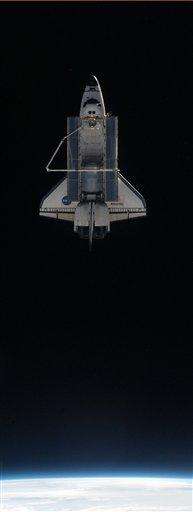
(AP) -- On the eve of NASA's historic, wheel-stopping end to the shuttle program, the four astronauts making the final journey and the flight controllers who will guide them home said Wednesday they're starting to feel a rush of emotions.
"You know what? I really do feel like it's coming near the end," said the commander of the homeward-bound space shuttle Atlantis, Christopher Ferguson.
"It's going to be tough," Ferguson said in a series of TV interviews 24 hours before Thursday's planned touchdown. "It's going to be an emotional moment for a lot of people who have dedicated their lives to the shuttle program for 30 years. But we're going to try to keep it upbeat. We're going to try to keep it light, and we're going to try to make it a celebration of the tremendous crowning achievements that have occurred over the last 30 years."
Flight director Tony Ceccacci, who will preside over Atlantis' return to Earth, refrained from publicly sharing his sentiments - until Wednesday.
"You guys must know that we do have a motto in the Mission Control Center that flight controllers don't cry," Ceccacci told reporters. "So we're going to make sure we keep that."
Among the space shuttle highlights noted Wednesday by the four-member crew as well as flight controllers: the 180 satellites deployed into orbit by the entire fleet and the construction of the International Space Station, a nearly 1 million-pound science outpost that took 12 1/2 years and 37 shuttle flights to build.
Atlantis departed the space station Tuesday, after restocking it with a year's worth of supplies.
The very last satellite to be released from a space shuttle popped out of a can Wednesday: a little 8-pound box covered with experimental solar cells.
As soon as the mini-satellite was on its way, astronaut Rex Walheim read a poem that he wrote to mark the occasion. It was the first of many tributes planned over the next few days; on Wednesday evening, the Empire State Building in New York was going to light up in red, white and blue in honor of the space shuttle program.
Walheim read: "One more satellite takes its place in the sky, / the last of many that the shuttle let fly. / Magellan, Galileo, Hubble and more / have sailed beyond her payload bay doors. / They've filled science books and still more to come. / The shuttle's legacy will live on when her flying is done."
Flight controllers applauded back in Houston.
On this last full day of this last mission, Ferguson told the controllers, "I'd love to have each and every one of you to stand up and take a bow, a round of applause. Then there would be no one to applaud and there would be nobody to watching the vehicle ... but believe me, our hearts go out to you."
Ferguson and his crew checked their critical flight systems for Thursday's planned 5:56 a.m. landing at Kennedy Space Center, not quite an hour before sunrise. Everything worked perfectly. To top it off, excellent weather was forecast to wind up the 135th flight of the space shuttle era.
Asked by a TV interviewer what he would tell all those watching Atlantis' return, Ferguson echoed what he told the lead team of flight controllers that signed off for the very last time Tuesday.
"Take a good look at it (Atlantis) and make a memory because you're never going to see anything like this again," he said. "It's been an incredible ride."
Space station astronaut Michael Fossum posted on Twitter a photo of the shuttle docked to the station 250 miles above the blue planet, which he snapped during last week's spacewalk. He noted in the tweet: "When will such beautiful ship dock again to ISS?"
NASA already is shifting gears.
It's working with private companies eager to take over cargo runs and astronaut flights to the space station. The first supply trip is expected to take place by the end of this year. Astronaut trips will take more time to put together, at least three to five years.
The long-term destination is true outer space: sending astronauts to an asteroid by 2025 and to Mars the following decade. That's the plan put forth by President Barack Obama. His predecessor wanted moon as the prize.
Throughout their 13-day mission and again Wednesday, the Atlantis astronauts stressed the need for a decades-long space exploration plan that does not change with each incoming president.
Ceccacci, whose Mission Control experience dates back to the first shuttle flight in 1981, said it's "tough" to think about all the experience that will be walking out the door following this mission. Thousands of layoffs are looming at the various NASA centers.
"We know there's going to be a rough spot for a while," he said. "But we hope that when we do get a good plan, a good direction, a good mission, that we can come back in here and do what we've been doing for the past 30 years for the shuttle and the years before that with Mercury, Gemini and Apollo."
Ceccacci plans to read a speech to his flight control team, once Atlantis and its crew are safely back on Earth, but there will be none of the flag-waving, cigar-smoking celebrations seen during the moon-landing days. Smoking is no longer permitted in the control center, he reminded journalists.
Rather, Ceccacci said he will gather flight controllers around to watch Ferguson, co-pilot Douglas Hurley, Rex Walheim and Sandra Magnus walk around the last shuttle one last time on the runway - so the controllers can "soak it in ... and congratulate each other on a job well done."
Atlantis is the last of the shuttles to be retired. It will remain at Kennedy Space Center, eventually going on public display at the visitors complex. Discovery is bound for the Smithsonian Institution in suburban Washington, and Endeavour for the California Science Center in Los Angeles.
More information: NASA: http://www.nasa.gov/shuttle
©2011 The Associated Press. All rights reserved. This material may not be published, broadcast, rewritten or redistributed.


