Rhesus monkeys have a form of self awareness not previously attributed to them
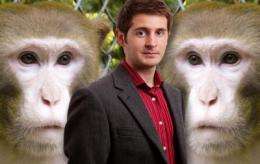
Cognitive psychologist Justin Couchman is seen here with Murph, one of the rhesus monkeys who helped Couchman demonstrate that his species does indeed possess a form of self awareness. Credit: University at Buffalo
In the first study of its kind in an animal species that has not passed a critical test of self-recognition, cognitive psychologist Justin J. Couchman of the University at Buffalo has demonstrated that rhesus monkeys have a sense of self-agency -- the ability to understand that they are the cause of certain actions -- and possess a form of self awareness previously not attributed to them.
The study, which will be published July 6 in Biology Letters, a journal of the Royal Society, may illuminate apparent self-awareness deficits in humans with autism, schizophrenia, Alzheimer's disease and developmental disabilities.
Rhesus monkeys are one of the best-known species of Old World monkeys, and have been used extensively in medical and biological research aimed at creating vaccines for rabies, smallpox and polio and drugs to manage HIV/AIDS; analyzing stem cells and sequencing the genome. Humans have sent them into space, cloned them and planted jellyfish genes in them.
Couchman, a PhD candidate at UB, is an instructor at UB and at the State University of New York College at Fredonia. He points out that previous research has shown that rhesus monkeys, like apes and dolphins, have metacognition, or the ability to monitor their own mental states. Nevertheless, the monkeys consistently fail the mirror self-recognition test, which assesses whether animals can recognize themselves in a mirror, and this is an important measure self-awareness.
"We know that in humans, the sense of self-agency is closely related to self-awareness," Couchman says, "and that it results from monitoring the relationship between pieces of intentional, sensorimotor and perceptual information.
"Based on previous findings in comparative metacognition research, we thought that even though they fail the mirror test, rhesus monkeys might have some other form of self-awareness. In this study we looked at whether the monkeys have a sense of self agency, that is, the understanding that some actions are the consequence of their own intentions."
For the study, Couchman trained 40 UB undergraduates and four male rhesus monkeys, housed in the Language Research Center of Georgia State University, to move a computer cursor with a joystick while a distractor cursor partially matched their movements. After moving the cursor, both humans and monkeys were asked to identify the computer cursor that they controlled -- the one that matched their movements and intentions. Both species were able to select the cursor they controlled from an array of choices, including the distractor cursor, at greater than chance levels.
"This suggests that the monkeys, like humans, have some understanding of self agency," says Couchman. "This awareness or implicit sense that it is 'me' who is presently executing a bodily movement or thinking thoughts is an important form of self-awareness."
Couchman says that because this is the first such demonstration of self-agency in a species that has not passed the mirror self-recognition test, the results may shed light on apparent self-awareness deficits in humans.
"Mirror self-recognition is developmentally delayed in autistic children and absent in many who are mentally retarded, have Alzheimer's disease or are schizophrenic. It is not clear why this deficit occurs, but like rhesus monkeys," he says, "these groups may simply have biases against mirrors.
"If, when studied, such individuals attempted to distinguish self-generated actions from partially altered actions in the paradigm reported in this study," Couchman say, "it might offer information as to whether the breakdown in their mirror self-recognition is due to a difficulty in processing certain kinds of perceptual or cognitive information."
Decades of psychological research has established that the concept of agency implies an active organism, one who desires, makes plans and carries out actions. The sense of agency and its scientific study is significant in the study of social cognition, moral reasoning and psychopathology because of its implications for intention, consciousness, responsibility, desire and development.
"Self agency also plays a pivotal role in cognitive development," Couchman says.
"It is linked to metacognition, the first stages of self-awareness and theory of mind (understanding the mental states of others). These abilities give humans the sense that they are entities separate from the external world, and allow them to interact with other agents and the environment in intelligent ways. If rhesus monkeys are able to recognize themselves as agents that cause certain actions," he says, "then they probably have a similar understanding that they are entities independent from the environment."
Provided by
University at Buffalo
-
From lemons to lemonade: Reaction uses carbon dioxide to make carbon-based semiconductor,
32 comments
-
Thioridazine kills cancer stem cells in human while avoiding toxic side-effects of conventional cancer treatments,
3 comments
-
SpaceX private rocket blasts off for space station (Update),
42 comments
-
Climate scientists say they have solved riddle of rising sea,
31 comments
-
SpaceX capsule has 'new car' smell, astronauts say (Update),
2 comments
-
What would stain as translucent on light-coloured fabric?
17 hours ago
-
How do I identify different bacteria on culture plates?
May 26, 2012
-
Why Do Dogs do Strange things...
May 25, 2012
-
What does exophillic and endophillic mean in terms of mosquito and their control?
May 24, 2012
-
Semen stains glows under black lights (uv light)?
May 23, 2012
-
Question on Human Chromosome 2
May 23, 2012
- More from Physics Forums - Biology
More news stories
Scientist: Evolution debate will soon be history
(AP) -- Richard Leakey predicts skepticism over evolution will soon be history. Not that the avowed atheist has any doubts himself.
16 hours ago |
3.3 / 5 (17) |
51
More plant species responding to global warming than previously thought
(Phys.org) -- Far more wild plant species may be responding to global warming than previous large-scale estimates have suggested.
May 22, 2012 |
4.6 / 5 (14) |
18
|
Thousands of shellfish found dead in Peru
Thousands of crustaceans were found dead off the coast of Lima following the mystery mass death of dolphins and pelicans, the Peruvian Navy said Friday.
May 26, 2012 |
4.8 / 5 (4) |
7
For monogamous sparrows, it doesn't pay to stray (but they do it anyway)
It's quite common for a female song sparrow to stray from her breeding partner and mate with the male next door, but a new study shows that sleeping around can be costly.
May 22, 2012 |
5 / 5 (2) |
7
|
Study uncovers secret to speedy burrowing by razor clams
(Phys.org) -- If you look at a razor burrowing clam sitting in a bucket, youd never guess that it could burrow itself down into the soil, much less do it with any speed. Razor clams look like fat straws, ...
Nvidia trumpets Tegra 3 phone design wins for 2012
(Phys.org) -- Nvidias competitive war paint has a name, Tegra 3. On the heels of Nvidia announcements about lowering costs of its Tegra 3 processors and Nvidia-enabled tablets running Android Ice Cream ...
Browser wars flare in mobile space
The browser wars are heating up again, but this time the fight is for dominance of the mobile Internet.
Dell tablet leak: 10.1-inch display, two-battery choice
(Phys.org) -- Headline after headline talks about vendors tablets in the wings as likely number-one contenders for the iPad. Such claims have justifiably been taken with a grain of salt, considering ...
Keep food safety in mind this memorial day weekend
(HealthDay) -- Picnics, parades and cookouts are as much a part of Memorial Day weekend as tributes to the United States' war veterans.
Social welfare cuts ultimately come with heavy price, researchers say
(Phys.org) -- Slashing government funding for Medicaid, food stamps and other programs that serve the poor while politically popular with some lawmakers and many conservatives may do more harm ...
Is a classical electrodynamics law incompatible with special relativity?
(Phys.org) -- The laws of classical electromagnetism that were developed in the 19th century are the same laws that scientists use today. They include Maxwell’s four equations along with the Lorentz la ...
Jul 05, 2011
Rank: 4.1 / 5 (7)
Jul 06, 2011
Rank: 3.3 / 5 (6)
Jul 06, 2011
Rank: 2.5 / 5 (4)
Jul 06, 2011
Rank: 2.3 / 5 (3)
While physics, medicine and especially mathematics can be proud of their state of the art, psycology is at the stone age. This is especially unfortunate now that society is becoming unlivable by the humans in it, as seen from the skyrocketing sales of antidepressants and other drugs of the mind -- and suicide and homicide rates.
Jul 06, 2011
Rank: 4.2 / 5 (5)
Animals like my two cats would fail the test, because they ignore the mirror image completely. And yet, their lack of interest shows clearly that they know that the mirror image is not some other cat.
They'll communicate with any cat except the one in the mirror. When they meet each other, they always greet each other, either by smelling each other or by lifting their tails in greeting. If I bring in an unknown cat from outside, they'll hiss and threaten aggressively. The cat in the mirror is the only exception.
What's more, the mirror test checks for far more than just self-awareness. It requires several steps of abstract reasoning to understand that a viewed image can represent oneself, that the spot on the forehead may be present not only on the image but also on oneself, that the spot represents a change from one's previous appearance, that removing the spot may be interesting or desirable, that removing the spot may be possible, and so on.
Jul 06, 2011
Rank: 2 / 5 (4)
Consider a different test. In front of a mirror you place an animal to be tested, then a wall, then a sibling, friend or doll with a spot on its forehead. The tested animal can see the sibling, friend or doll through the mirror, but not through the wall.
Suppose that when you've set this up, the tested animal reaches behind the wall to touch the spot on the companion's forehead.
Clearly this does not prove self-awareness, since the animal isn't turning its attention toward itself. It also doesn't prove awareness of otherness, i.e. awareness that companions are similar to self, since the companion can be a doll.
All it proves is awareness that a spot that is seen in a mirror may be reachable by touching a real spot, rather than its mirror image. That's certainly a very interesting observation, but it says practically nothing about self-awareness or awareness of otherness.
Jul 06, 2011
Rank: 2 / 5 (2)
Less than a tenth of the men paid any attention to the mirror or their reflection there.
Seems cognitive psychology scientists work in a place without public mirrors.
Jul 06, 2011
Rank: 5 / 5 (2)
Hmm, I wonder how the monkeys were asked that question?
Jul 06, 2011
Rank: 1 / 5 (1)
Jul 06, 2011
Rank: 2 / 5 (1)
Jul 06, 2011
Rank: 1 / 5 (1)
Jul 07, 2011
Rank: 2 / 5 (1)
Jul 09, 2011
Rank: not rated yet
"This is not meant as an insult, but I think psychology as a science knows even less than economics...Forest, ...trees." - gwrede
"While physics, medicine and especially mathematics can be proud of their state of the art, psycology is at the stone age." - gwrede
lol. True.
You try telling anyone you are as simply as we say you are.
And you will be accused of being stone aged.
No insult. We just can't convince anyone that nothing you do will surprise us. We will always offer you help (that never works.) That's called self employment. :)
Jul 11, 2011
Rank: not rated yet
Jul 11, 2011
Rank: not rated yet
-This story reminds of this very strange one:
http://www.dailym...era.html
-Those pics are eerie.
Jul 12, 2011
Rank: not rated yet
Nice find.
That could be developed into an interesting set of experiments, if it hasn't already been done.