NSF launches new cyberinfrastructure project to succeed TeraGrid
July 28, 2011

NSF launches new cyberinfrastructure project to succeed TeraGrid

Enlarge

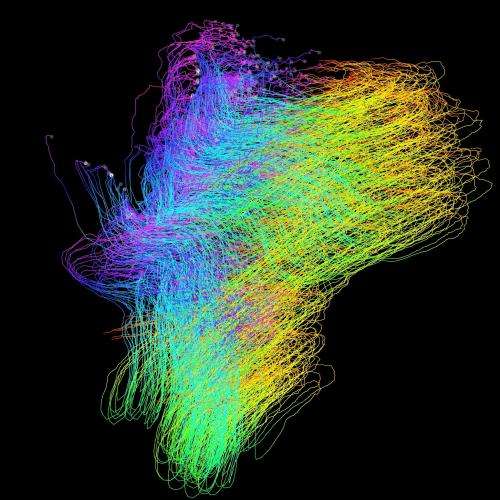
XSEDE resources will enhance advanced computational abilities to use track and mitigate the effects of a disaster. When the blowout of the British Petroleum (BP) Macondo well destroyed the Deepwater Horizon oil rig in the Gulf of Mexico on April 20, 2010, it touched off the largest environmental disaster in U.S. history, leading to a full-scale effort to stop the leak, assess the full scope of the damage, and take steps to minimize further harm. At universities across the nation, researchers used advanced cyberinfrastructure available through the Texas Advanced Computing Center (TACC) and Louisiana Optical Network Initiative (LONI), both TeraGrid resource providers, to help inform the response effort and forecast the oil spill's impact throughout the Gulf Coast region. This is an immersive (3-D made from 2-D) simulation of oil flow through water, based on computational fluid dynamics simulations. The "ribbons" show the particles; color and thickness indicate movement. XSEDE will enable greater discovery and learning to address future environmental challenges. Credit: Marcel Ritter, Jian Tao, Haihong Zhao, LSU Center for Computation and Technology

A partnership of 17 institutions last week announced a new project that allows researchers open access to the power of supercomputers, advanced computational tools and digital resources and services directly from their desktops.

Called Extreme Science and Engineering Discovery Environment (XSEDE), the project links computers, data and people from around the world to establish a single, virtual system that scientists can interactively use to conduct research.

Supported by the National Science Foundation (NSF), XSEDE will be the most advanced, powerful, and robust collection of integrated advanced digital resources and services in the world.  NSF will fund the project for five years at $121 million.

"Enabling scientific discovery though enhanced researcher productivity is our goal, and XSEDE's ultimate reason for being," explained Barry Schneider, a program director in NSF's Office of Cyberinfrastructure.

"For this sort of cyberscience to be truly effective and provide unique insights, it requires a cyberinfrastructure of local computing hardware at sites around the country, advanced supercomputers at larger centers, generally available software packages, and fast networks. Ideally, they should all work together so the researcher can move from local to national resources transparently and easily."

XSEDE, and the experts who lead the program, will make that ideal a reality as it replaces and expands the TeraGrid project that started more than a decade ago.

More than 10,000 scientists used the TeraGrid to complete thousands of research projects at no cost to the scientists.

XSEDE will enable that same kind of work--only providing more detail, generating more new knowledge and improving our world in an even broader range of fields.

"The TeraGrid really helped invent the concept of having digital resources like supercomputers, tools and expertise spread across the country and allowing researchers to easily use them," said John Towns of the University of Illinois's National Center for Supercomputing Applications. Towns, who had a variety of roles in the TeraGrid project, will lead the XSEDE project.

"This is much more than just the same old resources that TeraGrid offered," Towns said. "XSEDE will take the next step by lowering technological barriers to access and use. We are creating a distributed cyberinfrastructure in which researchers can establish private, secure environments that have all the resources, services, and collaboration support they need to be productive."

The XSEDE User Access Layer, for example, will provide a comprehensive view of the resources available--not just those at XSEDE partner sites, but any resources. It will integrate authentication and job monitoring, providing a comprehensive view and single contact point for all the cyberinfrastructure that researchers need to achieve their science and education goals.

XSEDE will provide an array of services to ensure that researchers can make the most of the supercomputers and tools. This will include outreach to new communities that have not traditionally used cyberinfrastructure and other digital services. It will also include advanced support for very large, complicated, or novel uses of XSEDE resources.

Initially, XSEDE will support 16 supercomputers across the country. It also will include other specialized digital resources and services to complement these computers. These resources will be expanded throughout the lifetime of the project.

Provided by University of California - Berkeley search and more info website


Rank 5 /5 (1 vote)
Relevant PhysicsForums posts
  • Ideas to mitigate risk of 911 calls being misdirected
    createdMay 24, 2012
  • Live scribe pen?
    createdMay 10, 2012
  • Shallow water flow simulation
    createdMay 07, 2012
  • Tablet for taking notes?
    createdMay 05, 2012
  • Best fit tablet for me?
    createdMay 05, 2012
  • Measure of Informaton
    createdMay 04, 2012
  • More from Physics Forums - Computing & Technology

More news stories

Browser wars flare in mobile space

The browser wars are heating up again, but this time the fight is for dominance of the mobile Internet.

Technology / Software

created 6 hours ago | popularity 5 / 5 (1) | comments 2

Probability of contamination from severe nuclear reactor accidents is higher than expected: study

Catastrophic nuclear accidents such as the core meltdowns in Chernobyl and Fukushima are more likely to happen than previously assumed. Based on the operating hours of all civil nuclear reactors and the number ...

Technology / Energy & Green Tech

created May 22, 2012 | popularity 3.6 / 5 (22) | comments 56 | with audio podcast

SpotterRF debuts Radar Backpack Kit (w/ Video)

(Phys.org) -- SpotterRF has announced a special radar backpack kit designed to enhance situational awareness for soldiers on the ground. The company says its special radar is designed for warfighters as part ...

Technology / Hi Tech & Innovation

created May 26, 2012 | popularity 5 / 5 (5) | comments 13 | with audio podcast report

HyperSolar shows dirty water no barrier to power world

(Phys.org) -- The Santa Barbara, California, company, HyperSolar, is set to transparently share the ups and downs of its research experiences toward the company’s ultimate vision, successfully producing ...

Technology / Energy & Green Tech

created May 24, 2012 | popularity 4.8 / 5 (16) | comments 17 | with audio podcast report

Tesla to launch electric sedan in US on June 22

Tesla Motors said Tuesday it would begin deliveries of "the world's first premium electric sedan" on June 22, slightly ahead of schedule.

Technology / Energy & Green Tech

created May 22, 2012 | popularity 4.5 / 5 (11) | comments 18


Nvidia trumpets Tegra 3 phone design wins for 2012

(Phys.org) -- Nvidia’s competitive war paint has a name, Tegra 3. On the heels of Nvidia announcements about lowering costs of its Tegra 3 processors and Nvidia-enabled tablets running Android Ice Cream ...

Scientist: Evolution debate will soon be history

(AP) -- Richard Leakey predicts skepticism over evolution will soon be history. Not that the avowed atheist has any doubts himself.

Dell tablet leak: 10.1-inch display, two-battery choice

(Phys.org) -- Headline after headline talks about vendors’ tablets in the wings as likely number-one contenders for the iPad. Such claims have justifiably been taken with a grain of salt, considering ...

Keep food safety in mind this memorial day weekend

(HealthDay) -- Picnics, parades and cookouts are as much a part of Memorial Day weekend as tributes to the United States' war veterans.

Social welfare cuts ultimately come with heavy price, researchers say

(Phys.org) -- Slashing government funding for Medicaid, food stamps and other programs that serve the poor – while politically popular with some lawmakers and many conservatives – may do more harm ...

Is a classical electrodynamics law incompatible with special relativity?

(Phys.org) -- The laws of classical electromagnetism that were developed in the 19th century are the same laws that scientists use today. They include Maxwell’s four equations along with the Lorentz la ...