Newly discovered molecule essential to resetting 'body clocks'
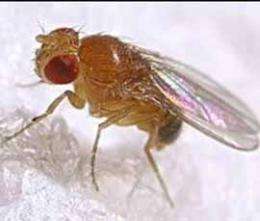
Scientists explored the impact of light on fruit flies (pictured)
(PhysOrg.com) -- Research has shown that light is the key to getting our 'body clocks' back in sync and now a new study exploring the resynchronisation mechanism in insects has discovered a molecule essential to the process.
Researchers from Queen Mary, University of London looked at the impact of light on the circadian clocks (commonly known as 'body clocks') of fruit flies. They identified a novel molecule, QUASIMODO (QSM), which was intrinsically involved in relaying light-information to the flies' inner clocks.
Ralf Stanewsky, Professor of Neurobiology at Queen Mary's School of Biological and Chemical Sciences who led the research, explained: "Circadian clocks regulate rhythmic biological processes in many organisms. A famous example is our sleep/wake cycle.
"It is regulated by our internal clock, which tells us when to go to bed and when to wake up. If you bring your clock out of sync with the external time, for example when you fly from London to New York, your internal clock still sends you to sleep according to London time.
"This shows that we indeed have a timer in us and that this timer needs to be reset like a normal wrist watch when you move to a different time zone or if you're a shift worker and need to adjust your sleep/wake cycles accordingly."
Professor Stanewsky had previously isolated a specialised circadian photoreceptor named CRYPTOCHROME (CRY) which is active directly within the clock neurones of flies' brains.
"Both insects and mammals use visual photoreceptors [i.e. those responsible for the ability to see] and specialised circadian photoreceptors, to synchronise the inner body clock," he said.
"In analysing the CRY receptor we realised there must be additional ways how light is transmitted to the circadian clock. When we investigated further we found that the novel molecule QSM is involved.
"We isolated the quasimodo gene in a genetic screen for novel timing genes, and found that the amount of QSM protein drastically increased in response to light. This results in a decrease of an important timing protein (named TIMELESS, or TIM) within the circadian clock and when QSM levels were decreased, the TIM protein was stabilised, even when the flies were continuously exposed to light."
The daily fluctuating levels of TIM protein are indicative of the 'time of day' and tell the fly when to be active or not. Since TIM levels are regulated by QSM, and QSM is regulated by light, this is an elegant and novel way to reset the clock according to the daily changes of light and darkness.
"QSM appears to be integral to the synchronisation of the circadian clock in flies and it will be interesting to see if a similar mechanism or molecule helps to synchronise our human circadian clock to light," Professor Stanewsky said.
The research was published in the journal Current Biology.
Provided by
Queen Mary, University of London
-
From lemons to lemonade: Reaction uses carbon dioxide to make carbon-based semiconductor,
32 comments
-
Thioridazine kills cancer stem cells in human while avoiding toxic side-effects of conventional cancer treatments,
3 comments
-
SpaceX private rocket blasts off for space station (Update),
42 comments
-
Climate scientists say they have solved riddle of rising sea,
31 comments
-
SpaceX capsule has 'new car' smell, astronauts say (Update),
2 comments
-
What would stain as translucent on light-coloured fabric?
18 hours ago
-
How do I identify different bacteria on culture plates?
May 26, 2012
-
Why Do Dogs do Strange things...
May 25, 2012
-
What does exophillic and endophillic mean in terms of mosquito and their control?
May 24, 2012
-
Semen stains glows under black lights (uv light)?
May 23, 2012
-
Question on Human Chromosome 2
May 23, 2012
- More from Physics Forums - Biology
More news stories
Scientist: Evolution debate will soon be history
(AP) -- Richard Leakey predicts skepticism over evolution will soon be history. Not that the avowed atheist has any doubts himself.
17 hours ago |
3.3 / 5 (17) |
54
More plant species responding to global warming than previously thought
(Phys.org) -- Far more wild plant species may be responding to global warming than previous large-scale estimates have suggested.
May 22, 2012 |
4.6 / 5 (14) |
18
|
Thousands of shellfish found dead in Peru
Thousands of crustaceans were found dead off the coast of Lima following the mystery mass death of dolphins and pelicans, the Peruvian Navy said Friday.
May 26, 2012 |
4.8 / 5 (4) |
7
For monogamous sparrows, it doesn't pay to stray (but they do it anyway)
It's quite common for a female song sparrow to stray from her breeding partner and mate with the male next door, but a new study shows that sleeping around can be costly.
May 22, 2012 |
5 / 5 (2) |
7
|
Study uncovers secret to speedy burrowing by razor clams
(Phys.org) -- If you look at a razor burrowing clam sitting in a bucket, youd never guess that it could burrow itself down into the soil, much less do it with any speed. Razor clams look like fat straws, ...
Browser wars flare in mobile space
The browser wars are heating up again, but this time the fight is for dominance of the mobile Internet.
Nvidia trumpets Tegra 3 phone design wins for 2012
(Phys.org) -- Nvidias competitive war paint has a name, Tegra 3. On the heels of Nvidia announcements about lowering costs of its Tegra 3 processors and Nvidia-enabled tablets running Android Ice Cream ...
Dell tablet leak: 10.1-inch display, two-battery choice
(Phys.org) -- Headline after headline talks about vendors tablets in the wings as likely number-one contenders for the iPad. Such claims have justifiably been taken with a grain of salt, considering ...
Keep food safety in mind this memorial day weekend
(HealthDay) -- Picnics, parades and cookouts are as much a part of Memorial Day weekend as tributes to the United States' war veterans.
Social welfare cuts ultimately come with heavy price, researchers say
(Phys.org) -- Slashing government funding for Medicaid, food stamps and other programs that serve the poor while politically popular with some lawmakers and many conservatives may do more harm ...
Is a classical electrodynamics law incompatible with special relativity?
(Phys.org) -- The laws of classical electromagnetism that were developed in the 19th century are the same laws that scientists use today. They include Maxwell’s four equations along with the Lorentz la ...