NASA's Juno to circle Jupiter for 'planetary recipe'
July 30, 2011 by Kerry Sheridan

The $1.1 billion unmanned orbiter is scheduled for launch on August 5

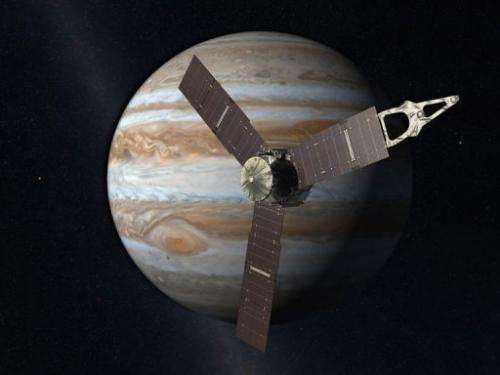
An artist's rendition released by NASA shows the Juno spacecraft orbiting Jupiter. The US space agency plans to launch next week a solar-powered spacecraft called Juno that will journey to the gassy planet of Jupiter in search of how the huge, stormy giant was formed.

The US space agency plans to launch next week a solar-powered spacecraft called Juno that will journey to the gassy planet of Jupiter in search of how the huge, stormy giant was formed.

The $1.1 billion unmanned orbiter is scheduled for launch on August 5 -- the start of a five-year odyssey toward the solar system's most massive planet in the hopes that it will be able to circle Jupiter for a period of a year.

With its fiery red eye and a mass greater than all planets in the combined, excluding the Sun, Jupiter is intriguing to astronomers because it is believed to be the first planet that took shape around the Sun.

"After the Sun formed, it got the majority of the leftovers," said Scott Bolton, principal investigator and scientist at the Southwest Research Institute in San Antonio, Texas.

"And that is why it is very interesting to us -- if we want to go back in time and understand where we came from and how the planets were made, Jupiter holds this secret," he said.

"So we want to know that ingredient list. What we are really after is discovering the recipe for making planets."

Juno aims to get closer to Jupiter than any other and will be the first to undertake a of the planet, said Bolton.

In 1989, NASA launched Galileo, an orbiter and probe that entered the planet's in 1995 and plunged into Jupiter in 2003, ending its life.

Other NASA spacecraft -- including Voyager 1 and 2, Ulysses and New Horizons -- have done flybys of the fifth planet from the Sun.

"We are getting closer to Jupiter than any other spacecraft has gone in orbiting Jupiter. We are only 5,000 kilometers (3,100 miles) above the cloud tops," Bolton told reporters this week.

"And we are actually dipping down beneath the radiation belts which is a very important thing for us because those radiation belts are the the most hazardous region in the solar system other than going right to the Sun itself."

Its trip to Jupiter, set to begin on August 5 when the launch window opens at 11:34 am (1534 GMT), will not be a direct shot, according to Jan Chodas, Juno project manager at NASA's Jet Propulsion Laboratory in Pasadena, California.

"We launch from Earth in August, we swing out past the orbit of Mars, we do a couple of deep space maneuvers to fire the engine," Chodas told reporters.

Juno then heads back toward Earth, "and we do a flyby of Earth of about 500 kilometers in October 2013, and then we slingshot ourselves out towards Jupiter arriving in July 2016," she said.

When it gets there Juno will make use of a series of instruments, some of which were provided by European space agency partners Italy, Belgium and France, to learn about the workings of the planet and what is inside.

Two key experiments are to gauge how much water is in Jupiter and whether the planet "has a core of heavy elements at the center, or whether it is just gas all the way down," said Bolton.

Scientists also hope to learn more about Jupiter's magnetic fields and its big red knot, a storm that has been raging for more than 300 years.

"One of the fundamental questions is how deep are the roots to that red spot? How does it maintain itself for so long?" Bolton wondered.

Back in 2003, when plans for Juno were being crafted, NASA briefly considered using some sort of nuclear fuel to power the spacecraft, but engineers decided it would be quicker and less risky to go with solar, he said.

Jim Green, director of the division at NASA headquarters in Washington, said Juno is part of a series of new planetary science missions, to be followed by Grail which is headed to the Moon in September and the Mars Science Laboratory set to take off in November.

"These missions are designed to tackle some of the toughest questions in planetary science, all about our origin and the evolution of the solar system," said Green.

(c) 2011 AFP

Filter


Move the slider to adjust rank threshold, so that you can hide some of the comments.


Display comments: newest first

MattShea
Jul 31, 2011

Rank: not rated yet
"With its fiery red eye and a mass greater than all planets in the solar system combined, excluding the Sun..."
The sun. You know, that big planet... lol
Rank 5 /5 (5 votes)
Relevant PhysicsForums posts
  • revamping general concept and cosmological principle
    createdMay 25, 2012
  • Transiting Exoplanet Light Curve
    createdMay 25, 2012
  • Math behind Theoretical Physics
    createdMay 24, 2012
  • Do we know whats at the center of galaxies yet?
    createdMay 23, 2012
  • Structure of the Milky Way?
    createdMay 20, 2012
  • What would it take to terraform Pluto and Charon?
    createdMay 19, 2012
  • More from Physics Forums - General Astronomy

More news stories

Sophisticated simulations predict future warming

The chances of our planet being hit by a global warming of 3 degrees Celsius by 2050 is as likely as it being hit by an increase of 1.4 degrees, new research shows. Presented in the journal Nature Geoscience, the British study ...

Space & Earth / Earth Sciences

created May 22, 2012 | popularity 4.4 / 5 (9) | comments 51

Kyoto Protocol architect 'frustrated' by climate dialogue

UN climate talks are going nowhere, as politicians dither or bicker while the pace of warming dangerously speeds up, one of the architects of the Kyoto Protocol told AFP.

Space & Earth / Environment

created May 23, 2012 | popularity 3.7 / 5 (7) | comments 39

Aliens don't want to eat us, says former SETI director

Alien life probably isn’t interested in having us for dinner, enslaving us or laying eggs in our bellies, according to a recent statement by former SETI director Jill Tarter.

Space & Earth / Space Exploration

created May 25, 2012 | popularity 4.4 / 5 (13) | comments 37

Dragon arrives at space station in historic 1st (Update 2)

The privately bankrolled Dragon capsule made a historic arrival at the International Space Station on Friday, triumphantly captured by astronauts wielding a giant robot arm.

Space & Earth / Space Exploration

created May 25, 2012 | popularity 5 / 5 (10) | comments 19

What's the big deal about private space launches?

(AP) -- The first private spaceship is headed to the International Space Station. Some questions and answers about the cargo mission by Space Exploration Technologies, known as SpaceX:

Space & Earth / Space Exploration

created May 22, 2012 | popularity 5 / 5 (6) | comments 35


Browser wars flare in mobile space

The browser wars are heating up again, but this time the fight is for dominance of the mobile Internet.

Nvidia trumpets Tegra 3 phone design wins for 2012

(Phys.org) -- Nvidia’s competitive war paint has a name, Tegra 3. On the heels of Nvidia announcements about lowering costs of its Tegra 3 processors and Nvidia-enabled tablets running Android Ice Cream ...

Scientist: Evolution debate will soon be history

(AP) -- Richard Leakey predicts skepticism over evolution will soon be history. Not that the avowed atheist has any doubts himself.

Dell tablet leak: 10.1-inch display, two-battery choice

(Phys.org) -- Headline after headline talks about vendors’ tablets in the wings as likely number-one contenders for the iPad. Such claims have justifiably been taken with a grain of salt, considering ...

Keep food safety in mind this memorial day weekend

(HealthDay) -- Picnics, parades and cookouts are as much a part of Memorial Day weekend as tributes to the United States' war veterans.

Social welfare cuts ultimately come with heavy price, researchers say

(Phys.org) -- Slashing government funding for Medicaid, food stamps and other programs that serve the poor – while politically popular with some lawmakers and many conservatives – may do more harm ...