Stopping malignancy in its tracks
July 1, 2011

Stopping malignancy in its tracks

Enlarge

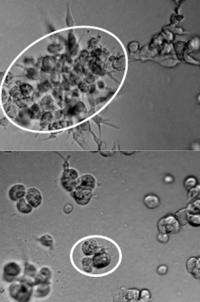
Figure 1: Cancer cells normally form colonies (top), but not when newly discovered natural product fusarisetin A is added to the culture (bottom). Credit: 2011 American Chemical Society

An unusual chemical compound isolated from a mud-dwelling fungus found in a soil sample collected in Daejeon, South Korea, could lead to a new family of antitumor drugs. Discovered by teams led by Jong Seog Ahn at the Korea Research Institute of Bioscience and Biotechnology (KRIBB), Ochang, and  Hiroyuki Osada at the RIKEN Advanced Science Institute, Wako, the compound prevents cancerous cells from forming mobile colonies—the point at which cancers become malignant and spread through the body. The teams began collaborating after Yukihiro Asami from RIKEN joined KRIBB.

The researchers spotted the compound while searching extracts of the fungus for candidate drug compounds using a recently developed screen called a 3D epithelial culture system. To date, this kind of biological assay has rarely been used to search for natural products with novel bioactivity, says Ahn. It was during the 3D screen, which they spiked with cancerous cells, that the researchers realized that a compound produced by the was inhibiting the cancer cells from clumping together to form colonies (Fig. 1). This type of screen is difficult using a conventional two-dimensional cell culture. 

The researchers isolated the bioactive compound and named it fusarisetin A. They then investigated its structure using an array of chemical characterization techniques, including nuclear magnetic resonance (NMR) and x-ray crystallography. They showed that fusarisetin A was a previously undescribed compound. Being able to grow crystals of the compound for x-ray studies was a breakthrough, says Osada. “It is very important for exact structural elucidation to get crystal analysis,” he says.

Having established that fusarisetin A is a new compound, the researchers probed its bioactivity in more detail. They showed that it simply blocks colony formation rather than killing cancer cells. They then compared the compound to others known to inhibit this process, and showed that it works differently to other compounds capable of blocking clumping. This suggests to the researchers that it could offer a new way to treat tumors.

The team is already working to discover how fusarisetin A inhibits the clumping of cancerous cells by looking for its molecular target. “We have already got candidate target proteins,” Osada adds.

Fusarisetin A itself is not bioactive enough to become a drug. However, it may be possible to fine-tune the structure to improve its activity, from which new drugs could be developed. “If we can get higher biological activity derivatives [of fusarisetin A], it may be possible,” says Ahn.

More information: Jang, J.-H., et al. Fusarisetin A, an acinar morphogenesis inhibitor from a soil fungus, Fusarium sp. FN080326. Journal of the American Chemical Society 133, 6865–6867 (2011).

Provided by RIKEN search and more info website


Rank 5 /5 (3 votes)
Relevant PhysicsForums posts
  • Gibbs Free Energy Change/Entropy
    created6 hours ago
  • What's the rule to covalent character
    created7 hours ago
  • Schwartz reagent-- NMR/MS/IR
    createdMay 26, 2012
  • High school chemistry EEI
    createdMay 25, 2012
  • oxidation of I- by KMnO4
    createdMay 25, 2012
  • Inversion temp
    createdMay 25, 2012
  • More from Physics Forums - Chemistry

More news stories

New CO2-removing catalyst can take the heat

(Phys.org) -- The current method of removing the greenhouse gas carbon dioxide (CO2) from the flues of coal-fired power plants uses so much energy that no one bothers to use it. So says Roger Aines, principal ...

Chemistry / Materials Science

created May 24, 2012 | popularity 5 / 5 (9) | comments 10 | with audio podcast

High-speed method to aid search for solar energy storage catalysts

Eons ago, nature solved the problem of converting solar energy to fuels by inventing the process of photosynthesis.

Chemistry / Materials Science

created May 25, 2012 | popularity 5 / 5 (3) | comments 4 | with audio podcast

Researchers demonstrate possible primitive mechanism of chemical info self-replication

(Phys.org) -- When scientists think about the replication of information in chemistry, they usually have in mind something akin to what happens in living organisms when DNA gets copied: a double-stranded molecule ...

Chemistry / Materials Science

created May 25, 2012 | popularity 5 / 5 (4) | comments 2 | with audio podcast

Building a better solar panel -- one molecule at a time

(Phys.org) -- One of the fundamental building blocks in modern chemistry, an organometallic chemical compound called ferrocene, has never been structurally defined - until now.

Chemistry / Materials Science

created May 25, 2012 | popularity 5 / 5 (3) | comments 0 | with audio podcast

Discarded data may hold the key to a sharper view of molecules

(Phys.org) -- There's nothing like a new pair of eyeglasses to bring fine details into sharp relief. For scientists who study the large molecules of life from proteins to DNA, the equivalent of new lenses have come in the ...

Chemistry / Biochemistry

created May 24, 2012 | popularity 4.7 / 5 (3) | comments 0 | with audio podcast


Nvidia trumpets Tegra 3 phone design wins for 2012

(Phys.org) -- Nvidia’s competitive war paint has a name, Tegra 3. On the heels of Nvidia announcements about lowering costs of its Tegra 3 processors and Nvidia-enabled tablets running Android Ice Cream ...

Browser wars flare in mobile space

The browser wars are heating up again, but this time the fight is for dominance of the mobile Internet.

Scientist: Evolution debate will soon be history

(AP) -- Richard Leakey predicts skepticism over evolution will soon be history. Not that the avowed atheist has any doubts himself.

Dell tablet leak: 10.1-inch display, two-battery choice

(Phys.org) -- Headline after headline talks about vendors’ tablets in the wings as likely number-one contenders for the iPad. Such claims have justifiably been taken with a grain of salt, considering ...

Keep food safety in mind this memorial day weekend

(HealthDay) -- Picnics, parades and cookouts are as much a part of Memorial Day weekend as tributes to the United States' war veterans.

Social welfare cuts ultimately come with heavy price, researchers say

(Phys.org) -- Slashing government funding for Medicaid, food stamps and other programs that serve the poor – while politically popular with some lawmakers and many conservatives – may do more harm ...