Hydrogen peroxide found in space
July 6, 2011

Hydrogen peroxide found in space

Enlarge

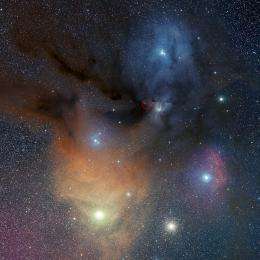
The colourful Rho Ophiuchi star formation region, about 400 light-years from Earth, contains very cold (around -250 degrees Celsius), dense clouds of cosmic gas and dust, in which new stars are being born. The clouds are mostly made of hydrogen, but contain traces of other chemicals, and are prime targets for astronomers hunting for molecules in space. Astronomers using the APEX telescope to observe this region discovered hydrogen peroxide molecules in interstellar space for the first time, in the area marked with the red circle. This is also a rich region for amateur observations. Rho Ophiuchi itself is the bright star near the top of the image. The bright yellowish star in the bottom left is Antares, one of the brightest stars in the sky. Below and to Antares’ right is the globular cluster Messier 4. This image of the region was obtained from the Paranal Observatory by observing with a 10-cm Takahashi FSQ106Ed f/3.6 telescope and a SBIG STL CCD camera, using a NJP160 mount. Images were collected through three different filters (B, V and R) and then stitched together. It was originally created as part of ESO’s Gigagalaxy Zoom project. Credit: ESO/S. Guisard

(PhysOrg.com) -- Molecules of hydrogen peroxide have been found for the first time in interstellar space. The discovery gives clues about the chemical link between two molecules critical for life: water and oxygen. On Earth, hydrogen peroxide plays a key role in the chemistry of water and ozone in our planet’s atmosphere, and is familiar for its use as a disinfectant or to bleach hair blonde. Now it has been detected in space by astronomers using the ESO-operated APEX telescope in Chile.

An international team of astronomers made the discovery with the Atacama Pathfinder Experiment telescope (APEX), situated on the 5000-metre-high Chajnantor plateau in the Chilean Andes. They observed a region in our galaxy close to the star Rho Ophiuchi, about 400 light-years away. The region contains very cold (around -250 degrees Celsius), dense clouds of cosmic gas and dust, in which new stars are being born. The clouds are mostly made of hydrogen, but contain traces of other chemicals, and are prime targets for astronomers hunting for molecules in space. Telescopes such as APEX, which make observations of light at millimetre- and submillimetre-wavelengths, are ideal for detecting the signals from these molecules.

Now, the team has found the characteristic signature of light emitted by , coming from part of the Rho Ophiuchi clouds.

“We were really excited to discover the signatures of hydrogen peroxide with APEX. We knew from laboratory experiments which wavelengths to look for, but the amount of hydrogen peroxide in the cloud is just one molecule for every ten billion hydrogen molecules, so the detection required very careful observations,” says Per Bergman, astronomer at Onsala Space Observatory in Sweden. Bergman is lead author of the study, which is published in the journal Astronomy & Astrophysics.

Hydrogen peroxide (H2O2) is a key molecule for both astronomers and chemists. Its formation is closely linked to two other familiar molecules, and water, which are critical for life. Because much of the water on our planet is thought to have originally formed in space, scientists are keen to understand how it is created.

Hydrogen peroxide is thought to form in space on the surfaces of cosmic dust grains — very fine particles similar to sand and soot — when hydrogen (H) is added to oxygen molecules (O2). A further reaction of the hydrogen peroxide with more hydrogen is one way to produce water (H2O). This new detection of hydrogen peroxide will therefore help astronomers better understand the formation of water in the Universe.

“We don’t understand yet how some of the most important molecules here on Earth are made in . But our discovery of hydrogen peroxide with APEX seems to be showing us that cosmic dust is the missing ingredient in the process,” says Bérengère Parise, head of the Emmy Noether research group on star formation and astrochemistry at the Max-Planck Institute for Radio Astronomy in Germany, and a co-author of the paper.

To work out just how the origins of these important are intertwined will need more observations of Rho Ophiuchi and other star-forming clouds with future telescopes such as the Atacama Large Millimeter/submillimeter Array (ALMA) — and help from chemists in laboratories on .

This research is published in the journal Astronomy & Astrophysics.

More information: http://www.aanda.o … 61/201117170

Provided by ESO search and more info website

Filter


Move the slider to adjust rank threshold, so that you can hide some of the comments.


Display comments: newest first

omatumr
Jul 06, 2011

Rank: 2 / 5 (4)
The occurrence of strong oxidizers and/or reducers in space is not surprising.

However, the occurrence of these in material that has throughly mixed to form the solids of meteorites or planets would be surprising.

With kind regards,
Oliver K. Manuel
Former NASA Principal
Investigator for Apollo
Shootist
Jul 06, 2011

Rank: 4.5 / 5 (4)

However, the occurrence of these in material that has throughly mixed to form the solids of meteorites or planets would be surprising.


Wouldn't Brownian (random) Motion be sufficient, unto itself, to ensure mixing over billions of years? Not to mention, gravity, light pressure and electromagnetic effects?

Temple
Jul 06, 2011

Rank: 4.5 / 5 (2)
Wouldn't Brownian (random) Motion be sufficient, unto itself, to ensure mixing over billions of years? Not to mention, gravity, light pressure and electromagnetic effects?


Brownian motion describes the motions of particles suspended in a fluid. I'm not aware of any results which have found a similar analog with vacuum fluctuations or what have you.

Though, I agree that the ridiculously complex system of light pressure, stellar winds, coronal ejections, stellar layer shedding, novae, gravity, etc would do a pretty good job of mixing differently sized, shaped, massed, etc particles over many billions of years.
omatumr
Jul 06, 2011

Rank: 1.3 / 5 (6)
Wouldn't Brownian (random) Motion be sufficient, unto itself, to ensure mixing over billions of years? Not to mention, gravity, light pressure and electromagnetic effects?


We all once thought that elements and isotopes would be throughly mixed in fresh supernova debris.

But they weren't in the supernova debris that formed the solar system.

Many chemical and isotopic gradients in the parent star are still preserved that way today.

With kind regards,
Oliver K. Manuel

Shootist
Jul 06, 2011

Rank: 5 / 5 (1)
I though Brownian Motion also described random motion of gas molecules, in a gas, no matter how tenuous.

Doctor Manuel

I do not follow you. I would think it obvious that our Solar System formed from the debris of not only Super Novas, but Wolf-Rayet stars, the planetary nebulae of Red Giants, and Super Giants like Eta Carina.

I cannot imagine the material in the Solar System came from one source. What leads you to that conclusion?
LKD
Jul 12, 2011

Rank: not rated yet
I would assume that the point is how Kuiper, Outer and Inner planets are not at all alike, and even within each belt, the inconsistency of planetary makeup is quite varied.

I will be honest and was expecting a blonde joke in the comments..
Rank 5 /5 (3 votes)
Relevant PhysicsForums posts
  • revamping general concept and cosmological principle
    createdMay 25, 2012
  • Transiting Exoplanet Light Curve
    createdMay 25, 2012
  • Math behind Theoretical Physics
    createdMay 24, 2012
  • Do we know whats at the center of galaxies yet?
    createdMay 23, 2012
  • Structure of the Milky Way?
    createdMay 20, 2012
  • What would it take to terraform Pluto and Charon?
    createdMay 19, 2012
  • More from Physics Forums - General Astronomy

More news stories

SpaceX capsule has 'new car' smell, astronauts say (Update)

SpaceX's Dragon cargo vessel smells like a new car, said astronauts at the International Space Station after opening the hatches Saturday following the spacecraft's landmark mission to the orbiting lab.

Space & Earth / Space Exploration

created 23 hours ago | popularity 4.5 / 5 (21) | comments 2

Australia hails surprise super-telescope decision

Australia has hailed a surprise decision giving it a role in a radio telescope project aimed at revolutionising astronomy, vowing to draw on its decades of experience in space science.

Space & Earth / Astronomy

created 23 hours ago | popularity 5 / 5 (4) | comments 3

Astronomers seize last chance in lifetime for Venus Transit

Astronomers are gearing for one the rarest events in the Solar System: an alignment of Earth, Venus and the Sun that will not be seen for another 105 years.

Space & Earth / Astronomy

created 23 hours ago | popularity 5 / 5 (3) | comments 2

Astronauts enter world's 1st private supply ship

(AP) -- Space station astronauts floated into the Dragon on Saturday, a day after its heralded arrival as the world's first commercial supply ship.

Space & Earth / Space Exploration

created 23 hours ago | popularity 5 / 5 (6) | comments 0

Sophisticated simulations predict future warming

The chances of our planet being hit by a global warming of 3 degrees Celsius by 2050 is as likely as it being hit by an increase of 1.4 degrees, new research shows. Presented in the journal Nature Geoscience, the British study ...

Space & Earth / Earth Sciences

created May 22, 2012 | popularity 4.4 / 5 (9) | comments 51


Nvidia trumpets Tegra 3 phone design wins for 2012

(Phys.org) -- Nvidia’s competitive war paint has a name, Tegra 3. On the heels of Nvidia announcements about lowering costs of its Tegra 3 processors and Nvidia-enabled tablets running Android Ice Cream ...

Browser wars flare in mobile space

The browser wars are heating up again, but this time the fight is for dominance of the mobile Internet.

Scientist: Evolution debate will soon be history

(AP) -- Richard Leakey predicts skepticism over evolution will soon be history. Not that the avowed atheist has any doubts himself.

Dell tablet leak: 10.1-inch display, two-battery choice

(Phys.org) -- Headline after headline talks about vendors’ tablets in the wings as likely number-one contenders for the iPad. Such claims have justifiably been taken with a grain of salt, considering ...

SpotterRF debuts Radar Backpack Kit (w/ Video)

(Phys.org) -- SpotterRF has announced a special radar backpack kit designed to enhance situational awareness for soldiers on the ground. The company says its special radar is designed for warfighters as part ...

Thousands of shellfish found dead in Peru

Thousands of crustaceans were found dead off the coast of Lima following the mystery mass death of dolphins and pelicans, the Peruvian Navy said Friday.