Hot springs microbe yields record-breaking, heat-tolerant enzyme
Bioprospectors from the University of California, Berkeley, and the University of Maryland School of Medicine have found a microbe in a Nevada hot spring that happily eats plant material – cellulose – at temperatures near the boiling point of water.
In fact, the microbe's cellulose-digesting enzyme, called a cellulase, is most active at a record 109 degrees Celsius (228 degrees Fahrenheit), significantly above the 100 C (212 F) boiling point of water.
This so-called hyperthermophilic microbe, discovered in a 95 C (203 F) geothermal pool, is only the second member of the ancient group Archaea known to grow by digesting cellulose above 80 C. And the microbe's cellulase is the most heat tolerant enzyme found in any cellulose-digesting microbe, including bacteria.
"These are the most thermophilic Archaea discovered that will grow on cellulose and the most thermophilic cellulase in any organism," said coauthor Douglas S. Clark, UC Berkeley professor of chemical and biomolecular engineering. "We were surprised to find this bug in our first sample."
Clark and coworkers at UC Berkeley are teaming with colleagues, led by Frank T. Robb, at the University of Maryland (U-Md) School of Medicine in Baltimore, to analyze microbes scooped from hot springs and other extreme environments around the United States in search of new enzymes that can be used in extreme industrial processes, including the production of biofuels from hard-to-digest plant fiber. Their team is supported by a grant from the Energy Biosciences Institute (EBI), a public-private collaboration that includes UC Berkeley, in which bioscience and biological techniques are being applied to help solve the global energy challenge.
"Our hope is that this example and examples from other organisms found in extreme environments – such as high-temperature, highly alkaline or acidic, or high salt environments – can provide cellulases that will show improved function under conditions typically found in industrial applications, including the production of biofuels," Clark said.
Clark, Robb and their colleagues, including UC Berkeley professor Harvey W. Blanch and postdoctoral researcher Melinda E. Clark, and U-Md postdoctoral researcher Joel E. Graham, will publish their results Tuesday, July 5, in the online-only journal Nature Communications.
Many industrial processes employ natural enzymes, some of them isolated from organisms that live in extreme environments, such as hot springs. The enzyme used in the popular polymerase chain reaction to amplify DNA originally came from a thermophilic organism found in a geyser in Yellowstone National Park.
But many of these enzymes are not optimized for industrial processes, Clark said. For example, a fungal enzyme is currently used to break down tough plant cellulose into its constituent sugars so that the sugars can be fermented by yeast into alcohol. But the enzyme's preferred temperature is about 50 C (122 F), and it is not stable at the higher temperatures desirable to prevent other microbes from contaminating the reaction.
Hence the need to look in extreme environments for better enzymes, he said.
"This discovery is interesting because it helps define the range of natural conditions under which cellulolytic organisms exist and how prevalent these bugs are in the natural world," Clark said. "It indicates that there are a lot of potentially useful cellulases in places we haven't looked yet."
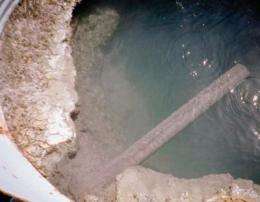
Robb and his colleagues collected sediment and water samples from the 95 C (203 F) Great Boiling Springs near the town of Gerlach in northern Nevada and grew microbes on pulverized Miscanthus gigas, a common biofuel feedstock, to isolate those that could grow with plant fiber as their only source of carbon.
After further growth on microcrystalline cellulose, the U-Md and UC Berkeley labs worked together to sequence the community of surviving microbes to obtain a metagenome, which indicated that three different species of Archaea were able to utilize cellulose as food. Using genetic techniques, they plucked out the specific genes involved in cellulose degradation, and linked the most active high-temperature cellulase, dubbed EBI-244, to the most abundant of the three Archaea.
Based on the structure of the enzyme, "this could represent a new type of cellulase or a very unusual member of a previously known family," Clark said.
The enzyme is so stable that it works in hot solutions approaching conditions that could be used to pretreat feedstocks like Miscanthus to break down the lignocelluloses and liberate cellulose. This suggests that cellulases may someday be used in the same reaction vessel in which feedstocks are pretreated.
The newly discovered hyperthermophilic cellulase may actually work at too high a temperature for some processes, Clark said. By collecting more hyperthermophilic cellulases, protein engineers may be able to create a version of the enzyme optimized to work at a lower temperature, but with the robust structural stability of the wild microbe.
"We might even find a cellulase that could be used as-is," he said, "but at least they will give us information to engineer new cellulases, and a better understanding of the diversity of nature."
Provided by University of California - Berkeley


