Evolved stars locked in fatalistic dance
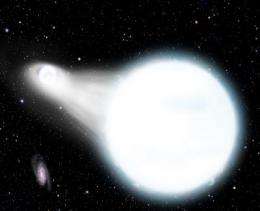
Two white dwarfs have been discovered on the brink of a merger. In just 900,000 years, material will start to stream from one star to the other (as shown in this artist's conception), beginning the process that may end with a spectacular supernova explosion. Watching these stars fall in will allow astronomers to test Einstein's theory of general relativity as well as the origin of a special class of supernovae. Credit: David A. Aguilar (CfA)
White dwarfs are the burned-out cores of stars like our Sun. Astronomers have discovered a pair of white dwarfs spiraling into one another at breakneck speeds. Today, these white dwarfs are so near they make a complete orbit in just 13 minutes, but they are gradually slipping closer together. About 900,000 years from now - a blink of an eye in astronomical time - they will merge and possibly explode as a supernova. By watching the stars converge, scientists will test both Einstein's theory of general relativity and the origin of some peculiar supernovae.
The two white dwarfs are circling at a bracing speed of 370 miles per second (600 km/s), or 180 times faster than the fastest jet on Earth.
"I nearly fell out of my chair at the telescope when I saw one star change its speed by a staggering 750 miles per second in just a few minutes," said Smithsonian astronomer Warren Brown, lead author of the paper reporting the find.
The brighter white dwarf contains about a quarter of the Sun's mass compacted into a Neptune-sized ball, while its companion has more than half the mass of the Sun and is Earth-sized. A penny made of this white dwarf's material would weigh about 1,000 pounds on Earth.
Their mutual gravitational pull is so strong that it deforms the lower-mass star by three percent. If the Earth bulged by the same amount, we would have tides 120 miles high.
The discovery team has been hunting for pairs of white dwarfs using the MMT telescope at the Whipple Observatory on Mt. Hopkins, Arizona. These star pairs are too close together to distinguish photographically. By looking at the spectra, however, Brown and his team were able to differentiate the two stars and measure their relative motions. These stars are also oriented such that they eclipse each other every 6 minutes.
"If there were aliens living on a planet around this star system, they would see one of their two suns disappear every 6 minutes - a fantastic light show." said Smithsonian astronomer and co-author Mukremin Kilic.
These eclipses provide a very accurate clock, which is extremely useful for measuring any changes in the system.
General relativity predicts that moving objects will create ripples in the fabric of space-time, called gravitational waves. These waves carry away energy, causing the stars to inch closer together and orbit each other faster and faster.
"Though we have not yet directly measured gravitational waves with modern instruments, we can test their existence by measuring the change in the separation of these two stars," said co-author J. J. Hermes, a graduate student at the University of Texas at Austin. "Because they don't seem to be exchanging mass, this system is an exceptionally clean laboratory to perform such a test."
The team expects to conduct this test in a few months, when the star pair emerges from behind the Sun as seen from Earth.
Some models predict merging white dwarf pairs such as these are the source of a rare class of unusually faint stellar explosions called underluminous supernovae.
"If these systems are responsible for underluminous supernovae, we will detect these binary white dwarf systems with the same frequency that we see the supernovae. Our survey isn't complete, but so far, the numbers agree," said Brown.
This work will provide an important observational test on theories of white dwarf mergers, which are thought to produce many kinds of supernovae, not just the underluminous type.
Provided by
Harvard-Smithsonian Center for Astrophysics
-
From lemons to lemonade: Reaction uses carbon dioxide to make carbon-based semiconductor,
32 comments
-
Thioridazine kills cancer stem cells in human while avoiding toxic side-effects of conventional cancer treatments,
3 comments
-
SpaceX private rocket blasts off for space station (Update),
42 comments
-
Climate scientists say they have solved riddle of rising sea,
31 comments
-
SpaceX capsule has 'new car' smell, astronauts say (Update),
2 comments
-
revamping general concept and cosmological principle
May 25, 2012
-
Transiting Exoplanet Light Curve
May 25, 2012
-
Math behind Theoretical Physics
May 24, 2012
-
Do we know whats at the center of galaxies yet?
May 23, 2012
-
Structure of the Milky Way?
May 20, 2012
-
What would it take to terraform Pluto and Charon?
May 19, 2012
- More from Physics Forums - General Astronomy
More news stories
Sophisticated simulations predict future warming
The chances of our planet being hit by a global warming of 3 degrees Celsius by 2050 is as likely as it being hit by an increase of 1.4 degrees, new research shows. Presented in the journal Nature Geoscience, the British study ...
Space & Earth / Earth Sciences
May 22, 2012 |
4.4 / 5 (9) |
51
Kyoto Protocol architect 'frustrated' by climate dialogue
UN climate talks are going nowhere, as politicians dither or bicker while the pace of warming dangerously speeds up, one of the architects of the Kyoto Protocol told AFP.
May 23, 2012 |
3.7 / 5 (7) |
39
Dragon arrives at space station in historic 1st (Update 2)
The privately bankrolled Dragon capsule made a historic arrival at the International Space Station on Friday, triumphantly captured by astronauts wielding a giant robot arm.
Space & Earth / Space Exploration
May 25, 2012 |
5 / 5 (10) |
19
Aliens don't want to eat us, says former SETI director
Alien life probably isnt interested in having us for dinner, enslaving us or laying eggs in our bellies, according to a recent statement by former SETI director Jill Tarter.
Space & Earth / Space Exploration
May 25, 2012 |
4.4 / 5 (13) |
37
What's the big deal about private space launches?
(AP) -- The first private spaceship is headed to the International Space Station. Some questions and answers about the cargo mission by Space Exploration Technologies, known as SpaceX:
Space & Earth / Space Exploration
May 22, 2012 |
5 / 5 (6) |
32
Nvidia trumpets Tegra 3 phone design wins for 2012
(Phys.org) -- Nvidias competitive war paint has a name, Tegra 3. On the heels of Nvidia announcements about lowering costs of its Tegra 3 processors and Nvidia-enabled tablets running Android Ice Cream ...
Browser wars flare in mobile space
The browser wars are heating up again, but this time the fight is for dominance of the mobile Internet.
Scientist: Evolution debate will soon be history
(AP) -- Richard Leakey predicts skepticism over evolution will soon be history. Not that the avowed atheist has any doubts himself.
Dell tablet leak: 10.1-inch display, two-battery choice
(Phys.org) -- Headline after headline talks about vendors tablets in the wings as likely number-one contenders for the iPad. Such claims have justifiably been taken with a grain of salt, considering ...
Keep food safety in mind this memorial day weekend
(HealthDay) -- Picnics, parades and cookouts are as much a part of Memorial Day weekend as tributes to the United States' war veterans.
Social welfare cuts ultimately come with heavy price, researchers say
(Phys.org) -- Slashing government funding for Medicaid, food stamps and other programs that serve the poor while politically popular with some lawmakers and many conservatives may do more harm ...
Jul 13, 2011
Rank: 4 / 5 (3)
Dictionary is your friend.
Jul 13, 2011
Rank: 5 / 5 (1)
Jul 13, 2011
Rank: 5 / 5 (1)
Jul 13, 2011
Rank: not rated yet
Jul 13, 2011
Rank: 5 / 5 (1)