3Q: The next Mars rover's destination
July 25, 2011 By Jennifer Chu

The next Mars rover's destination

Enlarge

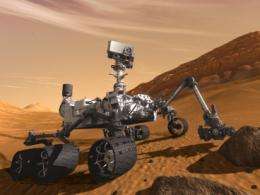
This artist concept features NASA's Mars Science Laboratory Curiosity rover, a mobile robot for investigating Mars' past or present ability to sustain microbial life. Curiosity is being tested in preparation for launch in the fall of 2011. Credit: NASA/JPL-Caltech

When the next-generation Mars rover, dubbed Curiosity, touches down on martian soil next summer, its cameras will likely capture a scene similar to what the first explorers of the Grand Canyon witnessed: towering layers of rock and sediment rising up from a dusty valley.

On Friday, officials announced that Curiosity will land in a region named Gale Crater, a large depression with a massive, finely stratified mountain at its center. For two years, the rover will explore and sample sediments from the crater's valleys and cliffs, seeking signs of habitability.

Maria Zuber, the Earle A. Griswold Professor of and and head of MIT's Department of Earth, Atmospheric and Planetary Sciences, says Gale Crater may reveal clues about Mars' past. She spoke with MIT News about a future in which humans might explore the .

Q. What makes Gale Crater an ideal landing site?

A. Gale is a large, ancient crater — about 154 kilometers [96 miles] in diameter — in the equatorial region of that formed somewhere in the range of 3.5 to 3.8 billion years ago. At the center of the crater is a five-kilometer-high [16,400-foot] mountain that contains hundreds of fine layers and grades in composition from the bottom up. Such a sequence of rocks, called a stratigraphic section, is a treasure trove of information for geologists. It preserves a temporal record, in which you're essentially looking back in time as you progress down the column.

Gale's mountain is the remnant of sediments that once filled the crater and were subsequently eroded. At the base of this mountain are clays, which form in water-rich conditions at elevated temperatures possibly associated with impact or hydrothermal conditions. The geologic context of the clay minerals will hopefully allow the origin to be distinguished. Further up the column the mineralogy transitions to reveal sulfate-rich rocks. The crystallization of sulfates also requires a substantial quantity of water, and some sulfates recognized on Mars require acidic conditions to form. This sequence implies a change in the aqueous chemistry of early Mars, conceivably indicating a significant change in environmental conditions.

The Curiosity rover will be able to ascend at least the lower layers of the central mountain, systematically studying the chemistry and geology and providing information that scientists will use to reconstruct just how the environment changed.

Q. What would this area have looked like during an age when there might have been water, and possibly life, on the planet?

A. Gale has had a complex history but it seems certain that water played a role in shaping the crater. There may have been a large amount of water on the floor, and water may have played a role in depositing the sediments that compose the central mountain. Several channels, likely carved by flowing water, cut the mountain, underscoring that water was present in multiple episodes of the crater's history.

Q. One of the goals of the Curiosity mission is to "prepare for human exploration." What does this mean, and how will the rover tackle this objective?

A. This mission will demonstrate the ability to deliver a large and heavy spacecraft to the surface of Mars. That's a step … that needs to be taken if you want to eventually send a human there: When humans go to Mars, the landed mass will be significant. The Curiosity lander is about as heavy as a small car and more than 300 kilograms heavier than the Mars exploration rovers; to deliver such a massive robotic explorer to the surface of Mars is real progress.

The precision landing system to set the rover on the martian surface, called "Sky Crane," is genuinely new, and increases the flexibility in selecting landing sites. When we used to evaluate landing sites on Mars, the engineers would always want to land at low elevation, with a lot of atmosphere above it — for parachuting in — and somewhere flat with no large rocks that would cause the rover to tip over or limit mobility. And the scientists would always want to go to the rocky, hazardous, mountainous places because those are the most interesting geologically. Because this landing system is so robust, can land in many places on Mars that would not have been possible in the past. The fact that a site may be rocky, or have a mountain or cliff nearby, need no longer necessarily be a showstopper.

This guided entry and the ability to do precision landing is extremely helpful for future human exploration, because humans will want to land in the best, safest place on Mars.


This story is republished courtesy of MIT News (http://web.mit.edu/newsoffice/), a popular site that covers news about MIT research, innovation and teaching.

Provided by Massachusetts Institute of Technology search and more info website

Filter


Move the slider to adjust rank threshold, so that you can hide some of the comments.


Display comments: newest first

fuviss_co_uk
Jul 25, 2011

Rank: not rated yet
Can this camera record movies ?
yyz
Jul 25, 2011

Rank: not rated yet
"Can this camera record movies ?"

According to the MSL website, Curiosity will indeed be able to acquire movies at the rate of ~10 fps at 720p quality(1280x720 pixels). Full science frames (1600x1200pixels) can be acquired at ~5 fps: http://msl-scicor...Mastcam/

So if if anything flitters by the cameras, these imagers should see it. ;)
gunslingor1
Jul 25, 2011

Rank: not rated yet
"What would this area have looked like during an age when there might have been water, and possibly life, on the planet?"
-ummmmmmmm, it would have had water and possibly signs of life? What kind of question is that. Like asking "what would this area have looked like if it had an amusement park".
xznofile
Jul 25, 2011

Rank: not rated yet
I don't get it, the central peak of an impact crater consists of the ejected material that fell straight back down after the impact. The deposition should be completely scrambled out of the original sequence. So why is it referred to as a "finely stratified mountain"?
nchazarra
Jul 25, 2011

Rank: not rated yet
I don't get it, the central peak of an impact crater consists of the ejected material that fell straight back down after the impact. The deposition should be completely scrambled out of the original sequence. So why is it referred to as a "finely stratified mountain"?


The point is that over the original central peak of the crater there is a stratified sequence of sediments that were placed there after the formation of the crater.
MPJ
Jul 26, 2011

Rank: 1 / 5 (1)
I really ask myself why they send a billion $ robot to a place which looks like a place we already know on Earth. Also the impact which created the crater most possibly wiped out all interesting stuff. Exploration is about finding new things. Lets hope theres something else which will be worth the $
Peteri
Jul 26, 2011

Rank: not rated yet
...the central peak of an impact crater consists of the ejected material that fell straight back down after the impact. The deposition should be completely scrambled out of the original sequence. So why is it referred to as a "finely stratified mountain"?


Both your statements are wrong.

The central peak is formed when the disrupted/molten material of the freshly excavated crater floor slumps back towards the centre of the crater. As the roughly symmetrical inflow of material meets at the centre it is forced upwards to form the central peak.

Lunar craters with a central peak (termed complex craters) are only found where the diameter of the crater is greater than 15km - this will differ for Mars due to crustal composition and the larger gravitational attraction of the planet.

I would assume that the stratifications referred to are the result of later sedimentation onto the central peak when the crater was flooded with water and these will also record the drop in water levels.
Rank 5 /5 (3 votes)
Relevant PhysicsForums posts
  • revamping general concept and cosmological principle
    createdMay 25, 2012
  • Transiting Exoplanet Light Curve
    createdMay 25, 2012
  • Math behind Theoretical Physics
    createdMay 24, 2012
  • Do we know whats at the center of galaxies yet?
    createdMay 23, 2012
  • Structure of the Milky Way?
    createdMay 20, 2012
  • What would it take to terraform Pluto and Charon?
    createdMay 19, 2012
  • More from Physics Forums - General Astronomy

More news stories

Sophisticated simulations predict future warming

The chances of our planet being hit by a global warming of 3 degrees Celsius by 2050 is as likely as it being hit by an increase of 1.4 degrees, new research shows. Presented in the journal Nature Geoscience, the British study ...

Space & Earth / Earth Sciences

created May 22, 2012 | popularity 4.4 / 5 (9) | comments 51

Dragon arrives at space station in historic 1st (Update 2)

The privately bankrolled Dragon capsule made a historic arrival at the International Space Station on Friday, triumphantly captured by astronauts wielding a giant robot arm.

Space & Earth / Space Exploration

created May 25, 2012 | popularity 5 / 5 (10) | comments 19

Kyoto Protocol architect 'frustrated' by climate dialogue

UN climate talks are going nowhere, as politicians dither or bicker while the pace of warming dangerously speeds up, one of the architects of the Kyoto Protocol told AFP.

Space & Earth / Environment

created May 23, 2012 | popularity 3.7 / 5 (7) | comments 39

Aliens don't want to eat us, says former SETI director

Alien life probably isn’t interested in having us for dinner, enslaving us or laying eggs in our bellies, according to a recent statement by former SETI director Jill Tarter.

Space & Earth / Space Exploration

created May 25, 2012 | popularity 4.4 / 5 (13) | comments 37

What's the big deal about private space launches?

(AP) -- The first private spaceship is headed to the International Space Station. Some questions and answers about the cargo mission by Space Exploration Technologies, known as SpaceX:

Space & Earth / Space Exploration

created May 22, 2012 | popularity 5 / 5 (6) | comments 32


Nvidia trumpets Tegra 3 phone design wins for 2012

(Phys.org) -- Nvidia’s competitive war paint has a name, Tegra 3. On the heels of Nvidia announcements about lowering costs of its Tegra 3 processors and Nvidia-enabled tablets running Android Ice Cream ...

Browser wars flare in mobile space

The browser wars are heating up again, but this time the fight is for dominance of the mobile Internet.

Scientist: Evolution debate will soon be history

(AP) -- Richard Leakey predicts skepticism over evolution will soon be history. Not that the avowed atheist has any doubts himself.

Dell tablet leak: 10.1-inch display, two-battery choice

(Phys.org) -- Headline after headline talks about vendors’ tablets in the wings as likely number-one contenders for the iPad. Such claims have justifiably been taken with a grain of salt, considering ...

Keep food safety in mind this memorial day weekend

(HealthDay) -- Picnics, parades and cookouts are as much a part of Memorial Day weekend as tributes to the United States' war veterans.

Family history of Alzheimer's affects functional connectivity

(HealthDay) -- Cognitively normal individuals with a family history of late-onset Alzheimer's disease (AD) may display lower resting state functional connectivity in the default mode network (DMN) of the brain, ...