BinCam: We've bin watching you!
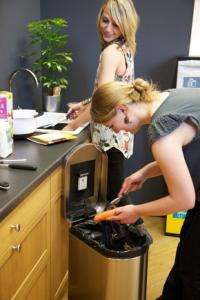
(PhysOrg.com) -- Computer scientists at Newcastle University have come up with a novel way of encouraging students to recycle – using a camera phone and Facebook.
Signing up five households to take part in the study, the aim is to monitor what they throw away and introduce an element of competition to try to improve recycling rates and minimise waste.
Placing a small sensor attached to a camera phone in a kitchen bin, “BinCam” takes a photograph every time the lid slams shut.
The image is then fed directly to the BinCam Facebook page where not only house members but also other BinCam users in the study can see what they’ve thrown away.
Graphs chart how well each household is doing in the recycling league and there’s the opportunity to leave comments or share recycling tips.
“There is a ‘naming and shaming’ element to the experiment although it’s fun rather than humiliating,” says Anja Thieme, who is leading the project together with fellow research students Jack Weeden and Julia Miebach, postgraduate students in human-computer interaction at Newcastle University.
“Normally when you throw something away and the lid goes down you forget about it – out of sight out of mind – and that’s the end of it. But the reality could not be further from the truth – waste has a massive environmental impact.
"By taking a photograph and uploading it to Facebook, the idea is that we create a platform for self-reflection - a permanent reminder. It’s a bit like having your conscience sat on your shoulder niggling away at you. And on top of that you know that other people are also judging you.”
Waste is one of the biggest problems facing the world today. In the UK alone, we throw away 5.3 million tons of food each year which could have been eaten and 4.9 million tons of packaging which could have been recycled.
And it is the 18-34 year olds that are the biggest culprits. Newcastle University’s Dr Rob Comber, a psychologist who has also worked on the project, explains: “Under the age of 18 we recycle because our parents do, but when we turn 18 we tend to move out and live by ourselves.
“When we do that we have to learn how to make decisions about issues such as sustainability on our own. We haven't got those people around us that usually guide us in making the right decisions.
"BinCam allows those individuals a way to monitor not only what they are doing but, using their social network, what others around them are doing too and to get feedback.
“This helps to raise awareness and ultimately change the behaviour of a group which might otherwise be unaware of the consequences of their actions."
Initial results from the project suggest it is working. Early images on Facebook show everything from beer cans to pizza boxes and large quantities of wasted food.
After just two weeks, however, the bin is being emptied fewer times due to less being thrown away and more being recycled.
“A few times we even saw people throwing something away and then going back into the bin to take it out again,” says Anja.
“During the focus groups, the students said they felt like the bin was watching them and that it definitely made them think twice about what they were throwing away.
“At the same time they felt motivated by the online league table to recycle more and improve their rating.”
The project is a collaboration between the School of Computing Science and Culture Lab at Newcastle University and the universities of Lincoln and Duisburg-Essen and the next step is to roll out BinCam to more student houses at the start of the new academic year in September.
The project is just one example of the research and initiatives underway at Newcastle University to tackle the great societal challenge of sustainability and as part of this, the University’s waste manager Daniel O’Connor is keen to introduce the scheme for staff.
"Students have busy lives and recycling competes with other demands. Anything that makes recycling easier is good - but when it is fun and innovative like BinCam it really encourages participation. The use of Facebook and the community peer pressure is fascinating and I am looking forward to introducing the application to other parts of the campus."
More information: More information about BinCam can be found on the website.
Provided by Newcastle University


