Roman ship carried live fish in tank

June 6, 2011 by Deborah Braconnier report

Roman ship carried live fish in tank
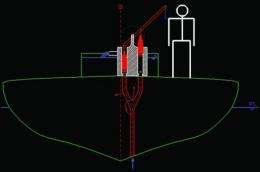
Enlarge

Image credit: S. Parizzi/[i]International Journal of Nautical Archaeology[/i]

(PhysOrg.com) -- A new report published in the International Journal of Nautical Archaeology shows that Roman fishing ships may have used a pumping system to supply oxygenated water to an onboard fish tank. Due to a lack of refrigeration, historians have long assumed that Roman ships caught fish and delivered it locally before the fish rotted, but this new discovery would have enabled them to keep the fish alive and transport them to buyers throughout the Mediterranean.

The wrecked fishing ship was discovered six miles from the coast of Grado, Italy and dates to second century AD. It was discovered in 1986 and brought up in pieces in 1999. It is currently located in the Museum of in Grado. The ship was 16.5 meters long and was carrying small containers filled with processed fish.

The find that has stumped until now was a lead pipe at the stern of the ship that went into a hole in the hull. The remaining piece of pipe is 1.3 meters long and between seven and 10 centimeters in diameter. They now believe the pipe was connected to a piston pump that was hand-operated. Archaeologists have seen such technology from the Romans but never on a ship. They have not, however, recovered a pump from the wreck.

It was originally believed that this pump could have been used to collect bilge water from the bottom of the ship or used to pump into the boat for cleaning or fighting fires. However, Carlo Beltrame, a marine archaeologist from Ca’ Foscari University, believes that chain pumps would have been used for the bilge water and that this ship was not large enough to need a system like that for cleaning or fires.

While they have not yet located a tank, they have calculated that the ship could have held one with about 4 cubic meters of water. The pump would have allowed it to pump and replace the water every 16 minutes, keeping it well oxygenated for fish transport.

This find would completely change what historians had believed to be true for the fishing market in Roman times. This opens up the possibility that they were transporting and marketing beyond their local market far earlier than previously thought.

More information: A Presumed Hydraulic Apparatus for the Transport of Live Fish, Found on the Roman Wreck at Grado, Italy, International Journal of Nautical Archaeology, DOI: 10.1111/j.1095-9270.2011.00317.x

Abstract
The Roman wreck found off Grado, not far from the city of Aquileia in the north Adriatic Sea, was recovered in 1999. The ship carried various kinds of amphoras with processed fish. A lead pipe, inserted in the hull near the keel, is curious evidence which the authors try to explain. The pipe could be connected to a piston-pump to suck water. A theoretical reconstruction demonstrates how this apparatus could work and that it could be used to feed a tank to allow trading in live fish over a long distance.

© 2010 PhysOrg.com

4.8 /5 (6 votes)  

Filter


Move the slider to adjust rank threshold, so that you can hide some of the comments.


Display comments: newest first

Beard
Jun 07, 2011

Rank: 5 / 5 (1)
The ancient Roman innovations and engineering feats are always impressive.

The Greeks and Romans could conceivably have experienced their own industrial revolutions if circumstances had been slightly different. The Greeks had working steam engines for example, but they considered them novelties and toys.
Doug_Huffman
Jun 07, 2011

Rank: 4 / 5 (1)
Not "circumstances" but their logic prevented significant technical advance.

See Randian Objectivist David Harriman's The Logical Leap (Penguin-NAL, 2010).

Not unlike what we are facing in post-modern magical thinking as the rational is abandoned.
Rank 4.8 /5 (6 votes)
Relevant PhysicsForums posts

More news stories

Social welfare cuts ultimately come with heavy price, researchers say

(Phys.org) -- Slashing government funding for Medicaid, food stamps and other programs that serve the poor – while politically popular with some lawmakers and many conservatives – may do more harm ...

Other Sciences / Social Sciences

created May 24, 2012 | popularity 4.3 / 5 (16) | comments 130

Ancient Bethlehem seal unearthed in Jerusalem

Israeli archaeologists have discovered a 2,700-year-old seal that bears the inscription "Bethlehem," the Israel Antiquities Authority announced Wednesday, in what experts believe to be the oldest artifact ...

Other Sciences / Archaeology & Fossils

created May 23, 2012 | popularity 3.5 / 5 (14) | comments 23

Oldest Jewish archaeological evidence on the Iberian Peninsula

German archaeologists of the Friedrich Schiller University Jena found one of the oldest archaeological evidence so far of Jewish Culture on the Iberian Peninsula at an excavation site in the south of Portugal, ...

Other Sciences / Archaeology & Fossils

created May 25, 2012 | popularity 4.3 / 5 (4) | comments 12

Dollars and sense: Why are some people morally against tax?

As the U.S. presidential election campaigns heat up, the economic debate is dominated by bailouts, austerity and, inevitably, taxation. Now a new study published in Symbolic Interaction asks why tax is such an important issue ...

Other Sciences / Social Sciences

created May 23, 2012 | popularity 3 / 5 (2) | comments 12

Oldest art even older

New dates from Geißenklösterle Cave in Southwest Germany document the early arrival of modern humans and early appearance of art and music.

Other Sciences / Archaeology & Fossils

created May 24, 2012 | popularity 4.3 / 5 (3) | comments 6


Nvidia trumpets Tegra 3 phone design wins for 2012

(Phys.org) -- Nvidia’s competitive war paint has a name, Tegra 3. On the heels of Nvidia announcements about lowering costs of its Tegra 3 processors and Nvidia-enabled tablets running Android Ice Cream ...

Browser wars flare in mobile space

The browser wars are heating up again, but this time the fight is for dominance of the mobile Internet.

Scientist: Evolution debate will soon be history

(AP) -- Richard Leakey predicts skepticism over evolution will soon be history. Not that the avowed atheist has any doubts himself.

Dell tablet leak: 10.1-inch display, two-battery choice

(Phys.org) -- Headline after headline talks about vendors’ tablets in the wings as likely number-one contenders for the iPad. Such claims have justifiably been taken with a grain of salt, considering ...

Keep food safety in mind this memorial day weekend

(HealthDay) -- Picnics, parades and cookouts are as much a part of Memorial Day weekend as tributes to the United States' war veterans.

Is a classical electrodynamics law incompatible with special relativity?

(Phys.org) -- The laws of classical electromagnetism that were developed in the 19th century are the same laws that scientists use today. They include Maxwell’s four equations along with the Lorentz la ...