'Quantum magic' without any 'spooky action at a distance'
June 24, 2011

'Quantum magic' without any 'spooky action at a distance'

Enlarge

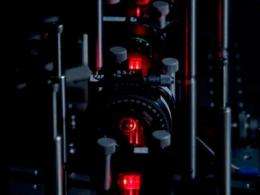
The central part of the optical setup used to demonstrate that even a system which does not allow entanglement exhibits features commonly attributed to this phenomenon. Credit: IQOQI; Jacqueline Godany 2011

The quantum mechanical entanglement is at the heart of the famous quantum teleportation experiment and was referred to by Albert Einstein as "spooky action at a distance". A team of researchers led by Anton Zeilinger at the University of Vienna and the Institute for Quantum Optics and Quantum Information of the Austrian Academy of Sciences used a system which does not allow for entanglement, and still found results which cannot be interpreted classically. Their findings were published in the latest issue of the renowned scientific journal Nature.

Asher Peres, a pioneer of quantum information theory once remarked jokingly in a letter to a colleague (Dagmar Bruß): Entanglement is a trick 'quantum magicians' use to produce phenomena that cannot be imitated by 'classical magicians'. When two particles are entangled, measurements performed on one of them immediately affect the other, no matter how far apart the particles are. What if, in an experiment, one considers a system that does not allow for entanglement? Will the quantum magicians still have an advantage over the classical magicians?

Quantum physics beyond magic

This is the question the team of quantum physicists led by Anton Zeilinger from the Faculty of Physics at the University of Vienna and from the IQOQI of the Austrian Academy of Sciences addressed in their experiment. The physicists used a "qutrit" – a quantum system consisting of a single photon that can assume three distinguishable states. "We were able to demonstrate experimentally that quantum mechanical measurements cannot be interpreted in a classical way even when no is involved," Radek Lapkiewicz explains. The findings relate to the theoretical predictions by John Stewart Bell, Simon B. Kochen, and Ernst Specker.

Quantum world versus everyday life

Quantum physics is in stark contrast with what we perceive and experience in our everyday lives and what we understand as "classical physics". Let us, for example, examine a globe: from a given point of view we can only see one respective hemisphere at any given time. When spinning the globe once around its axis we are able to construct a meaningful and "true" picture of our planet assuming that the shape of the continents stays the same, even when we cannot see them.

Therefore, by means of our experience and the assumptions made in classical physics, we can assign certain properties to a system without actually observing it. This is no longer the case if one pictures a "quantum globe". Contrary to a globe where –due to the assumptions of classical properties– the various pieces fit together as they do in a puzzle, the pictures of the quantum globe do not fit together. Yet the pattern is not random: it is possible to predict by how much the individual parts will differ from each other after an observation.

More information: Experimental non-classicality of an indivisible quantum system, Radek Lapkiewicz, Peizhe Li, Christoph Schaeff, Nathan K. Langford, Sven Ramelow, Marcin Wiesniak and Anton Zeilinger, Nature, June 23, 2011. DOI: 10.1038/nature10119

Provided by University of Vienna search and more info website

3.5 /5 (11 votes)  

Filter


Move the slider to adjust rank threshold, so that you can hide some of the comments.


Display comments: newest first

NotAsleep
Jun 24, 2011

Rank: 2.7 / 5 (6)
"When two particles are entangled, measurements performed on one of them immediately affect the other, no matter how far apart the particles are."

It's wording like this that drives people to believe quantum entanglement is more than it really is... measuring one will not change the other. It will merely add a piece of information to the other that was unmeasured previously
Tachyon8491
Jun 24, 2011

Rank: 4.3 / 5 (4)
This article is seriously incomplete - apart from no insightful information given about the apparatus involved, more seriously, no mention is made of factual symptoms observed in parameters revealed by experimental comparison of the two (classical and non-classical) systems. Paradoxically, I presume we can now refer to "non-entangled entanglement" - simply, and axiomatically accepting that there is nothing which is not mutually sensitive. Interestingly this is an age-old memetic truism already assumed by the "Twelve Nidhanas" - the Buddhistic metaphysical axiom of "interdependent origination." Sometimes science lags behind by a few millennia..
c0y0te
Jun 24, 2011

Rank: 5 / 5 (2)
@NotAsleep
I am not a physicist, but from what I read it is much more complex than that. Don't get me wrong, but do you think that you are the first one that has thought of a hidden "unmeasured" information?!? (check Bell's inequality theorem if you haven't already)
Although, I must say that I've always deeply felt that universe is totally deterministic, and as I have recently found out Gerard 't Hooft disputed the validity of Bell's theorem in such universe. So, if I understand it right, if there is a hidden variable then the universe must be superdeterministic.
NotAsleep
Jun 24, 2011

Rank: 3 / 5 (4)
It's possible that the future will change our understanding of time. I'm hopeful that someday we discover some force or particle that travels faster than the speed of light. If discovered, it might have the ability to transmit useful information to another object at speeds greater than "c". With our current view on time, this would mean we can see something happen before it happens.

I agree that our current understanding of time is flawed but only to the extent that we haven't found anything that can transmit information faster than "c". It's this discussion on what constitutes "information" that has popped up in three posts this week. Something doesn't exist until it exists (duh). Along those lines, something can't exist unless it can be measured. Therin lies the limitations of our current knowledge. Just because we don't have the ability to measure something doesn't mean it CAN'T be measured. My issue is that the article makes unusual statements without explaining them
NotAsleep
Jun 24, 2011

Rank: 1 / 5 (3)
They used the term "affect", which to a casual reader might imply that one particle has a physical interaction with the other across any distance. As we understand physics, this isn't how it works. Assigning a piece of information to something does affect it but it is not the incredible phenomenon that the article makes it out to be
stealthc
Jun 24, 2011

Rank: 4 / 5 (6)
Everything is already entangled, our observation of which is merely isolation of elements from the already entangled system. See instead of it happening out of the blue, when you isolate it local entanglement effects begin to take over the less-local entanglement effects (such as particle transmissions of various sorts). If it's in things predicted not to have them, then this is probably the 40,000th time I've mentioned my theory, maybe this time it won't be falling on a lot of deaf ears. Everything is already entangled, it's like the glue in the spider web that creates the mesh structure.
SteveL
Jun 24, 2011

Rank: 2.5 / 5 (2)
"I'm hopeful that someday we discover some force or particle that travels faster than the speed of light. If discovered, it might have the ability to transmit useful information to another object at speeds greater than "c". With our current view on time, this would mean we can see something happen before it happens."

Is that really our view? I'd think that speeds greater than light would simply mean faster than light. There is a gap between the speed of light and instantaneous. In that gap I don't see how effect could preceed cause.
seb
Jun 24, 2011

Rank: 4 / 5 (1)
I think it's not about "measurement information" being transmitted faster than light, but rather that the notion of there being any space in between say, two entangled particles, is a flawed human concept, and that perhaps until something acts on it, they are not "two" different items at all, but rather some sort of "reflection" of one item.

NotAsleep
Jun 24, 2011

Rank: 2.5 / 5 (4)
@ stealthc, I believe that someday we'll have a better understanding of what gravity really is, after which your thoughts will carry more weight.

@ steveL, Yes, that's what our view is mostly because we haven't been able to observe any evidence to the contrary. I understand what you're saying but you need to put it in the frame of information theory, which essentially says we perceive things happening in relation to the fastest particle of information that the event emits. This absolutely leaves the door open to change our understanding of time.

@ seb, ok, but what use is that to us? They're developing applications for cryptography but that's about the limit. Imagining the particles as being "the same" is a good visualization but, unless we have a breakthru in physics, it isn't reality
TabulaMentis
Jun 24, 2011

Rank: 4 / 5 (1)
@Stealthc:
Everything already being entangled makes sense after reading this article. What theory is it that you speak of?
seb
Jun 24, 2011

Rank: 5 / 5 (1)
@ seb, ok, but what use is that to us? They're developing applications for cryptography but that's about the limit. Imagining the particles as being "the same" is a good visualization but, unless we have a breakthru in physics, it isn't reality


There's 0 reason to assume they are "different particles" either, yet we jump to that conclusion because we are used to thinking in such ways. Quantum level physics seems to need some serious thinking outside of the box to make heads and tails of.

One way they can be the "same item" even if they are "different particles" is if the "potential wave" of both is literally the same wave, that only collapses into "different particles" when a measurement is taken - one item becomes two items of the same values traveling along the local path of that part of the wave function, so to speak, because the act of measuring has caused an alteration.. Make any sense?

SteveL
Jun 24, 2011

Rank: 3.8 / 5 (4)
The only way cause can follow effect is to be faster than instant - faster than zero time. 200,000 miles per second is not faster than zero time and is significantly slower than instant. Yes, 200,000 miles per second is faster than light and is faster than any method we have to communicate that cause.

There are supernovas that have already occoured, we just don't know it yet because the light or radiation hasn't reached us. Just because we don't know it, does not mean it hasn't happened.
emsquared
Jun 24, 2011

Rank: not rated yet
Absolutely not a physicist here, so sorry if this is a stupid question, but I'm wondering does this have implications for quantum computing? Like more capacity for information transfer from a single qubit or anything? Or is this just a commentary on the nature of quantum mechanics or...?
loreak
Jun 24, 2011

Rank: 5 / 5 (3)
This seemed like a very poorly written article, lacking anything conclusive or even a point.
NotAsleep
Jun 24, 2011

Rank: not rated yet
@ steveL, agreed. It's like the "tree falling in the woods" question: If a star goes supernova in another part of the universe and no radiation has yet reached earth, did it really happen?

@ emsguared, not only is it probably too early to tell but, as loreak says, the article did a really bad job at making any particular point

@ seb, I'm not disagreeing with your statement, although I think it's just semantic jousting. I can understand the argument that they remain as the same particle just like I can understand the argument that fire and crystals are living organisms
George_Rodart
Jun 24, 2011

Rank: 3.7 / 5 (3)
Here's a link to a better article
http://www.scienc...ce-80335
jjoensuu
Jun 24, 2011

Rank: 1 / 5 (3)
Another issue is that just because some action at a distance seems "instant" does not mean that it in reality was "instant". It could have just been sufficiently fast for us to be unable to measure the speed. In other words, not 0 time, but like 9.1093822×10^31 time or something like that.
holoman
Jun 24, 2011

Rank: not rated yet
only talking about photons.

tigger
Jun 24, 2011

Rank: 3 / 5 (2)
What if the universe is operating in a clockwork fashion, but it can't be determined because we're inside and part of that system... we, the observers are part of the system itself... part of a system that is fundamentally clockwork and not at all weird and nonsensical in the way quantum physics is so often presented.

Agree very much with StealthC... the entire system is entangled, we like to think we can draw a circle around things and say "that's an isolated experiment and nothing outside influences it"... I think that's a flawed premise. We do what we can as observers within the system... but for so so many years I've been baffled at the magic powers physicists seem to give this observer, which is just another collection of atoms within the same system.
Vendicar_Decarian
Jun 24, 2011

Rank: 5 / 5 (5)
Wow.. This article is completely devoid of content.

I wonder how long it took to scrub all the meaning out of it.

hush1
Jun 24, 2011

Rank: not rated yet
Great efforts are made to assign the concept 'location' an absolute meaning. Location has to be relative to anything imagined.
The classic aid to location is dimensionality.
Information(here)is used without reference to location.
Establishing location using any form of reference adds information to any concept under consideration.
Deesky
Jun 25, 2011

Rank: 5 / 5 (3)
I think it's not about "measurement information" being transmitted faster than light, but rather that the notion of there being any space in between say, two entangled particles, is a flawed human concept, and that perhaps until something acts on it, they are not "two" different items at all, but rather some sort of "reflection" of one item.

Two entangled particles are in a sense a single unit - they share the same quantum state. But they can nevertheless be physically separated by vast distances, and yet the act of measuring one will instantaneously affect the other (though no information can be thus communicated). But explaining the effect away by saying the particles are just a single system, even though they could be separated by light years of distance, doesn't explain away the spookiness of it all.
hush1
Jun 25, 2011

Rank: 1 / 5 (2)
"Entanglement" I believe is a translation misnomer. If you are bilingual (German/English, English/German), you will 'know' equivalency between the translation of the 'concept' does not exist.

Languages using words are never equivalent. Equivalency among the words of all languages implies redundancy, not extension.
(The conclusion leads to only one outcome - Only one (worded) language is needed to expression any concept completely.)

All translation morphs meaning.
And I refuse to make probability wear the shoe of causality.
scikud
Jun 26, 2011

Rank: not rated yet
I remember the days when people wrote articles with actual content.
Rank 3.5 /5 (11 votes)
Relevant PhysicsForums posts
  • Question about high electric charge.
    created1 hour ago
  • eyeglasses with smallest chromatic abberation
    created4 hours ago
  • Linear momentum converted to angular momentum?!
    created4 hours ago
  • Physics laboratory project - bumpers/crash tests
    created5 hours ago
  • How to open a winebottle with a shoe
    created5 hours ago
  • magnetic field from stream of protons
    created15 hours ago
  • More from Physics Forums - Classical Physics

More news stories

Is a classical electrodynamics law incompatible with special relativity?

(Phys.org) -- The laws of classical electromagnetism that were developed in the 19th century are the same laws that scientists use today. They include Maxwell’s four equations along with the Lorentz la ...

Physics / General Physics

created May 24, 2012 | popularity 4.7 / 5 (16) | comments 42 | with audio podcast feature

Landmark calculation clears the way to answering how matter is formed

(Phys.org) -- An international collaboration of scientists, including Thomas Blum, associate professor of physics, is reporting in landmark detail the decay process of a subatomic particle called a kaon – ...

Physics / General Physics

created May 25, 2012 | popularity 4.2 / 5 (21) | comments 47 | with audio podcast

Lying in wait for WIMPs: Researchers seek to dramatically increase sensitivity of Large Underground Xenon detector

Although it's invisible, dark matter accounts for at least 80 percent of the matter in the universe. No one knows what it is, but most scientists would bet on weakly interacting massive particles, or WIMPs.

Physics / General Physics

created May 23, 2012 | popularity 4 / 5 (7) | comments 15 | with audio podcast

Hawaii lab turns laser-powered bubbles into microrobots

(Phys.org) -- A team of scientists from the University of Hawaii are working on microrobots created from bubbles of air in a saline solution. The bubbles take on their title of “robots” as a laser ...

Physics / General Physics

created May 23, 2012 | popularity 5 / 5 (4) | comments 2 | with audio podcast weblog

Sound increases the efficiency of boiling

Scientists at the Georgia Institute of Technology achieved a 17-percent increase in boiling efficiency by using an acoustic field to enhance heat transfer. The acoustic field does this by efficiently removing vapor bubbles ...

Physics / Soft Matter

created May 24, 2012 | popularity 5 / 5 (2) | comments 2


Nvidia trumpets Tegra 3 phone design wins for 2012

(Phys.org) -- Nvidia’s competitive war paint has a name, Tegra 3. On the heels of Nvidia announcements about lowering costs of its Tegra 3 processors and Nvidia-enabled tablets running Android Ice Cream ...

Browser wars flare in mobile space

The browser wars are heating up again, but this time the fight is for dominance of the mobile Internet.

Scientist: Evolution debate will soon be history

(AP) -- Richard Leakey predicts skepticism over evolution will soon be history. Not that the avowed atheist has any doubts himself.

Dell tablet leak: 10.1-inch display, two-battery choice

(Phys.org) -- Headline after headline talks about vendors’ tablets in the wings as likely number-one contenders for the iPad. Such claims have justifiably been taken with a grain of salt, considering ...

Keep food safety in mind this memorial day weekend

(HealthDay) -- Picnics, parades and cookouts are as much a part of Memorial Day weekend as tributes to the United States' war veterans.

Social welfare cuts ultimately come with heavy price, researchers say

(Phys.org) -- Slashing government funding for Medicaid, food stamps and other programs that serve the poor – while politically popular with some lawmakers and many conservatives – may do more harm ...