The Port of Athens was once an island
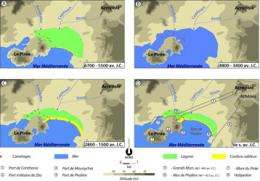
Evolution of coastal landscapes between Athens and Piraeus from the seventh millennium BC onwards. Credit: Julien Cavero CNRS /Université Lyon 2
Piraeus, the main port of Athens, was an island from 4 800 3 400 BC, in other words 4 500 years before the Parthenon was built on the Acropolis. This discovery was made by a French-Greek team led by Jean-Philippe Goiran, a CNRS researcher, who studied and dated sediments collected in the Piraeus area. The research was carried out in collaboration with colleagues from the Universities of Athens, Paris 1 and Paris Ouest, and is published in the June 2011 issue of the journal Geology.
Looking at Piraeus today, it is hard to believe that this urban area was once an island separated from the mainland by a stretch of water. And yet, in the first century AD, the Greek geographer Strabo hypothesized that Piraeus had once been an island. Located approximately seven kilometers southwest of Athens, this vast rocky hill was home to the three ancient ports of the Greek capital, Zea, Mounichia and Cantharos. During the fifth century BC, this strategic place was connected to Athens by a road protected by high walls, known as the 'Long Walls', that guaranteed safe travel.
Until recently, no archeological research had ever been carried out to verify Strabo's hypothesis. To put his intuition to the test, researchers from France and Greece took around ten geological core samples from boreholes over 20 meters deep in what is today the Cephissus (Kifisos) plain located between Piraeus and Athens. They compared the sedimentary records contained in the core samples with written records. Each sedimentary bed was dated using the carbon-14 method. This stratigraphic study enabled the researchers to discover four main stages in the evolution of coastal landscapes in the Piraeus region.
During the first stage, 6 700 5 500 BC, sea levels in the Mediterranean were considerably lower than today. The hill of Piraeus was not an island and was geographically connected to the mainland. Then from 4 800 3 400 BC, sea levels rose, and Piraeus became an island. During the third stage, from 2 800 BC on, sea levels started to rise more slowly, while at the same time massive amounts of sediment were carried down by rivers in the region. This dual phenomenon caused sediments to build up on the Cephissus plain, which led to the establishment of a lagoon environment. Finally, in the fifth century BC, at the time the Parthenon was being built on the Acropolis, the lagoons were still present. To build the Long Walls, the engineers of the time were therefore forced to fill in these wetlands.
Since Strabo lived some 3 500 years after Piraeus was an island, what lies behind his intuition? One possible explanation is that he based his opinions on texts written by his predecessors. Another possibility is that he carried out an analysis of the coastal landscape when he travelled to Athens in the first century AD: at the time, the rocky hill of Piraeus stood above a still marshy coastal plain. And finally, Strabo may have used both these sources to work out that the sea must have been present between Athens and Piraeus at an earlier period.
More information: Piraeus, the ancient island of Athens : Evidence from Holocene sediments and historical archives. Jean-Philippe Goiran, et al. Geology, June 2011
Provided by
CNRS
-
From lemons to lemonade: Reaction uses carbon dioxide to make carbon-based semiconductor,
32 comments
-
Thioridazine kills cancer stem cells in human while avoiding toxic side-effects of conventional cancer treatments,
3 comments
-
SpaceX private rocket blasts off for space station (Update),
42 comments
-
Climate scientists say they have solved riddle of rising sea,
31 comments
-
SpaceX capsule has 'new car' smell, astronauts say (Update),
2 comments
-
Hypothetical desert earth
11 hours ago
-
More human population = greater mass?
May 25, 2012
-
Conversion from aircraft bearing to normal degrees
May 23, 2012
-
Interpretation/Analysis of the Lab results(HEPA filter)
May 22, 2012
-
Has anyone here attended the The Urbino Summer School in Paleoclimatology?
May 22, 2012
-
Earthquakes: Mag 6 N. Italy and Mag 5.6 W. Bulgaria
May 21, 2012
- More from Physics Forums - Earth
More news stories
Sophisticated simulations predict future warming
The chances of our planet being hit by a global warming of 3 degrees Celsius by 2050 is as likely as it being hit by an increase of 1.4 degrees, new research shows. Presented in the journal Nature Geoscience, the British study ...
Space & Earth / Earth Sciences
May 22, 2012 |
4.4 / 5 (9) |
51
Kyoto Protocol architect 'frustrated' by climate dialogue
UN climate talks are going nowhere, as politicians dither or bicker while the pace of warming dangerously speeds up, one of the architects of the Kyoto Protocol told AFP.
May 23, 2012 |
3.7 / 5 (7) |
39
Dragon arrives at space station in historic 1st (Update 2)
The privately bankrolled Dragon capsule made a historic arrival at the International Space Station on Friday, triumphantly captured by astronauts wielding a giant robot arm.
Space & Earth / Space Exploration
May 25, 2012 |
5 / 5 (10) |
19
Aliens don't want to eat us, says former SETI director
Alien life probably isnt interested in having us for dinner, enslaving us or laying eggs in our bellies, according to a recent statement by former SETI director Jill Tarter.
Space & Earth / Space Exploration
May 25, 2012 |
4.4 / 5 (13) |
37
What's the big deal about private space launches?
(AP) -- The first private spaceship is headed to the International Space Station. Some questions and answers about the cargo mission by Space Exploration Technologies, known as SpaceX:
Space & Earth / Space Exploration
May 22, 2012 |
5 / 5 (6) |
32
Nvidia trumpets Tegra 3 phone design wins for 2012
(Phys.org) -- Nvidias competitive war paint has a name, Tegra 3. On the heels of Nvidia announcements about lowering costs of its Tegra 3 processors and Nvidia-enabled tablets running Android Ice Cream ...
Browser wars flare in mobile space
The browser wars are heating up again, but this time the fight is for dominance of the mobile Internet.
Scientist: Evolution debate will soon be history
(AP) -- Richard Leakey predicts skepticism over evolution will soon be history. Not that the avowed atheist has any doubts himself.
Dell tablet leak: 10.1-inch display, two-battery choice
(Phys.org) -- Headline after headline talks about vendors tablets in the wings as likely number-one contenders for the iPad. Such claims have justifiably been taken with a grain of salt, considering ...
Keep food safety in mind this memorial day weekend
(HealthDay) -- Picnics, parades and cookouts are as much a part of Memorial Day weekend as tributes to the United States' war veterans.
Social welfare cuts ultimately come with heavy price, researchers say
(Phys.org) -- Slashing government funding for Medicaid, food stamps and other programs that serve the poor while politically popular with some lawmakers and many conservatives may do more harm ...
Jun 17, 2011
Rank: not rated yet