For Mars rovers, a friendly rivalry
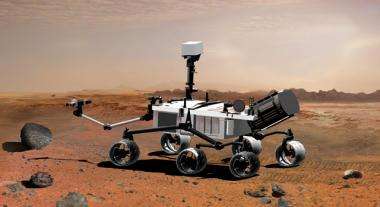
NASA's newest Mars rover - or a replica of it, anyway - sat expectantly at the bottom of a hill. After years in design and construction, the grandly named Mars Science Laboratory was ready to test its wheels on a 20-degree flagstone slope in the "Mars Yard" at the Jet Propulsion Laboratory in La Canada Flintridge, Calif.
Engineers crowded around to see whether the rover's aluminum wheels and titanium suspension were ready for Martian terrain, which varies from bedrock to rocky soil to soft sand. The first wheel slowly pivoted into position. Then another. Then a third, fourth, fifth and sixth - all making a crinkly sound as they slid through the soil. Once in position, the craft crept up the flagstone slope at about 8 feet per minute.
"This is actually really exciting," said Savannah McCoy, one of the engineers observing the trial run.
But not as exciting as what awaits. Toward year's end, NASA plans to send its $1.8 billion rover to scout for evidence that life could have existed on the Red Planet. Nicknamed Curiosity, the craft will examine rocks that scientists believe could have formed only in warm, wet conditions that may have harbored living beings.
The product of almost 10 years of work by 1,000 people, Curiosity has all the ingredients of a scientific triumph.
If only another rover wasn't poised to steal its thunder.
Opportunity, which has been ambling across Mars for seven years, is more than a little worn - "40 times past its warranty," as one JPL scientist put it. It's also on track to reach similar crucial rocks months before Curiosity does.
The thought that Opportunity might scoop Curiosity has competitive juices flowing among the pocket-protector set.
"It's a race for the most interesting part of Mars history," crowed Matt Golombek, a geologist who has been working on Opportunity for 11 years. "We're going to beat them!"
Scott Maxwell, who writes the computer programs that steer Opportunity, can envision the older rover rolling to the edge of the crater that is its goal. "That's going to be SWEET!"
But John Grotzinger, head scientist for Curiosity's mission, is a little dismissive of the idea that Opportunity could upstage his cutting-edge rover. "To think that this is a possibility ... it's unbelievable," he said, shaking his head.
In Opportunity's earlier days, members of the mission team occasionally got kicks making bets: How long would the aging rover survive?
They eventually gave up on the pools.
People now think twice before they bet against Opportunity.
The wildly successful Mars Exploration Rovers - Opportunity and its identical twin Spirit - blasted off in 2003 to look for evidence that water, a prerequisite for life, once existed on the planet. The rovers are roughly the size of a golf cart and weigh about 385 pounds apiece. Each was supposed to spend about 90 days scooting around an area the size of a large parking lot, taking photos and performing tests with instruments that can identify rocks and soils.
Within weeks of landing, Opportunity sent data that showed that extensive areas on Mars had indeed been warm and wet for extended periods. Mission accomplished, it has rolled along for six-plus years, helping enrich scientists' understanding of the Red Planet.
Spirit, which uncovered evidence of hot springs or steam vents, has retired from service. With only five wheels working, it got trapped in soft soil in 2009. It last communicated with NASA on March 22, 2010, and engineers gave up hopes of re-establishing contact last month.
Curiosity is supposed to take over where the older rovers left off.
A nuclear-powered lab on wheels, Curiosity has a nearly two-year mission targeting sites containing clay rocks called phyllosilicates that could hold clues about the Martian climate. Its explorations will help geologists figure out how the surface of Mars has changed over the last 4 billion years and when, if ever, creatures could have evolved there. Where there are phyllosilicates, the thinking goes, there might be evidence of conditions allowing life.
"A home run would be that the rover can drive far enough, climb high enough, go low enough that we can see enough layers to read the storybook of Mars," said Grotzinger, who has been preparing Curiosity for almost four years.
About twice as long and five times as heavy as the earlier rovers, Curiosity carries far more instruments and will be able to conduct dozens of tests.
It will zap rocks with a laser from more than 20 feet away to see what they're made of. It will pulse neutrons underground to detect ice. It will take high-definition, 3-D color photographs of the Martian landscape.
It will also scoop up, grind and sift samples and load them into testing chambers. These should determine what minerals lurk in the Martian crust, and whether organic carbon compounds - the building blocks of life - are among them, Grotzinger said.
Golombek, the geologist who has worked with Opportunity for more than a decade, lovingly describes Opportunity as "middle-aged" and "arthritic."
After traversing a 17-mile route that is nearly 40 times longer than it was ever intended to travel, Opportunity now drives best in reverse because its front right wheel can't be steered.
The rover's robotic arm sticks out awkwardly as it scoots along. Extreme temperatures disabled the mechanism that used to move it in and out of its stowed position.
It takes days for some of Opportunity's sensors and tools to handle tasks that once took them minutes.
Still, if Opportunity can trek about two miles to reach a giant crater called Endeavour and then a couple of miles farther to phyllosilicates along the crater's rim, it could provide useful information.
The rover can "see" textures and layering of rocks and send pictures back to Earth, Golombek said. Its alpha-particle X-ray spectrometer, which analyzes the elements in rocks, works perfectly. Other instruments still function too.
In combination with data from three orbiters circling the planet, Opportunity's observations could give scientists "a very, very good idea" of what Mars was like in the warmer and wetter era that may have been favorable to life, Golombek said.
"It will be a treasure trove," he said. "There are years of geology to do."
The rover rivalry has the attention of space enthusiasts, who track both vehicles. The Planetary Society, a space exploration advocacy organization, has been playing up the competition since last summer.
"It's a fun thing to pit one team against another," said Bill Nye, executive director of the group. "Who doesn't love that?"
JPL scientists say the rivalry is friendly and that Opportunity's beeline for the phyllosilicates really can't hurt Curiosity's mission.
Researchers on Opportunity's team say they can't wait to study Curiosity's data. Curiosity scientists have kind words for Opportunity, too - though these can sound like faint praise.
"Opportunity gets to do things that will be low priority for MSL when we land," said Grotzinger, Curiosity's chief scientist.
But first, Curiosity has to get to the Red Planet. It is parked in a clean room at JPL, its development two years behind schedule and almost double its original budget. Scientists are still debating where it should make landfall on Mars. The soonest it could reach the planet is August 2012. Depending where it lands, it may have to drive for months to reach phyllosilicates.
For Curiosity, the stakes are high. Opportunity has little to lose.
Its team is able to hustle single-mindedly to get its rover to Endeavour as quickly as reasonably possible.
In an ideal world, the craft would travel about 120 yards per excursion and conduct several drives per week. But its progress is limited by energy (it's solar powered) and bandwidth (driving creates a lot of small data files, and the rover can upload and download them only at certain times).
The team recently rejiggered operations to maximize driving time. These days Opportunity doesn't spend weeks taking pictures of objects in its path. Instead, it stops briefly to snap a picture before moving relentlessly on.
(c) 2011, Los Angeles Times.
Distributed by McClatchy-Tribune Information Services.


