Measuring evolution's waistline
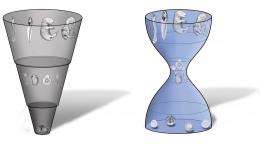
Figure 1: The funnel-like model (left) and the hourglass model (right) are two competing theories that explain how developmental processes are conserved during evolution. In the funnel-like model, conservation occurs at the earliest embryonic stage (bottom) but in the hourglass model it occurs during the middle. Credit: 2011 Naoki Irie and Shigeru Kuratani
Nearly 150 years ago, noted German biologist Ernst Haeckel made the bold assertion that ontogeny recapitulates phylogeny: in other words, morphological changes that occur during an organisms embryonic development mirror its evolutionary history.
This concept has long since been debunked, but has nevertheless provided useful starting points for considering the yet-unsolved question of how the developmental process has evolved. Naoki Irie of the RIKEN Center for Developmental Biology (CDB) in Kobe has pondered this problem since graduate school. My main interest then and now has been to understand the basic or common rules of how animal bodies develop, he says.
Now, as a postdoctoral fellow in Shigeru Kuratanis laboratory at CDB, Irie has conducted an ambitious comparative analysis of four vertebrate species with the aim of resolving an ongoing debate over two prevailing evolutionary models1 (Fig. 1). The funnel-like model, informed in part by Haeckels thinking, suggests that the process of vertebrate embryonic development is very similar across species at the earliest stages, but increasingly differs at later stages. In contrast, the hourglass model suggests that the earliest and latest stages of development differ considerably, whereas the greatest similarity is observed at the intermediate stages where organ development and body patterning take place.
To resolve this so-called evo-devo debate, Irie and Kuratani analyzed changes in expression levels of thousands of evolutionarily conserved genes at different developmental points in the mouse, chicken, frog and zebrafish. The data provided striking support for the hourglass model, with gene transcription levels most similar at the intermediate stage known as pharyngula, where the animal has developed primitive precursors of the heart, kidney, brain and other tissues. They observed particularly strong conservation of activity among the Hox genes, which contribute to limb development, as well as several growth factor genes.
These findings offer new fuel for the evo-devo debate, but also raise complicated questions. It is puzzling for me how vertebrate embryos established differences in early developmental stages while conserving the mid-embryonic stages, says Irie. Its obvious that later developmental stages will not exist if earlier stages fail to develop successfully.
Irie now hopes to obtain further support for the hourglass model by expanding his approach to include well-characterized invertebrate species, such as the fruit fly. He also intends to dig deeper into the nuts and bolts of development. We would like to go down to the level of tissues and primordial organs to find which structures have been conserved during evolution, he says.
More information: Irie, N. & Kuratani, S. Comparative transcriptome analysis reveals vertebrate phylotypic period during organogenesis. Nature Communications 2, 248 (2011). doi:10.1038/ncomms1248
Provided by
RIKEN
-
From lemons to lemonade: Reaction uses carbon dioxide to make carbon-based semiconductor,
32 comments
-
Thioridazine kills cancer stem cells in human while avoiding toxic side-effects of conventional cancer treatments,
3 comments
-
SpaceX private rocket blasts off for space station (Update),
42 comments
-
Climate scientists say they have solved riddle of rising sea,
31 comments
-
SpaceX capsule has 'new car' smell, astronauts say (Update),
2 comments
-
What would stain as translucent on light-coloured fabric?
15 hours ago
-
How do I identify different bacteria on culture plates?
May 26, 2012
-
Why Do Dogs do Strange things...
May 25, 2012
-
What does exophillic and endophillic mean in terms of mosquito and their control?
May 24, 2012
-
Semen stains glows under black lights (uv light)?
May 23, 2012
-
Question on Human Chromosome 2
May 23, 2012
- More from Physics Forums - Biology
More news stories
Scientist: Evolution debate will soon be history
(AP) -- Richard Leakey predicts skepticism over evolution will soon be history. Not that the avowed atheist has any doubts himself.
14 hours ago |
3.5 / 5 (14) |
33
More plant species responding to global warming than previously thought
(Phys.org) -- Far more wild plant species may be responding to global warming than previous large-scale estimates have suggested.
May 22, 2012 |
4.6 / 5 (14) |
18
|
Thousands of shellfish found dead in Peru
Thousands of crustaceans were found dead off the coast of Lima following the mystery mass death of dolphins and pelicans, the Peruvian Navy said Friday.
May 26, 2012 |
4.8 / 5 (4) |
7
For monogamous sparrows, it doesn't pay to stray (but they do it anyway)
It's quite common for a female song sparrow to stray from her breeding partner and mate with the male next door, but a new study shows that sleeping around can be costly.
May 22, 2012 |
5 / 5 (1) |
7
|
Study uncovers secret to speedy burrowing by razor clams
(Phys.org) -- If you look at a razor burrowing clam sitting in a bucket, youd never guess that it could burrow itself down into the soil, much less do it with any speed. Razor clams look like fat straws, ...
Nvidia trumpets Tegra 3 phone design wins for 2012
(Phys.org) -- Nvidias competitive war paint has a name, Tegra 3. On the heels of Nvidia announcements about lowering costs of its Tegra 3 processors and Nvidia-enabled tablets running Android Ice Cream ...
Browser wars flare in mobile space
The browser wars are heating up again, but this time the fight is for dominance of the mobile Internet.
Dell tablet leak: 10.1-inch display, two-battery choice
(Phys.org) -- Headline after headline talks about vendors tablets in the wings as likely number-one contenders for the iPad. Such claims have justifiably been taken with a grain of salt, considering ...
Keep food safety in mind this memorial day weekend
(HealthDay) -- Picnics, parades and cookouts are as much a part of Memorial Day weekend as tributes to the United States' war veterans.
Family history of Alzheimer's affects functional connectivity
(HealthDay) -- Cognitively normal individuals with a family history of late-onset Alzheimer's disease (AD) may display lower resting state functional connectivity in the default mode network (DMN) of the brain, ...
Social welfare cuts ultimately come with heavy price, researchers say
(Phys.org) -- Slashing government funding for Medicaid, food stamps and other programs that serve the poor while politically popular with some lawmakers and many conservatives may do more harm ...
Jun 03, 2011
Rank: 1 / 5 (54)
Jun 03, 2011
Rank: 1.8 / 5 (15)
God requires, REQUIRES faith in order to find him - that is not a realm of science, pure and simple."Now Faith is the substance of things hoped for the evidence of things not seen. Hebrews 11:1."
SCIENCE is our toolbox to understand those things we can measure, infer, and see essential cause and effect, the rhyme and reason for the phenomena in our realm of existence that we choose to understand. Why did God do something? In yur private meditations ASK Him & seek D answer! MEANWHILE, back at the ranch, we have the honor and duty as sentient beings to gather as much data as is available and progressively advance our little but noble species further away from doubt and fear.
Faith is a different tool for a much different realm of thought, but, there are faith-filled scientists who marvel at our universe and seek the wisdom to solve problems, and ask HARD questions.
word-to-ya-muthas
Jun 03, 2011
Rank: 2.1 / 5 (11)
Jun 03, 2011
Rank: 1 / 5 (8)
You can make a better system? Id love to see what you can come up with! :)
Jun 03, 2011
Rank: 5 / 5 (3)
Jun 03, 2011
Rank: 0.9 / 5 (50)
Not me, but Craig Venter is as we speak!
Jun 03, 2011
Rank: not rated yet
Greeks also had a lot of things wrong, later discovered during the Renaissance.
Jun 06, 2011
Rank: not rated yet