New evidence backs up claim of dinosaur soft tissue find
June 15, 2011 by Bob Yirka report

New evidence backs up claim of dinosaur soft tissue find

Enlarge

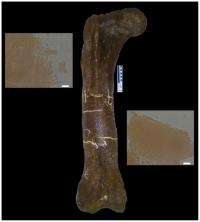
Tyrannosaurus rex femur (MOR 1125) from which demineralized matrix (insets; bars, 20 µm) and peptides were obtained. Image: PLoS ONE 6(6): e20381. doi:10.1371/journal.pone.0020381

(PhysOrg.com) -- In a new study, biochemist James San Antonio and colleagues offer evidence to support the claims by Mary Higby Schweitzer back in 2005, that she and her colleagues had unearthed a soft tissue specimen that belonged to a Tyrannosaurus rex. Roundly criticized by many in the science community, the specimen, discovered inside a femur fragment, has yet to be proven to be anything else. Now, in a paper published on PLoS ONE, San Antonio and his colleagues (including Mary Schweitzer) claim they’ve found a plausible explanation for the survival of soft dinosaur material after some 68 million years.

The team focused on bits of found in the remains, which are a group of proteins found in the flesh and bones of animals; it grows in a triple helix, which when it winds together, is known as a microfibril. When thousands of microfibril wind together, as they often do, they are known as microfibrils.

After carefully studying 11 fragments of collagen recovered from the T. rex bone and then comparing them to similar fragments in modern rat and human collagen, the team discovered that the found fragments all came from the same innermost part of the fibrils that make up microfibrils. San Antononio likens them to tiny fibers that sit at the very innermost part of a very thick strong rope.
In their paper, the research team suggests that because they were so tightly wound, the microfibrils could have survived over millions of years. They also note that the specimens also contained very few amino acids, which are very susceptible to decay.

To back up her claims, or to quiet the naysayers, Schweitzer points out that if the found were actually contaminants from other more recent organisms, as some have claimed, there should have been more randomness to the collagen, instead of the strict uniformity that was found. She also notes that two other labs have corroborated her results.
The unfortunate side story to all the research done so far though, including these latest findings, is that thus far there is no way to definitively prove whether the soft tissue found inside that T. rex bone was in fact a remnant from its original owner, or something that came after. Thus, claims from both those supporting the idea that dinosaur tissue could have survived for millions of years, and those that think it’s nonsense, are likely to continue.

More information: San Antonio JD, Schweitzer MH, Jensen ST, Kalluri R, Buckley M, et al. (2011) Dinosaur Peptides Suggest Mechanisms of Protein Survival. PLoS ONE 6(6): e20381. doi:10.1371/journal.pone.0020381

Abstract
Eleven collagen peptide sequences recovered from chemical extracts of dinosaur bones were mapped onto molecular models of the vertebrate collagen fibril derived from extant taxa. The dinosaur peptides localized to fibril regions protected by the close packing of collagen molecules, and contained few acidic amino acids. Four peptides mapped to collagen regions crucial for cell-collagen interactions and tissue development. Dinosaur peptides were not represented in more exposed parts of the collagen fibril or regions mediating intermolecular cross-linking. Thus functionally significant regions of collagen fibrils that are physically shielded within the fibril may be preferentially preserved in fossils. These results show empirically that structure-function relationships at the molecular level could contribute to selective preservation in fossilized vertebrate remains across geological time, suggest a ‘preservation motif’, and bolster current concepts linking collagen structure to biological function. This non-random distribution supports the hypothesis that the peptides are produced by the extinct organisms and suggests a chemical mechanism for survival.

© 2010 PhysOrg.com

4.3 /5 (7 votes)  

Filter


Move the slider to adjust rank threshold, so that you can hide some of the comments.


Display comments: newest first

chthonic
Jun 15, 2011

Rank: 4 / 5 (1)
All shall be microfibril and all shall be microfibril and all manner of things shall be microfibril.
Yellowdart
Jun 15, 2011

Rank: 1 / 5 (1)
Thus, claims from both those supporting the idea that dinosaur tissue could have survived for millions of years, and those that think its nonsense, are likely to continue.


Hey hey, let's not forget about those claims that dinosaurs aren't that old anyway! :)
kevinrtrs
Jun 15, 2011

Rank: 1.5 / 5 (16)
is that thus far there is no way to definitively prove whether the soft tissue found inside that T. rex bone was in fact a remnant from its original owner, or something that came after.

This is the crux of the matter then, isn't it? I think what it calls for is a thorough search for soft tissue in dino fossils and then using 3D non-invasive techniques to determine whether any non-dino material could have gotten into it.

My take on this story is simply that evolutionists are facing an insurmountable obstacle here and are looking for all kinds of escape routes, including the one that says it's foreign material inside the fossil bone.
There are other indicators, much more vivid, that dinos actually lived with birds, reptiles, foxes etc. Just go and make exhausting searches of the dino fossil beds and catalogue EVERYTHING found there. These other intrusions into those beds are not broadcast to the public or displayed in museums. Dinos fossils are not 60m years old. Period.
SCVGoodToGo
Jun 15, 2011

Rank: 4.6 / 5 (11)
Kevin, your ignorance is encyclopedic.
Sinister1811
Jun 15, 2011

Rank: 1 / 5 (1)
It's a pity they didn't find any T-Rex DNA. I know, maybe I'm dreaming. But this is still an exciting find, nonetheless.
jnj
Jun 15, 2011

Rank: 5 / 5 (3)
I hope they are eventually able to clone some of these! Right now they are looking at the woolly mammoth.
mattytheory
Jun 15, 2011

Rank: 3 / 5 (4)
"There are other indicators, much more vivid, that dinos actually lived with birds, reptiles, foxes etc. Just go and make exhausting searches of the dino fossil beds and catalogue EVERYTHING found there. These other intrusions into those beds are not broadcast to the public or displayed in museums. Dinos fossils are not 60m years old. Period."

So, what you're saying is that because we have found 30MYO fossils on top of or adjacent to fossils dated more than 65MYO that those animals somehow lived together? And, I am pretty sure those findings are published, and even displayed in museums, its just that the rest of the world doesn't consider 30MYO and 65MYO to be even remotely the same. But, you are right about ONE thing, dinosaurs aren't 60MYO... they are AT LEAST 65MYO. Period.
Peteri
Jun 15, 2011

Rank: 3.7 / 5 (6)
Dinos fossils are not 60m years old. Period


Quite right Kevin - they are in fact at least 65 million years old!

As to your other comment: "evolutionists are facing an insurmountable obstacle here and are looking for all kinds of escape routes, including the one that says it's foreign material inside the fossil bone." Hardly an insurmountable obstacle nor an escape route - that's just wishful thinking on your part! Palaeontologists of course need to eliminate the possibility of contamination - it would be bad scientific practice otherwise.
Sinister1811
Jun 15, 2011

Rank: 1 / 5 (1)
@jnj I hope that they're eventually able to clone extinct species too. But, so far, they haven't discovered any Dinosaur DNA. Or, if they have, it certainly hasn't been enough. I read an interesting article about reactivating the primitive genes in birds (and other animals) to re-create the dinosaurs (and other extinct creatures). I hope that they're eventually able to do this. That would be an exciting scientific endeavor.
Yellowdart
Jun 17, 2011

Rank: 5 / 5 (1)
So, what you're saying is that because we have found 30MYO fossils on top of or adjacent to fossils dated more than 65M that those animals somehow lived together?


I think he's referencing polystrata. Not that one is on top or adjacent, but that they overlap. The argument being that decay rate of exposed animals wouldn't survive waiting around for the upper layer forming to protect it.

Vertebrates pretty much make up only .25% of the fossil record that we currently have.

Ramael
Jun 18, 2011

Rank: 5 / 5 (3)
Clone it and find out! MUAHAHAHA
Rank 4.3 /5 (7 votes)
Relevant PhysicsForums posts
  • Gibbs Free Energy Change/Entropy
    created3 hours ago
  • What's the rule to covalent character
    created4 hours ago
  • Schwartz reagent-- NMR/MS/IR
    created23 hours ago
  • High school chemistry EEI
    createdMay 25, 2012
  • oxidation of I- by KMnO4
    createdMay 25, 2012
  • Inversion temp
    createdMay 25, 2012
  • More from Physics Forums - Chemistry

More news stories

New CO2-removing catalyst can take the heat

(Phys.org) -- The current method of removing the greenhouse gas carbon dioxide (CO2) from the flues of coal-fired power plants uses so much energy that no one bothers to use it. So says Roger Aines, principal ...

Chemistry / Materials Science

created May 24, 2012 | popularity 5 / 5 (7) | comments 7 | with audio podcast

High-speed method to aid search for solar energy storage catalysts

Eons ago, nature solved the problem of converting solar energy to fuels by inventing the process of photosynthesis.

Chemistry / Materials Science

created May 25, 2012 | popularity 5 / 5 (3) | comments 4 | with audio podcast

Researchers demonstrate possible primitive mechanism of chemical info self-replication

(Phys.org) -- When scientists think about the replication of information in chemistry, they usually have in mind something akin to what happens in living organisms when DNA gets copied: a double-stranded molecule ...

Chemistry / Materials Science

created May 25, 2012 | popularity 5 / 5 (4) | comments 2 | with audio podcast

Building a better solar panel -- one molecule at a time

(Phys.org) -- One of the fundamental building blocks in modern chemistry, an organometallic chemical compound called ferrocene, has never been structurally defined - until now.

Chemistry / Materials Science

created May 25, 2012 | popularity 5 / 5 (3) | comments 0 | with audio podcast

Discarded data may hold the key to a sharper view of molecules

(Phys.org) -- There's nothing like a new pair of eyeglasses to bring fine details into sharp relief. For scientists who study the large molecules of life from proteins to DNA, the equivalent of new lenses have come in the ...

Chemistry / Biochemistry

created May 24, 2012 | popularity 4.7 / 5 (3) | comments 0 | with audio podcast


Nvidia trumpets Tegra 3 phone design wins for 2012

(Phys.org) -- Nvidia’s competitive war paint has a name, Tegra 3. On the heels of Nvidia announcements about lowering costs of its Tegra 3 processors and Nvidia-enabled tablets running Android Ice Cream ...

Browser wars flare in mobile space

The browser wars are heating up again, but this time the fight is for dominance of the mobile Internet.

Scientist: Evolution debate will soon be history

(AP) -- Richard Leakey predicts skepticism over evolution will soon be history. Not that the avowed atheist has any doubts himself.

Dell tablet leak: 10.1-inch display, two-battery choice

(Phys.org) -- Headline after headline talks about vendors’ tablets in the wings as likely number-one contenders for the iPad. Such claims have justifiably been taken with a grain of salt, considering ...

Keep food safety in mind this memorial day weekend

(HealthDay) -- Picnics, parades and cookouts are as much a part of Memorial Day weekend as tributes to the United States' war veterans.

Family history of Alzheimer's affects functional connectivity

(HealthDay) -- Cognitively normal individuals with a family history of late-onset Alzheimer's disease (AD) may display lower resting state functional connectivity in the default mode network (DMN) of the brain, ...