New delivery system for Viagra ingredient
June 22, 2011

New delivery system for Viagra ingredient

Enlarge

Scientists are reporting development and successful initial tests of a potential new delivery system for the biological signaling agent responsible for the effects of Viagra. It could be used to deliver the substance, called nitric oxide or NO, to treatment conditions ranging from heart disease to skin ulcers and other wounds that fail to heal, according to a report in the Journal of the American Chemical Society.

Joao Rocha and colleagues explain that NO acts as an important agent in the body for expanding blood vessels (its role in Viagra and related medicines for erectile dysfunction), preventing the formation of blood clots, aiding , and repairing wounds. NO's multipurpose role makes it an exciting prospect for new drug development, but current NO delivery systems sometimes cause undesirable side effects. "Clearly, new materials and technologies are needed to store and target-deliver NO in biological amounts," the report notes.

The researchers developed a highly absorbent material that can carry varying amounts of NO. The material slowly releases NO at a rate that is useful for treating diseases, they conclude. More work must be done to calculate the "shelf life" of the material loaded with NO, Rocha and colleagues note, but they conclude: "This work is a first step toward assessing the real potential therapeutic applications of these materials."

More information: “Slow Release of NO by Microporous Titanosilicate ETS-4”, J. Am. Chem. Soc., 2011, 133 (16), pp 6396–6402
DOI: 10.1021/ja200663e

Abstract
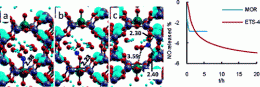
A novel approach to designing nitric oxide (NO) storage and releasing microporous agents based on very stable, zeolite-type silicates possessing framework unsaturated transition-metal centers has been proposed. This idea has been illustrated with ETS-4 [Na9Si12Ti5O38(OH)·xH2O], a titanosilicate that displays excellent NO adsorption capacity and a slow releasing kinetics. The performance of these materials has been compared to the performance of titanosilicate ETS-10, [(Na,K)2Si5TiO13·xH2O], of benchmark zeolites mordenite and CaA, and of natural and pillared clays. DFT periodic calculations have shown that the presence of water in the pores of ETS-4 promotes the NO adsorption at the unsaturated (pentacoordinated) Ti4+ framework ions.

Provided by American Chemical Society search and more info website


Rank 5 /5 (1 vote)
Relevant PhysicsForums posts
  • Gibbs Free Energy Change/Entropy
    created3 hours ago
  • What's the rule to covalent character
    created4 hours ago
  • Schwartz reagent-- NMR/MS/IR
    created23 hours ago
  • High school chemistry EEI
    createdMay 25, 2012
  • oxidation of I- by KMnO4
    createdMay 25, 2012
  • Inversion temp
    createdMay 25, 2012
  • More from Physics Forums - Chemistry

More news stories

New CO2-removing catalyst can take the heat

(Phys.org) -- The current method of removing the greenhouse gas carbon dioxide (CO2) from the flues of coal-fired power plants uses so much energy that no one bothers to use it. So says Roger Aines, principal ...

Chemistry / Materials Science

created May 24, 2012 | popularity 5 / 5 (7) | comments 7 | with audio podcast

High-speed method to aid search for solar energy storage catalysts

Eons ago, nature solved the problem of converting solar energy to fuels by inventing the process of photosynthesis.

Chemistry / Materials Science

created May 25, 2012 | popularity 5 / 5 (3) | comments 4 | with audio podcast

Researchers demonstrate possible primitive mechanism of chemical info self-replication

(Phys.org) -- When scientists think about the replication of information in chemistry, they usually have in mind something akin to what happens in living organisms when DNA gets copied: a double-stranded molecule ...

Chemistry / Materials Science

created May 25, 2012 | popularity 5 / 5 (4) | comments 2 | with audio podcast

Building a better solar panel -- one molecule at a time

(Phys.org) -- One of the fundamental building blocks in modern chemistry, an organometallic chemical compound called ferrocene, has never been structurally defined - until now.

Chemistry / Materials Science

created May 25, 2012 | popularity 5 / 5 (3) | comments 0 | with audio podcast

Discarded data may hold the key to a sharper view of molecules

(Phys.org) -- There's nothing like a new pair of eyeglasses to bring fine details into sharp relief. For scientists who study the large molecules of life from proteins to DNA, the equivalent of new lenses have come in the ...

Chemistry / Biochemistry

created May 24, 2012 | popularity 4.7 / 5 (3) | comments 0 | with audio podcast


Nvidia trumpets Tegra 3 phone design wins for 2012

(Phys.org) -- Nvidia’s competitive war paint has a name, Tegra 3. On the heels of Nvidia announcements about lowering costs of its Tegra 3 processors and Nvidia-enabled tablets running Android Ice Cream ...

Browser wars flare in mobile space

The browser wars are heating up again, but this time the fight is for dominance of the mobile Internet.

Scientist: Evolution debate will soon be history

(AP) -- Richard Leakey predicts skepticism over evolution will soon be history. Not that the avowed atheist has any doubts himself.

Dell tablet leak: 10.1-inch display, two-battery choice

(Phys.org) -- Headline after headline talks about vendors’ tablets in the wings as likely number-one contenders for the iPad. Such claims have justifiably been taken with a grain of salt, considering ...

Keep food safety in mind this memorial day weekend

(HealthDay) -- Picnics, parades and cookouts are as much a part of Memorial Day weekend as tributes to the United States' war veterans.

Family history of Alzheimer's affects functional connectivity

(HealthDay) -- Cognitively normal individuals with a family history of late-onset Alzheimer's disease (AD) may display lower resting state functional connectivity in the default mode network (DMN) of the brain, ...