Coevolution not healthy for the female sea monkey
June 20, 2011 by Deborah Braconnier report

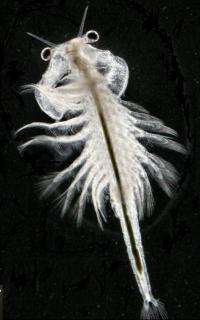
Artemia urmiana

Artemia urmiana

(PhysOrg.com) -- In a new study titled Male-Female Coevolution in the Wild: Evidence from a Time Series in Artemia Franciscana and published in Evolution, evolutionary ecologist Nicolas Rode from the Centre for Functional and Evolutionary Ecology looked at the sexual behavior of the sea monkey and what happened when females were bred with past and future generations.

Sea monkeys, or brine shrimp, lay eggs that are tough in nature and are able to survive for long periods of time. They can lay dormant for years, as in the case of a drought, and then once the water returns are then able to hatch.

Looking at the Great Salt Lake in Utah, researchers collected eggs from layers that had formed in 1985, 1996 and 2007. They took these eggs back to the lab and allowed them to hatch. Keeping each generation separate, the researchers then bred the females with eggs from their generation and previous and past generations.

What they discovered was that the longer the time difference between the male and female partner, the sooner the female sea monkey died. When a female from 1985 was bred with a male from 2007, her was cut short by as much as 12 percent.

The research seems to match the idea of and that female shrimp are best suited to breed with their own generation. It appears males and females adapt new mating strategies through different generations and this proves deadly for the female sea monkey.
The change in from a different generation did not however seem to have an effect on the female’s reproductive success. Even though they were dying faster, they were also producing eggs at a faster rate.

The one mystery still puzzling the researchers is just how the males are harming the females and shortening their lifespan.

More information: MALE-FEMALE COEVOLUTION IN THE WILD: EVIDENCE FROM A TIME SERIES IN ARTEMIA FRANCISCANA, Evolution, DOI: 10.1111/j.1558-5646.2011.01384.x

ABSTRACT
Sexual conflicts are ubiquitous in nature and are expected to lead to an antagonistic coevolution between the sexes. This coevolutionary process is driven by selection on sexually antagonistic traits that can either be directional or fluctuating. In this study, we used dormant cysts of Artemia franciscana, collected in the same population in three different years over a 23-year period (corresponding to ∼160 generations in this system), to investigate male-female coevolution in natural conditions over time. We performed a cross experiment study where reproduction of females mated to males from the past, present or future was monitored until death. In agreement with a model of ‘fluctuating selection’, we found that females survived better and had longer interbrood intervals when mated with their contemporary males compared to when mated with males from the future or the past. However, female weekly and lifetime reproductive successes displayed no differences between contemporary and non-contemporary matings. Finally, the coevolutionary patterns (‘arms race dynamics’ or ‘fluctuating selection dynamics’) possibly acting on female relative fitness could not be discriminated. This study is the first direct demonstration that the process of male – female coevolution, previously revealed by experimental evolution in laboratory artificial conditions, can occur in nature on a short evolutionary time scale.

© 2010 PhysOrg.com

3.7 /5 (3 votes)  

Filter


Move the slider to adjust rank threshold, so that you can hide some of the comments.


Display comments: newest first

gwargh
Jun 20, 2011

Rank: not rated yet
Why in the world would you have that title, physorg?

It's not coevolution that's unhealthy, it's precisely the lack of it that caused the decreased lifespans of the females. They are unable to adapt to the sexual characters of future males as well (toxins to destroy other males' sperm, sexual organ changes, etc.)
Rank 3.7 /5 (3 votes)
Relevant PhysicsForums posts

More news stories

Scientist: Evolution debate will soon be history

(AP) -- Richard Leakey predicts skepticism over evolution will soon be history. Not that the avowed atheist has any doubts himself.

Biology / Evolution

created 15 hours ago | popularity 3.4 / 5 (16) | comments 46

More plant species responding to global warming than previously thought

(Phys.org) -- Far more wild plant species may be responding to global warming than previous large-scale estimates have suggested.

Biology / Ecology

created May 22, 2012 | popularity 4.6 / 5 (14) | comments 18 | with audio podcast

Thousands of shellfish found dead in Peru

Thousands of crustaceans were found dead off the coast of Lima following the mystery mass death of dolphins and pelicans, the Peruvian Navy said Friday.

Biology / Ecology

created May 26, 2012 | popularity 4.8 / 5 (4) | comments 7

For monogamous sparrows, it doesn't pay to stray (but they do it anyway)

It's quite common for a female song sparrow to stray from her breeding partner and mate with the male next door, but a new study shows that sleeping around can be costly.

Biology / Plants & Animals

created May 22, 2012 | popularity 5 / 5 (1) | comments 7 | with audio podcast

Study uncovers secret to speedy burrowing by razor clams

(Phys.org) -- If you look at a razor burrowing clam sitting in a bucket, you’d never guess that it could burrow itself down into the soil, much less do it with any speed. Razor clams look like fat straws, ...

Biology / Plants & Animals

created May 25, 2012 | popularity 1 / 5 (1) | comments 3 | with audio podcast report


Nvidia trumpets Tegra 3 phone design wins for 2012

(Phys.org) -- Nvidia’s competitive war paint has a name, Tegra 3. On the heels of Nvidia announcements about lowering costs of its Tegra 3 processors and Nvidia-enabled tablets running Android Ice Cream ...

Browser wars flare in mobile space

The browser wars are heating up again, but this time the fight is for dominance of the mobile Internet.

Dell tablet leak: 10.1-inch display, two-battery choice

(Phys.org) -- Headline after headline talks about vendors’ tablets in the wings as likely number-one contenders for the iPad. Such claims have justifiably been taken with a grain of salt, considering ...

Keep food safety in mind this memorial day weekend

(HealthDay) -- Picnics, parades and cookouts are as much a part of Memorial Day weekend as tributes to the United States' war veterans.

Social welfare cuts ultimately come with heavy price, researchers say

(Phys.org) -- Slashing government funding for Medicaid, food stamps and other programs that serve the poor – while politically popular with some lawmakers and many conservatives – may do more harm ...

Is a classical electrodynamics law incompatible with special relativity?

(Phys.org) -- The laws of classical electromagnetism that were developed in the 19th century are the same laws that scientists use today. They include Maxwell’s four equations along with the Lorentz la ...