Study shows chimps capable of insightful reasoning ability
June 10, 2011 by Bob Yirka report

chimpanzee

Enlarge

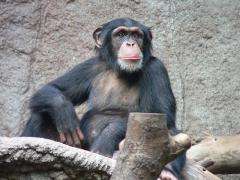
Common chimpanzee in the Leipzig Zoo. Image credit: Thomas Lersch, via Wikipedia.

(PhysOrg.com) -- A new study conducted by researchers from the Max Planck Institute in Germany, with results published in PLoS ONE, shows that some apes are capable of using insightful reasoning to achieve goals. When presented with a peanut floating in a tube a quarter filled with water, some chimpanzees were able to figure out that they could raise the water level, and hence the peanut, by filling their mouths with water from a nearby dispenser, then spitting it into the tube. Doing so enough times, raised the floating peanut to such a level that they were eventually able to retrieve and eat it.

The research team conducted nearly the same experiment three times; the first was at a research center in Germany, and was a complete failure in that none of the figured out how to get the floating peanut. When the experiment was done again in a facility in Africa, however, the results were quite different; five of the 24 chimp volunteers successfully filled the tube and ate the peanut. Also, interestingly, one actually resorted to urinating into the tube, which also worked.

In the third experiment, instead of testing , human children were given nearly the same test; though instead of having to spit water from their mouths, they were allowed a water pitcher which they could use to pour the water into the tube. In this study, three age groups were tested, 4, 6, and eight year olds. Not surprisingly, the youngest group fared quite poorly, while the oldest group outperformed the chimps by a wide margin.

In addition to testing and children, the researchers also included other primates in their studies. In the first they tested in the same way as the chimps, but none of the gorillas were able to solve the riddle. In the second experiment, they included , which were actually the basis for their experiments as other researchers had shown they were remarkably adept at figuring out the floating peanut problem. Unfortunately, when tested in this study, none of them were able to secure the peanut, leading the researchers to believe that other factors were at work.

And finally, the researchers went back to the first group in Germany and retested the chimps that had failed the first time around, only this time, they installed a second water dispenser, and lo and behold, some of the chimps were then able to get the peanut. This, the researchers suggested meant that the chimps had become so fixated on the original water dispensers as simple thirst quenching devices, that they had become unable to think of using them in any other way; thus, when a new dispenser was added, they were able to see it as an open source sort of tool.

The whole point of the study was to see if primates are capable of the kind of higher level learning known as insight; or in other words, of having that aha moment where an idea sort of pops into the head as possible solution to a problem. As it turns out, it appears some other than humans are indeed capable of such thinking, which means, we might have to take a harder look at what higher actually intelligence means.

More information: Hanus D, Mendes N, Tennie C, Call J (2011) Comparing the Performances of Apes (Gorilla gorilla, Pan troglodytes, Pongo pygmaeus) and Human Children (Homo sapiens) in the Floating Peanut Task. PLoS ONE 6(6): e19555. doi:10.1371/journal.pone.0019555

Abstract
Recently, Mendes et al. described the use of a liquid tool (water) in captive orangutans. Here, we tested chimpanzees and gorillas for the first time with the same “floating peanut task.” None of the subjects solved the task. In order to better understand the cognitive demands of the task, we further tested other populations of chimpanzees and orangutans with the variation of the peanut initially floating or not. Twenty percent of the chimpanzees but none of the orangutans were successful. Additional controls revealed that successful subjects added water only if it was necessary to obtain the nut. Another experiment was conducted to investigate the reason for the differences in performance between the unsuccessful (Experiment 1) and the successful (Experiment 2) chimpanzee populations. We found suggestive evidence for the view that functional fixedness might have impaired the chimpanzees' strategies in the first experiment. Finally, we tested how human children of different age classes perform in an analogous experimental setting. Within the oldest group (8 years), 58 percent of the children solved the problem, whereas in the youngest group (4 years), only 8 percent were able to find the solution.

© 2010 PhysOrg.com

Filter


Move the slider to adjust rank threshold, so that you can hide some of the comments.


Display comments: newest first

Squirrel
Jun 10, 2011

Rank: not rated yet
The link does not work to PlosOne does not work. This does:
http://www.ploson....ambra02
hush1
Jun 10, 2011

Rank: not rated yet
Kudos.
We are spared. Indignation. For now.
In that the researchers did not test how human children of all age classes perform in an analogous experimental setting.

That insight will arrive as well.
Isaacsname
Jun 10, 2011

Rank: 5 / 5 (1)
I for one, am ready for our new Chimpanzee overlords.

...." Ooook ooook "
hush1
Jun 10, 2011

Rank: not rated yet
Welcome aboard.
NickFun
Jun 10, 2011

Rank: not rated yet
I admit that when faced with similar problems I may have had trouble figuring them out.
Beard
Jun 11, 2011

Rank: not rated yet
I'd really like to see the selective breeding of the most intelligent chimps with the eventual goal of effectively teaching them sign language.

If they are already at the intellectual level of a four year old human, selective breeding and language might engender sapience. This process would be a brilliant tool to study our own evolutionary origins.
hush1
Jun 16, 2011

Rank: not rated yet
@Beard
A noble gesture. I can not teach them sign language. Why?
I do not know how they learn. In fact, are own species, humans, from the moment of birth till age three, describe those 1095 days as the "most formative" period of time and LEARNING than at any other period of time during a human life span.

Excuse me? Most formative, greatest learning? Now why do researchers describe this human time segment with descriptors like "most", "formative", "greatest learning curve" and fill the scientific literature, journals, papers and essays with just one word: "NOTHING" to describe this "most important" segment of human life?

Give me 1095 days with you. With the tools no self respecting scientist can afford to be caught dead with: those of a newborn. I guarantee you, you will never have to be "taught" even the most profound, abstract, of "grown up" thoughts.

With those tools, give me 1095 days with a chimpanzee.
cont...
hush1
Jun 16, 2011

Rank: not rated yet
cont...

With those tools, give me 1095 days with a chimpanzee. And when you meet this chimpanzee after those 1095 days, you will walk away with an inferior complex the likes of which you will never be able to forget or emotionally be able to handled.

All said in jest. O.k.? Jest, which harbors more truth that one is willing to bear.

Yes. A brilliant tool. Yet, who is the one being studied?
And will you listen? When this chimpanzee tells you in flawless speech about your own evolutionary origins?
lol

I will shed light on those 1095 days and tools. I have no idea what species will take advantage of that knowledge. Universal knowledge has no loyalty.
Deesky
Jun 16, 2011

Rank: not rated yet
I'd really like to see the selective breeding of the most intelligent chimps with the eventual goal of effectively teaching them sign language.

Already been done, without a breeding program. Look up Washoe or Koko.
hush1
Jun 16, 2011

Rank: not rated yet
Assigning "human blueprint plans" to the genome sequence of any other life form other than human is taboo. A "work-a-round" is "selective breeding".

No researcher can say Washoe was the "most intelligent" for the life, researchers singled her out for.

No amount of flawless Human Ecology will ever dispel doubts about the ways we will or will not want to communicate with life that is not human.

There is no consensus even to the way humans treat each other, despite all law ever written.
Rank 5 /5 (4 votes)
Relevant PhysicsForums posts

More news stories

Scientist: Evolution debate will soon be history

(AP) -- Richard Leakey predicts skepticism over evolution will soon be history. Not that the avowed atheist has any doubts himself.

Biology / Evolution

created 15 hours ago | popularity 3.4 / 5 (16) | comments 46

More plant species responding to global warming than previously thought

(Phys.org) -- Far more wild plant species may be responding to global warming than previous large-scale estimates have suggested.

Biology / Ecology

created May 22, 2012 | popularity 4.6 / 5 (14) | comments 18 | with audio podcast

Thousands of shellfish found dead in Peru

Thousands of crustaceans were found dead off the coast of Lima following the mystery mass death of dolphins and pelicans, the Peruvian Navy said Friday.

Biology / Ecology

created May 26, 2012 | popularity 4.8 / 5 (4) | comments 7

For monogamous sparrows, it doesn't pay to stray (but they do it anyway)

It's quite common for a female song sparrow to stray from her breeding partner and mate with the male next door, but a new study shows that sleeping around can be costly.

Biology / Plants & Animals

created May 22, 2012 | popularity 5 / 5 (1) | comments 7 | with audio podcast

Study uncovers secret to speedy burrowing by razor clams

(Phys.org) -- If you look at a razor burrowing clam sitting in a bucket, you’d never guess that it could burrow itself down into the soil, much less do it with any speed. Razor clams look like fat straws, ...

Biology / Plants & Animals

created May 25, 2012 | popularity 1 / 5 (1) | comments 3 | with audio podcast report


Nvidia trumpets Tegra 3 phone design wins for 2012

(Phys.org) -- Nvidia’s competitive war paint has a name, Tegra 3. On the heels of Nvidia announcements about lowering costs of its Tegra 3 processors and Nvidia-enabled tablets running Android Ice Cream ...

Browser wars flare in mobile space

The browser wars are heating up again, but this time the fight is for dominance of the mobile Internet.

Dell tablet leak: 10.1-inch display, two-battery choice

(Phys.org) -- Headline after headline talks about vendors’ tablets in the wings as likely number-one contenders for the iPad. Such claims have justifiably been taken with a grain of salt, considering ...

Keep food safety in mind this memorial day weekend

(HealthDay) -- Picnics, parades and cookouts are as much a part of Memorial Day weekend as tributes to the United States' war veterans.

Social welfare cuts ultimately come with heavy price, researchers say

(Phys.org) -- Slashing government funding for Medicaid, food stamps and other programs that serve the poor – while politically popular with some lawmakers and many conservatives – may do more harm ...

Is a classical electrodynamics law incompatible with special relativity?

(Phys.org) -- The laws of classical electromagnetism that were developed in the 19th century are the same laws that scientists use today. They include Maxwell’s four equations along with the Lorentz la ...