Cave researchers explore stream-filled cavern at entrance to Jerusalem
Jun 14, 2011
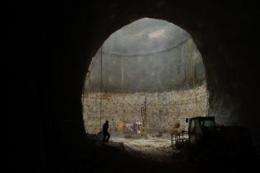
This is a view from the entrance of a newly discovered cave at the entrance to Jerusalem. Credit: Hebrew University photo by Amos Frumkin

Hebrew University of Jerusalem researchers have conducted an initial survey of what appears to be an important, ancient water source in a cave that was been discovered during excavation work for a new train station being constructed at the entrance to Jerusalem.

The work was done by members of the Research Unit of the university, headed by Prof. Amos Frumkin of the Department of Geography. The cave was exposed near the base of a deep service shaft that was dug for the train tunnel leading into the new station, located opposite the main bus station in Jerusalem. The full length of the cave is as yet unexplored.

The cave is narrow and a few dozen meters high, forming an underground canyon. It contains an underground stream, flowing in a southeasterly direction. It is a type of karstic cave, which refers to an area of limestone in which dissolution has produced sinkholes, underground streams and caverns. Karstic caves are common mainly where the climate is wetter, such as Slovenia.

The length of the cave is believed to extend for several hundred meters, at least, though its true length will only be known after subsequent explorations. At a distance of some 200 meters from the service shaft, the Hebrew University cave explorers found a series of small waterfalls. Testing of the water in the cave, it is believed, can yield valuable information about potential pollution of the underground water supply in the Jerusalem area.

"This cave is the largest and most impressive of its type that has yet been found in Israel," said Frumkin. He pointed out that the cave is situated in an area about which there is uncertainty regarding the direction of the flow of water in the mountain aquifer, and this cave can assist in achieving a better understanding of that phenomenon.

Frumkin cited the law that requires preservation of the cave for , but said that this should be feasible for the most part without harming the work on the construction of the new train station.

Explore further: Prehistoric rock art maps cosmological belief

add to favorites email to friend print save as pdf

Related Stories

Earliest evidence of our cave-dwelling human ancestors

Dec 19, 2008

A research team led by Professor Michael Chazan, director of the University of Toronto's Archaeology Centre, has discovered the earliest evidence of our cave-dwelling human ancestors at the Wonderwerk Cave in South Africa.

Historic Italian cave may collapse

May 01, 2008

Archaeologists are warning a signature Stone Age cavern in southern Italy, called the Paglicci Cave, is in imminent danger of collapse.

Recommended for you

Wooden beam could be detached part of shipwreck

9 hours ago

A wooden beam that has long been the focus of the search for a 17th century shipwreck in northern Lake Michigan was not attached to a buried vessel as searchers had suspected, but still may have come from the elusive Griffin ...

Prehistoric rock art maps cosmological belief

16 hours ago

It is likely some of the most widespread and oldest art in the United States. Pieces of rock art dot the Appalachian Mountains, and research by University of Tennessee, Knoxville, anthropology professor Jan ...

User comments : 1

Adjust slider to filter visible comments by rank

Display comments: newest first

Mahal_Kita
not rated yet Jun 14, 2011
"Frumkin cited the law that requires preservation of the cave for future generations, but said that this should be feasible for the most part without harming the work on the construction of the new train station."

More news stories

Prehistoric rock art maps cosmological belief

It is likely some of the most widespread and oldest art in the United States. Pieces of rock art dot the Appalachian Mountains, and research by University of Tennessee, Knoxville, anthropology professor Jan ...

The broken symphony of swinging metronomes

An experiment with 30 metronomes reveals chimera states which combine aspects of synchrony and of disorder. Researchers had been looking for such states for ten years.

Wooden beam could be detached part of shipwreck

A wooden beam that has long been the focus of the search for a 17th century shipwreck in northern Lake Michigan was not attached to a buried vessel as searchers had suspected, but still may have come from the elusive Griffin ...

Gay marriage ruling unlikely to cause anti-gay backlash

Concerns that a U.S. Supreme Court ruling favorable to gay marriage might produce a backlash that would impede efforts to achieve equality are unfounded, according to a study by researchers at University of California campuses ...

Danish chemists in molecular chip breakthrough

Electronic components built from single molecules using chemical synthesis could pave the way for smaller, faster and more green and sustainable electronic devices. Now for the first time, a transistor made ...

Sony chief says time needed to study proposal

Sony Corp. needs more time to study a key proposal from a U.S. hedge fund to spin off a part of its entertainment unit as a way to propel its fledgling revival, the chief executive told shareholders Thursday.

China astronauts float water blob in kids' lecture

Astronauts struck floating martial arts poses, twirled gyroscopes and manipulated wobbling globes of water during a lecture Thursday from China's orbiting space station that's part of efforts to popularize ...

Philippines financial capital bans plastic bags

The Philippines financial capital banned disposable plastic shopping bags and styrofoam food containers on Thursday, as part of escalating efforts across the nation's capital to curb rubbish that exacerbates ...