Turning off cancer's growth signals
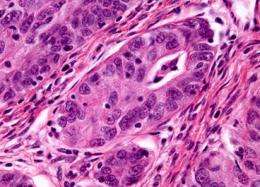
One hallmark of cancer cells is uncontrollable growth, provoked by inappropriate signals that instruct the cells to keep dividing. Researchers at MIT and Brigham and Women’s Hospital have now identified a new way to shut off one of the proteins that spreads those signals — a receptor known as HER3.
Drugs that interfere with HER3’s better-known cousins, EGFR and HER2, have already proven effective in treating many types of cancer, and early-stage clinical trials are underway with antibodies directed against HER3. HER3 is of great interest to cancer biologists because it is commonly involved in two of the deadliest forms of the disease, ovarian and pancreatic cancer, says MIT Professor Linda Griffith, who led the research team with Harvard Stem Cell Institute and Brigham and Women’s cardiologist Richard Lee.
The study, published online May 26 in the Journal of Biological Chemistry, resulted from a serendipitous finding in a regenerative-medicine project. Co-first author Luis Alvarez, who earned his PhD from MIT during a three-year leave from the Army, was interested in regenerative medicine because he knew many soldiers who had been wounded in Iraq and Afghanistan.
While looking for ways to promote bone regrowth, Alvarez developed a series of paired proteins that the researchers thought might promote interactions between growth receptors such as HER3 and EGFR to control growth and differentiation.
Alvarez’s proteins had some impact on regeneration, but the researchers also noticed that in some cases, they appeared to shut off cell growth and migration. Alvarez and others in Griffith’s lab decided to see what would happen if they treated cancer cells with the protein. To their surprise, they found that the cells stopping growing, and in some cases died.
“It was not something we were expecting to see — you don’t expect to shut off a receptor with something that normally activates it — but in retrospect it seemed obvious to try this approach for HER3,” says Griffith, the School of Engineering Professor of Innovative Teaching in MIT’s Department of Biological Engineering and director of the Center for Gynepathology Research. “We pursued it only because we had people in the lab working with cancer cells, and we thought, ‘Since it had these effects in stem cells, let’s just try this in tumor cells, and see if something interesting happens.’”
Targeting vulnerability
Around the same time, Griffith developed a personal interest in this family of cell receptors: She was diagnosed with a form of breast cancer that often overexpresses the receptor EGFR.
EGFR has received much attention from biologists — the cancer drugs Erbitux, Iressa and Tarceva all target it — but not all cancers that overexpress the EGFR respond to targeted therapies. The first highly successful targeted chemotherapy, Herceptin, goes after another member of the family, the HER2 receptor.
The new MIT protein targets a specific vulnerability of HER3: To convey its growth-stimulating signals to the rest of the cell, HER3 must pair up with another receptor, usually HER2.
The new protein, which consists of a fused pair of neuregulin molecules, disrupts that pairing. Single molecules of neuregulin normally stimulate the HER3 receptor, promoting cell growth and differentiation. However, when the paired neuregulin is given to cells, it binds together two adjacent HER3 receptors, preventing them from interacting with the HER2 receptors they need to send their signals.
The researchers tested the molecule in six different types of cancer cells that overexpress HER3, and found that it effectively shut off growth in all of them, including a cell type that is resistant to drugs that target EGFR.
Mark Moasser, a professor of oncology at the University of California at San Francisco, described the new technique as clever and elegant, adding that more experiments are needed to determine if it will be effective in living organisms. “Based on the mechanism, it has potential, and it lays the groundwork for a lot of future work,” says Moasser, who was not involved in this study.
The MIT and Brigham and Women’s team is now working on a new version of the molecule that would be more suited to tests in living animals. They plan to undertake such testing soon under the leadership of Steven Jay, a joint MIT/Brigham and Women’s postdoc and co-first author of the new paper. MIT postdoc Elma Kurtagic and graduate student Seymour de Picciotto are also first authors of the paper.
This story is republished courtesy of MIT News (web.mit.edu/newsoffice/), a popular site that covers news about MIT research, innovation and teaching.
More information: Paper online: www.jbc.org/content/early/2011 … M111.221093.abstract
Provided by Massachusetts Institute of Technology


