Astronomers observe Pluto and its moons
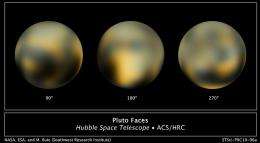
A best-fit color image/map of Pluto generated with the Hubble Space Telescope and advanced computers. Image: NASA
(PhysOrg.com) -- A Williams College team of astronomers, headed by Bryce Babcock and Jay Pasachoff, have been in Hawaii, near Honolulu, to observe a rare double-double event about Pluto. On June 23rd, they observed an occultation, a hiding, when Plutos largest moon, Charon, only 755 miles across, went in front of (occulted) a star, revealing its size accurately as well as the absence of any atmosphere. About 11 minutes later, Pluto went in front of the same star, though the astronomers and their students have to analyze their observations to see if they detected that second event.
At this occasion, and at a previous Charon occultation the joint Williams-MIT team observed in 2005, the light from the star disappeared abruptly, while Plutos atmosphere makes the starlight disappear gradually when Pluto is occulted.
On June 27, Pluto, which is about 1750 miles across, had a second double occultation. It went in front of another star, occulting it. About 33 minutes later, its tiny moon Hydra, perhaps only 50 miles wide, was scheduled to go in front of the star, casting a shadow exactly its same size on Earth, perhaps only 40 to 100 miles across. The Williams team is allied with an MIT group that provided the continually updated calculations and that itself sent out astronomers with special cameras. Indeed, one MIT astronomer carried such a camera to Yunnan, China, to a telescope with access arranged by Pasachoff.
The Williams College team includes Babcock, Pasachoff, and students Shubpanga Pandey 13 from Nepal as well as Wesleyan exchange student David Amrhein 12, part of the National Science Foundation sponsored Keck Northeast Astronomy Consortium. The MIT team, founded by the late Jim Elliot, is now headed by Michael Person and Amanda Bosh in collaboration with Amanda Gulbis, who is also at the South African Astronomical Observatory in Cape Town. They also work with Stephen Levine, who works at the Lowell Observatory in flagstaff, who has been providing up-to-the-day positions of Pluto and of the stars. The consortium has the cooperation of David Tholen of the University of Hawaiis Institute for Astronomy, who provided late corrections to the position of Hydra based on Hubble Space Telescope observations, with the tiny motions of the stars across the sky over the last few years providing the limit in accuracy.
Contrary to popular belief, the International Astronomical Unions actions in Prague in 2006 promoted Pluto to its current state of dwarf planet, making it the first and a major object in its class instead of a diminutive member of a class of much larger planets. The measurement of a supposedly larger object in the outer solar system, now named Eris, has now been shown to have probably been in error, with Eris slightly smaller than Pluto although, thanks to a presence of a Moon, known to be more massive.
The June 23 observations were tremendously successful, with the Williams team detecting 100 data points over 50 seconds showing the brightness of the star diminished as Charon passed in front of it. These results were obtained at Leeward Community College with its 20″ telescope, in collaboration with Mohan Kakkala, the astronomer there. Robert Lucas from Sydney, Australia, and Eric Pilger 84, from the Hawaii Institute of Geophysics, joined in the observations. The alternative site on the other side of Oahu, Honolulus island, at Windward Community College with its 16″ telescope was cloudy, as it usually is. The collaboration there is with astronomer Joseph Ciotti and his students Sam Plunkett and Nathaniel Hiraoka. Pasachoff, Amrhein, and MIT undergraduate Stephanie Sallum 12 were on site for both dates. The June 27 observations were foiled by cloudy conditions at both Windward and Leeward Community College. The Williams College and Windward Community College teams were joined each time by David Tholen and Marco Micheli of the University of Hawaii.
The observations from Hawaii were sponsored by grants from NASAs Planetary Astronomy division to Williams College and to MIT. The cameras were provided to Williams and MIT by a previous NASA grant. Steven Souza at Williams was one of the planners of the camera systems, each of which is known as POETS, for Portable Occultation, Eclipse, and Transit System.
The successful observations from Honolulu were matched by successful observations from NASAs Infrared Telescope Facility on Mauna Kea, operated by Gulbis. Moreover, Person and Lowell Observatory astronomer Ted Dunham flew on NASAs new Stratospheric Observatory for Infrared Astronomy, SOFIA, in one of its first science flights after decades of development. They flew down the projected center line for Plutos shadow, and captured a focusing of the starlight all around Plutos circumference by Plutos atmosphere, related to a phenomenon called the central flash. American Astronomical Society press officer Rick Fienberg was on board to chronicle the historic flight.
Two other teams of astronomers, one from the Observatory of Paris and the other from Southwest Research Institute in Boulder, Colo., had interlocking locations of telescopes across the Pacific and adjacent countries, all to capture the double-double occultations involving Pluto, Charon, and Hydra.
Provided by Williams College
-
From lemons to lemonade: Reaction uses carbon dioxide to make carbon-based semiconductor,
32 comments
-
Thioridazine kills cancer stem cells in human while avoiding toxic side-effects of conventional cancer treatments,
3 comments
-
SpaceX private rocket blasts off for space station (Update),
42 comments
-
Climate scientists say they have solved riddle of rising sea,
31 comments
-
SpaceX capsule has 'new car' smell, astronauts say (Update),
2 comments
-
revamping general concept and cosmological principle
May 25, 2012
-
Transiting Exoplanet Light Curve
May 25, 2012
-
Math behind Theoretical Physics
May 24, 2012
-
Do we know whats at the center of galaxies yet?
May 23, 2012
-
Structure of the Milky Way?
May 20, 2012
-
What would it take to terraform Pluto and Charon?
May 19, 2012
- More from Physics Forums - General Astronomy
More news stories
Sophisticated simulations predict future warming
The chances of our planet being hit by a global warming of 3 degrees Celsius by 2050 is as likely as it being hit by an increase of 1.4 degrees, new research shows. Presented in the journal Nature Geoscience, the British study ...
Space & Earth / Earth Sciences
May 22, 2012 |
4.4 / 5 (9) |
51
Kyoto Protocol architect 'frustrated' by climate dialogue
UN climate talks are going nowhere, as politicians dither or bicker while the pace of warming dangerously speeds up, one of the architects of the Kyoto Protocol told AFP.
May 23, 2012 |
3.7 / 5 (7) |
39
Aliens don't want to eat us, says former SETI director
Alien life probably isnt interested in having us for dinner, enslaving us or laying eggs in our bellies, according to a recent statement by former SETI director Jill Tarter.
Space & Earth / Space Exploration
May 25, 2012 |
4.4 / 5 (13) |
37
Dragon arrives at space station in historic 1st (Update 2)
The privately bankrolled Dragon capsule made a historic arrival at the International Space Station on Friday, triumphantly captured by astronauts wielding a giant robot arm.
Space & Earth / Space Exploration
May 25, 2012 |
5 / 5 (10) |
19
What's the big deal about private space launches?
(AP) -- The first private spaceship is headed to the International Space Station. Some questions and answers about the cargo mission by Space Exploration Technologies, known as SpaceX:
Space & Earth / Space Exploration
May 22, 2012 |
5 / 5 (6) |
32
Nvidia trumpets Tegra 3 phone design wins for 2012
(Phys.org) -- Nvidias competitive war paint has a name, Tegra 3. On the heels of Nvidia announcements about lowering costs of its Tegra 3 processors and Nvidia-enabled tablets running Android Ice Cream ...
Browser wars flare in mobile space
The browser wars are heating up again, but this time the fight is for dominance of the mobile Internet.
Scientist: Evolution debate will soon be history
(AP) -- Richard Leakey predicts skepticism over evolution will soon be history. Not that the avowed atheist has any doubts himself.
Dell tablet leak: 10.1-inch display, two-battery choice
(Phys.org) -- Headline after headline talks about vendors tablets in the wings as likely number-one contenders for the iPad. Such claims have justifiably been taken with a grain of salt, considering ...
Keep food safety in mind this memorial day weekend
(HealthDay) -- Picnics, parades and cookouts are as much a part of Memorial Day weekend as tributes to the United States' war veterans.
Social welfare cuts ultimately come with heavy price, researchers say
(Phys.org) -- Slashing government funding for Medicaid, food stamps and other programs that serve the poor while politically popular with some lawmakers and many conservatives may do more harm ...
Jun 28, 2011
Rank: 3 / 5 (6)
"Hydra, perhaps only 50 miles wide, was scheduled to go in front of the star, casting a shadow exactly its same size on Earth"
Exactly?? No, NOT exactly. Very close? yup. Tiny bit smaller? sure. Identically equal? NO.
Unless they are prepared to way that the diameter of that star is EXACTLY the same as the diameter of Hydra, then they should pick a new adverb. Words have meanings.
Jun 28, 2011
Rank: 5 / 5 (1)
On the plus side, cool event. It'd be much cooler if the shadow were observable to the naked eye.
"What's that in the field over there?"
"Pluto."
Jun 28, 2011
Rank: 5 / 5 (4)
Jun 28, 2011
Rank: 5 / 5 (4)
The star is far enough away for the difference in size between Hydra and its shadow to be negligible.
Jun 28, 2011
Rank: 1 / 5 (1)
Once it's done with Pluto, it will travel further and study the Kuiper Belt. I wish were there were also plans to visit Eris, but that sounds a little too far fetched.
Jun 29, 2011
Rank: 5 / 5 (2)
Sometimes I feel sad for what could have been if Venus had been a true twin of earth and inhabitable.
Jun 29, 2011
Rank: 1 / 5 (4)
Yes, and it certainly makes you wonder sometime just why, if they were supposedly formed in the same way from the same material, how they could be so radically different. The one drenched in water and the other a veritable furnace. Really makes one wonder.
As for Pluto, I wonder just how it managed to acquire it's moons since it's such a small body with so little gravity?
Jun 29, 2011
Rank: not rated yet
They don't know how big it is exactly and eluded to that. So they are right and you are being a little unfair.
Jun 29, 2011
Rank: not rated yet
Jun 29, 2011
Rank: not rated yet
I'd love to hear more about them using this novel approach to measure all the large bodies in our solar system. That would be quite an achievement.
Jun 29, 2011
Rank: 5 / 5 (1)
"Bob" did it.
Jun 29, 2011
Rank: not rated yet
we knows what we can do in the future.
Jun 29, 2011
Rank: 5 / 5 (1)
Ref: Universe Today, Occultation Reveals Distant Kuiper Belt Object is Surprisingly Icy Bright
by Nancy Atkinson on June 18, 2010
Before the NASA SOFIA on a 747SP was the KAO on a C-141 which made many successful measurements. I find it amazing how many photons are generated by a star to have some arrive in a telescope after passing through a planet's atmosphere. Also how much information is transmitted by the photons relative to time and frequency. So many things had to go right on SOFIA to make this happen, and SOFIA is still in the process of taking its first science flights. The team is still learning how to use the instrument. Apparently the focus, pointing, and stabilizing systems are all working.
Jun 29, 2011
Rank: 5 / 5 (2)
I want you to try a little experiment out for me. Grab a flashlight and a small object, like a ball for example. Put the object about 6 inches from a wall and put the flashlight a foot away and project the shadow on the wall. Now move the flashlight away. Notice how the shadow starts bigger than the object and approaches the actual size of the object as you move the light source away. You can see it for yourself on the scale of a couple feet. Guess what happens when the distance is increased to a few thousand light years and more.