Predictive model offers accurate remote mapping of plant communities
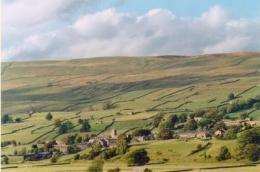
This is a view of Askrigg, Wensleydale. Credit: Yorkshire Dales National Park Authority (YDNPA)
A PhD student at the University of Leeds has developed a fast, accurate and inexpensive method of creating detailed vegetation community maps over very large areas, by coupling aerial photographs with data from maps.
Working in partnership with the Yorkshire Dales National Park Authority, Ute Bradter from Leeds' Faculty of Biological Sciences, has collated existing data (such as soil type, altitude, slope and aspect) and using a sophisticated statistical model, predicted the distribution of plant communities at a high resolution in the Yorkshire Dales, over 1600 km2.
Her results, published today (01 June) in the British Ecological Society's Journal of Applied Ecology showed an accuracy of up to 92 per cent, comparable with the traditional mapping method of on-site surveys conducted by trained ecologists.
Detailed and high resolution vegetation maps noting species distribution are a crucial resource for land management, conservation planning, environmental monitoring and research. But manual mapping is a slow and expensive process, and faster, reliable methods are much needed.
Automatic mapping using aerial or satellite photography has been attempted, but until now, achieving reliable degrees of accuracy has proven difficult.
"What Ute has achieved is remarkable," says her supervisor and co-author Professor Tim Benton. "To put it into perspective, it would take sixteen years of day-in, day-out sampling for one experienced ecologist to replicate this particular mapping exercise by hand."
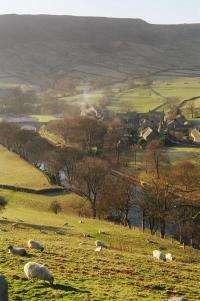
This is a view of Burnsall Fell, Wharfedale. Credit: Yorkshire Dales National Park Authority (YDNPA)
Vegetation in an area is classified into different communities depending on the range of species and their abundance. Communities can be described in detail, for example there are 22 vegetation communities on British heaths alone.The Leeds research combined information and datasets from a range of readily available sources, such as soil maps, standard ordnance survey maps and aerial photography. The predictions were categorised into 24 National Vegetation Classification groups (plus an extra catch-all category of "wood") to a 5m resolution.
"The statistical model is highly accurate because of the diverse range of information we used," says Bradter. "The high resolution aerial photography gave us added colour and texture for example to differentiate wooded areas from other areas - but we incorporated additional physical information into the model, such as topographical measurements of slopes and elevation, and information from different spatial scales."
"Our approach shows that even for relatively complex vegetation classifications it is possible to produce accurate maps over hundreds of square kilometres. We're particularly pleased given that some vegetation communities are difficult to distinguish even using trained field workers," she adds.
If further research confirms that the method performs as well in other environments, such as lowland areas, Bradter is confident that it could be used to accurately assess the conservation value of land in other regions and countries where similar datasets are available.
Co-author and Senior Wildlife Conservation Officer at YDNPA, Dr Tim Thom, says: "This method also has the potential to be used for a wide range of other environmental purposes, such as identifying rare habitat, or where drainage ditches are grown over and so pose a flood risk, or where erosion-risk is high in areas of bare peat. What's most exciting is that if we can map the plants accurately, we can also make a better guess what animals live there too, so we could also remotely monitor biodiversity across the farmed habitat or predict the potential value of setting aside pockets of land for conservation as part of agri-environmental schemes."
Provided by
University of Leeds
-
From lemons to lemonade: Reaction uses carbon dioxide to make carbon-based semiconductor,
32 comments
-
Thioridazine kills cancer stem cells in human while avoiding toxic side-effects of conventional cancer treatments,
3 comments
-
SpaceX private rocket blasts off for space station (Update),
42 comments
-
Climate scientists say they have solved riddle of rising sea,
31 comments
-
SpaceX capsule has 'new car' smell, astronauts say (Update),
2 comments
-
Hypothetical desert earth
12 hours ago
-
More human population = greater mass?
May 25, 2012
-
Conversion from aircraft bearing to normal degrees
May 23, 2012
-
Interpretation/Analysis of the Lab results(HEPA filter)
May 22, 2012
-
Has anyone here attended the The Urbino Summer School in Paleoclimatology?
May 22, 2012
-
Earthquakes: Mag 6 N. Italy and Mag 5.6 W. Bulgaria
May 21, 2012
- More from Physics Forums - Earth
More news stories
Sophisticated simulations predict future warming
The chances of our planet being hit by a global warming of 3 degrees Celsius by 2050 is as likely as it being hit by an increase of 1.4 degrees, new research shows. Presented in the journal Nature Geoscience, the British study ...
Space & Earth / Earth Sciences
May 22, 2012 |
4.4 / 5 (9) |
51
Kyoto Protocol architect 'frustrated' by climate dialogue
UN climate talks are going nowhere, as politicians dither or bicker while the pace of warming dangerously speeds up, one of the architects of the Kyoto Protocol told AFP.
May 23, 2012 |
3.7 / 5 (7) |
39
Aliens don't want to eat us, says former SETI director
Alien life probably isnt interested in having us for dinner, enslaving us or laying eggs in our bellies, according to a recent statement by former SETI director Jill Tarter.
Space & Earth / Space Exploration
May 25, 2012 |
4.4 / 5 (13) |
37
Dragon arrives at space station in historic 1st (Update 2)
The privately bankrolled Dragon capsule made a historic arrival at the International Space Station on Friday, triumphantly captured by astronauts wielding a giant robot arm.
Space & Earth / Space Exploration
May 25, 2012 |
5 / 5 (10) |
19
What's the big deal about private space launches?
(AP) -- The first private spaceship is headed to the International Space Station. Some questions and answers about the cargo mission by Space Exploration Technologies, known as SpaceX:
Space & Earth / Space Exploration
May 22, 2012 |
5 / 5 (6) |
32
Nvidia trumpets Tegra 3 phone design wins for 2012
(Phys.org) -- Nvidias competitive war paint has a name, Tegra 3. On the heels of Nvidia announcements about lowering costs of its Tegra 3 processors and Nvidia-enabled tablets running Android Ice Cream ...
Browser wars flare in mobile space
The browser wars are heating up again, but this time the fight is for dominance of the mobile Internet.
Scientist: Evolution debate will soon be history
(AP) -- Richard Leakey predicts skepticism over evolution will soon be history. Not that the avowed atheist has any doubts himself.
Dell tablet leak: 10.1-inch display, two-battery choice
(Phys.org) -- Headline after headline talks about vendors tablets in the wings as likely number-one contenders for the iPad. Such claims have justifiably been taken with a grain of salt, considering ...
Keep food safety in mind this memorial day weekend
(HealthDay) -- Picnics, parades and cookouts are as much a part of Memorial Day weekend as tributes to the United States' war veterans.
Social welfare cuts ultimately come with heavy price, researchers say
(Phys.org) -- Slashing government funding for Medicaid, food stamps and other programs that serve the poor while politically popular with some lawmakers and many conservatives may do more harm ...
