Sailing the Titan seas
May 06, 2011
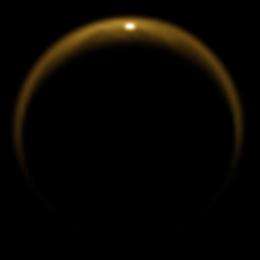
Sunlight reflects off a Titan lake in this image captured by NASA's Cassini spacecraft. The Titan Mare Explorer (TiME), a candidate for NASA's next Discovery-class mission, would perform the first direct inspection of an ocean environment beyond Earth by landing in, and floating on, a large methane-ethane sea on the cloudy, complex moon of Saturn. Image Credit:NASA

(PhysOrg.com) -- The Johns Hopkins University Applied Physics Laboratory (APL) in Laurel, Md., is managing a project to explore the organic seas of Saturn's moon Titan, one of three proposals selected by NASA this week as candidates for the agency's next Discovery Program mission.

The Titan Mare Explorer, or TiME, would perform the first direct inspection of an ocean environment beyond Earth by landing in, and floating on, a large methane-ethane sea on the cloudy, complex moon. The mission would be led by principal investigator Ellen Stofan of Proxemy Research Inc. in Gaithersburg, Md. Lockheed Martin in Denver would build the TiME capsule, with scientific instruments provided by APL, Goddard Space Flight Center in Greenbelt, Md., and Malin Space Science Systems in San Diego.

Also selected were a NASA Jet Propulsion Laboratory lander that would study the Martian interior, and a NASA Goddard project to land on a comet multiple times and observe its interaction with the sun. Chosen from 28 full-mission proposals submitted to NASA last summer, each investigation team now receives $3 million to develop a detailed concept study. After another review of those studies in 2012, NASA will select one to develop for launch. The selected mission will be cost-capped at $425 million, not including funding.

APL also has a role on the NASA Goddard mission team, to provide a high-resolution telescopic camera for the "Comet Hopper" spacecraft.

"NASA's comment on the Discovery selection was, 'if ever there was a time to demonstrate being able to think differently, this is it,'" says John Sommerer, head of APL's Space Department. "It's 'common knowledge' that outer-planets missions are billion-dollar operations, but our team proposed a lander on Titan in the low-cost Discovery mission series. Coming off the success of both the MESSENGER mission to Mercury and the New Horizons mission now on its way to Pluto, it's clear that APL has met the challenge to think differently."

The TiME capsule would launch in 2016 and reach Titan in 2023, parachuting onto the moon's second-largest northern sea, the Ligeia Mare. For 96 days the capsule would study the composition and behavior of the sea and its interaction with Titan's weather and climate. TiME would also seek evidence of the complex organic chemistry that may be active on Titan today, and that may be similar to processes that led to the development of life on the early Earth.

Explore further: NASA head views progress on asteroid lasso mission

add to favorites email to friend print save as pdf

Related Stories

Titan's lakes could be explored by boat

Dec 22, 2009

(PhysOrg.com) -- If a suggestion to be made to NASA comes to fruition, vast lakes thought to be filled with liquid hydrocarbons near the north pole of Saturn's moon Titan, may one day be explored by boat.

NASA selects investigations for future key missions

May 06, 2011

(PhysOrg.com) -- NASA has selected three science investigations from which it will pick one potential 2016 mission to look at Mars' interior for the first time; study an extraterrestrial sea on one of Saturn's ...

NASA Selects Proposals for Future Mars Missions and Studies

Jan 09, 2007

On Monday, NASA selected for concept study development two proposals for future robotic missions to Mars. These missions would increase understanding of Mars' atmosphere, climate and potential habitability in greater detail ...

NASA Stardust Capsule To Go On Display At Smithsonian

Sep 26, 2008

(PhysOrg.com) -- Having returned the world's first particles from a comet, NASA's Stardust sample return capsule will join the collection of flight icons in the Smithsonian's National Air and Space Museum ...

Recommended for you

Dark, massive asteroid to fly by Earth on May 31

6 hours ago

It's 1.7 miles long. Its surface is covered in a sticky black substance similar to the gunk at the bottom of a barbecue. If it impacted Earth it would probably result in global extinction. Good thing it is ...

Research team explains 'Lazarus' comets

9 hours ago

Astronomers from the University of Antioquia have discovered a graveyard of comets. These once-dormant comets, dubbed by astronomers as "The Lazarus comets," are now rejuvenated.

NASA ships sensors for seafaring satellite to France

10 hours ago

(Phys.org) —Three NASA-built instruments that are integral components of the next in a series of U.S./European ocean altimetry satellites have arrived in France for integration with their spacecraft in ...

Trip into space with DiCaprio costs $1.55m

10 hours ago

Leonardo DiCaprio is going to get closer to stars of a different kind as he heads into space aboard the Virgin Galactic, and a well-heeled bidder at the Cannes Film Festival has paid 1.2 million euros (1.5 million) to be ...

User comments : 5

Adjust slider to filter visible comments by rank

Display comments: newest first

that_guy
1 / 5 (1) May 06, 2011
Dear Nasa,

Please allow private citizens to donate funds to projects like this one. This interplanetary boat sounds so cool.

That_guy
GSwift7
2.3 / 5 (3) May 06, 2011
Also selected were a NASA Jet Propulsion Laboratory lander that would study the Martian interior


I think I'm leaning towards this one.
Nydoc
5 / 5 (1) May 06, 2011
TiME was originally envisioned as part of a joint NASA/ESA program called Titan Saturn System Mission and was proposed to be launched in 2020 and arrive in the Saturn system in 2029. This program didn't recieve funding because NASA and ESA decided to spend money on a joint Europa Jupiter System Mission instead. NASA had been considering revisiting the TSSM program at a later date, probably launching in the late 2020s. TSSM was estimated to cost $2.5 billion, so if the Discovery program is able to get the job done on $425 million and ahead of the NASA/ESA schedule it would be very impressive. I hope they select this mission and are successful because I think Titan is the most interesting place in our solar system besides Earth. The raw materials on Titan will be crucial for long-term space occupation and the sooner we get more data on this moon the better.
ACW
not rated yet May 07, 2011
Would also like to see a mission towards Enceladus
GSwift7
1 / 5 (2) May 09, 2011
A lander to look for water at the poles of Luna should be within the Discovery budget price range. Maybe even a sample return. Imagine setting a lander down in a crater then repeating the idea of crashing the booster stage into the crater. Risky but probably very informing if it worked.

More news stories

Galaxies fed by funnels of fuel

(Phys.org) —Computer simulations of galaxies growing over billions of years have revealed a likely scenario for how they feed: a cosmic version of swirly straws.

Dark, massive asteroid to fly by Earth on May 31

It's 1.7 miles long. Its surface is covered in a sticky black substance similar to the gunk at the bottom of a barbecue. If it impacted Earth it would probably result in global extinction. Good thing it is ...

Source of life running out: water scientists

The majority of people on Earth people will face severe water shortages within a generation or two if pollution and waste continues unabated, scientists warned at a conference in Bonn Friday.

Google eyes emerging markets networks

Google has become deeply involved in a series of projects to build and operate wireless networks in emerging markets including sub-Saharan Africa and Southeast Asia, a report said Friday.

Facial-recognition technology proves its mettle

(Phys.org) —In a study that evaluated some of the latest in automatic facial recognition technology, researchers at Michigan State University were able to quickly identify one of the Boston Marathon bombing ...