How to learn a star's true age
May 24, 2011

How to learn a star's true age

Enlarge

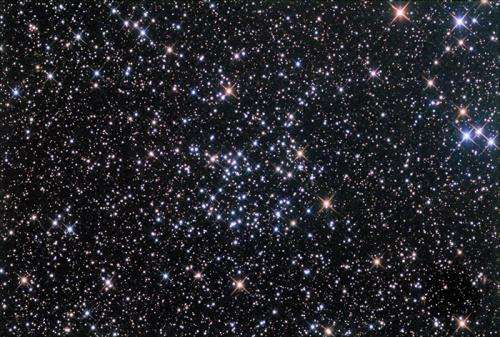
Using the unique capabilities of NASA's Kepler space telescope, Soren Meibom (CfA) and his collaborators measured the rotation rates for stars in a 1-billion-year-old cluster called NGC 6811. They found rotation periods ranging from 1 to 11 days (with hotter, more massive stars spinning faster), compared to the 30-day spin rate of our Sun. More importantly, they found a strong relationship between stellar mass and rotation rate, with little scatter. This result confirms that gyrochronology is a promising new method to learn the ages of isolated stars. Credit: Anthony Ayiomamitis

(PhysOrg.com) -- For many movie stars, their age is a well-kept secret. In space, the same is true of the actual stars. Like our Sun, most stars look almost the same for most of their lives. So how can we tell if a star is one billion or 10 billion years old? Astronomers may have found a solution - measuring the star's spin.

"A star's rotation slows down steadily with time, like a top spinning on a table, and can be used as a clock to determine its age," says astronomer Soren Meibom of the Harvard-Smithsonian Center for Astrophysics.

Meibom presented his findings today in a press conference at the 218th meeting of the American Astronomical Society.

Knowing a star's age is important for many astronomical studies and in particular for . With the bountiful harvest from NASA's Kepler spacecraft (launched in 2009) adding to previous discoveries, astronomers have found nearly 2,000 planets orbiting . Now, they want to use this new zoo of planets to understand how form and evolve and why they are so different from each other.

"Ultimately, we need to know the ages of the and their planets to assess whether might have evolved on these distant worlds," says Meibom. "The older the planet, the more time life has had to get started. Since stars and planets form together at the same time, if we know a star's age, we know the age of its planets too."
How to learn a star's true age
Enlarge

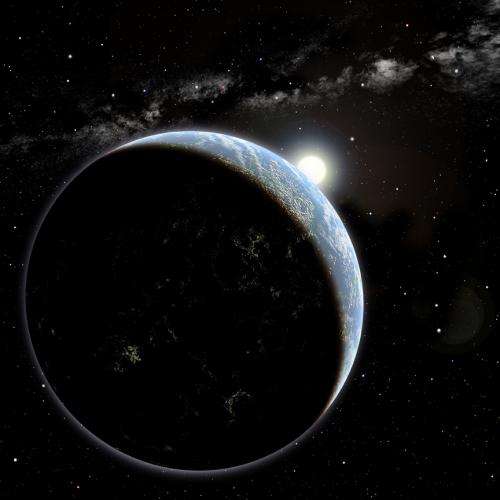
Artist's conception of a hypothetical exoplanet. Gyrochronology is a promising new method to learn the ages of isolated stars, including all stars known to have planets. Credit: David A. Aguilar (CfA)

Learning a star's age is relatively easy when it's in a cluster of hundreds of stars that all formed at the same time. Astronomers have known for decades that if they plot the colors and brightnesses of the stars in a cluster, the pattern they see can be used to tell the cluster's age. But this technique only works on clusters. For stars not in clusters (including all stars known to have planets), determining the age is much more difficult.

Using the unique capabilities of the Kepler , Meibom and his collaborators measured the rotation rates for stars in a 1-billion-year-old cluster called NGC 6811. This new work nearly doubles the age covered by previous studies of younger clusters. It also significantly adds to our knowledge of how a star's spin rate and age are related.

If a relationship between stellar rotation and age can be established by studying stars in clusters, then measuring the rotation period of any star can be used to derive its age - a technique called gyrochronology (pronounced ji-ro-kron-o-lo-gee). For gyrochronology to work, astronomers first must calibrate their new "clock."

They begin with stars in clusters with known ages. By measuring the spins of cluster stars, they can learn what spin rate to expect for that age. Measuring the rotation of stars in clusters with different ages tells them exactly how spin and age are related. Then by extension, they can measure the spin of a single isolated star and calculate its age.

To measure a star's spin, astronomers look for changes in its brightness caused by dark spots on its surface - the stellar equivalent of sunspots. Any time a spot crosses the star's face, it dims slightly. Once the spot rotates out of view, the star's light brightens again. By watching how long it takes for a spot to rotate into view, across the star and out of view again, we learn how fast the star is spinning.

The changes in a star's brightness due to spots are very small, typically a few percent or less, and become smaller the older the star. Therefore, the rotation periods of stars older than about half a billion years can't be measured from the ground where Earth's atmosphere interferes. Fortunately, this is not a problem for the Kepler spacecraft. Kepler was designed specifically to measure stellar brightnesses very precisely in order to detect planets (which block a star's light ever so slightly if they cross the star's face from our point of view).

To extend the age-rotation relationship to NGC 6811, Meibom and his colleagues faced a herculean task. They spent four years painstakingly sorting out stars in the cluster from unrelated stars that just happened to be seen in the same direction. This preparatory work was done using a specially designed instrument (Hectochelle) mounted on the MMT telescope on Mt. Hopkins in southern Arizona. Hectochelle can observe 240 stars at the same time, allowing them to observe nearly 7000 stars over four years. Once they knew which stars were the real cluster stars, they used data to determine how fast those stars were spinning.

They found rotation periods ranging from 1 to 11 days (with hotter, more massive stars spinning faster), compared to the 30-day spin rate of our Sun. More importantly, they found a strong relationship between stellar mass and rotation rate, with little scatter. This result confirms that gyrochronology is a promising new method to learn the ages of isolated stars.

The team now plans to study other, older star clusters to continue calibrating their stellar "clocks." Those measurements will be more challenging because older stars spin slower and have fewer and smaller spots, meaning that the brightness changes will be even smaller and more drawn out. Nevertheless, they feel up to the challenge.

"This work is a leap in our understanding of how stars like our Sun work. It also may have an important impact on our understanding of planets found outside our solar system," said Meibom.

The paper reporting this research has been accepted for publication in The Astrophysical Journal Letters and is posted online.

Provided by Harvard-Smithsonian Center for Astrophysics search and more info website

Filter


Move the slider to adjust rank threshold, so that you can hide some of the comments.


Display comments: newest first

that_guy
May 24, 2011

Rank: 5 / 5 (1)
I think this is a good technique for rough estimates, and of course, another victory for the awesomely useful kepler telescope. But i don't think we should take this method too seriously, because there are some major assumptions on the speed and consistency of spin down (planets, passing objects can affect the spin down rate).
EWH
May 24, 2011

Rank: 5 / 5 (3)
I wonder if the spectral line spreading could provide a measure of spin? The edge spinning toward us should have a slightly greater frequency than that moving away from us. It would require very high resolution spectroscopy but in principle it should work.
ThatOneGuy
May 25, 2011

Rank: 5 / 5 (1)
I wonder if the spectral line spreading could provide a measure of spin? The edge spinning toward us should have a slightly greater frequency than that moving away from us. It would require very high resolution spectroscopy but in principle it should work.

It does work. That's exactly how we determine spin rates of stars. And really, it doesn't require ultra-high precision. Sure the KST is brand new and is decked out in the latest and greatest, but we've been doing it for years here on the ground and with the HST.
LKD
May 25, 2011

Rank: not rated yet
"They found rotation periods ranging from 1 to 11 days (with hotter, more massive stars spinning faster), compared to the 30-day spin rate of our Sun."

Is this because the stars they could measure needed to be bigger then our own sun, as exoplanets need to be Jupiter sized to detect? It strikes me that our sun is at least 3 times slower then the ones in the stellar cluster, yet our sun is larger than most stars.

Could someone enlighten me?
that_guy
May 25, 2011

Rank: not rated yet
They used a ~1 billion year old cluster for this study, so basically the difference is explained by the difference in age - the sun has had longer to slow down, as it is 5 or 6 bln years old.
LKD
May 25, 2011

Rank: not rated yet
Thank you. If they gave a rough approximation about the effect I might have seen the obvious. But I get dense at times. :)
that_guy
May 25, 2011

Rank: not rated yet
@thatOneguy

I despise your name. It's plagarism and blasphemy.
Rank 5 /5 (3 votes)
Relevant PhysicsForums posts
  • revamping general concept and cosmological principle
    createdMay 25, 2012
  • Transiting Exoplanet Light Curve
    createdMay 25, 2012
  • Math behind Theoretical Physics
    createdMay 24, 2012
  • Do we know whats at the center of galaxies yet?
    createdMay 23, 2012
  • Structure of the Milky Way?
    createdMay 20, 2012
  • What would it take to terraform Pluto and Charon?
    createdMay 19, 2012
  • More from Physics Forums - General Astronomy

More news stories

SpaceX capsule has 'new car' smell, astronauts say (Update)

SpaceX's Dragon cargo vessel smells like a new car, said astronauts at the International Space Station after opening the hatches Saturday following the spacecraft's landmark mission to the orbiting lab.

Space & Earth / Space Exploration

created 22 hours ago | popularity 4.5 / 5 (20) | comments 2

Australia hails surprise super-telescope decision

Australia has hailed a surprise decision giving it a role in a radio telescope project aimed at revolutionising astronomy, vowing to draw on its decades of experience in space science.

Space & Earth / Astronomy

created 22 hours ago | popularity 5 / 5 (4) | comments 2

Astronomers seize last chance in lifetime for Venus Transit

Astronomers are gearing for one the rarest events in the Solar System: an alignment of Earth, Venus and the Sun that will not be seen for another 105 years.

Space & Earth / Astronomy

created 22 hours ago | popularity 5 / 5 (3) | comments 2

Astronauts enter world's 1st private supply ship

(AP) -- Space station astronauts floated into the Dragon on Saturday, a day after its heralded arrival as the world's first commercial supply ship.

Space & Earth / Space Exploration

created 22 hours ago | popularity 5 / 5 (6) | comments 0

Sophisticated simulations predict future warming

The chances of our planet being hit by a global warming of 3 degrees Celsius by 2050 is as likely as it being hit by an increase of 1.4 degrees, new research shows. Presented in the journal Nature Geoscience, the British study ...

Space & Earth / Earth Sciences

created May 22, 2012 | popularity 4.4 / 5 (9) | comments 51


Browser wars flare in mobile space

The browser wars are heating up again, but this time the fight is for dominance of the mobile Internet.

Nvidia trumpets Tegra 3 phone design wins for 2012

(Phys.org) -- Nvidia’s competitive war paint has a name, Tegra 3. On the heels of Nvidia announcements about lowering costs of its Tegra 3 processors and Nvidia-enabled tablets running Android Ice Cream ...

Scientist: Evolution debate will soon be history

(AP) -- Richard Leakey predicts skepticism over evolution will soon be history. Not that the avowed atheist has any doubts himself.

Dell tablet leak: 10.1-inch display, two-battery choice

(Phys.org) -- Headline after headline talks about vendors’ tablets in the wings as likely number-one contenders for the iPad. Such claims have justifiably been taken with a grain of salt, considering ...

SpotterRF debuts Radar Backpack Kit (w/ Video)

(Phys.org) -- SpotterRF has announced a special radar backpack kit designed to enhance situational awareness for soldiers on the ground. The company says its special radar is designed for warfighters as part ...

Thousands of shellfish found dead in Peru

Thousands of crustaceans were found dead off the coast of Lima following the mystery mass death of dolphins and pelicans, the Peruvian Navy said Friday.