'Sighted' wheelchair tested
May 17, 2011

'Sighted' wheelchair tested

Enlarge

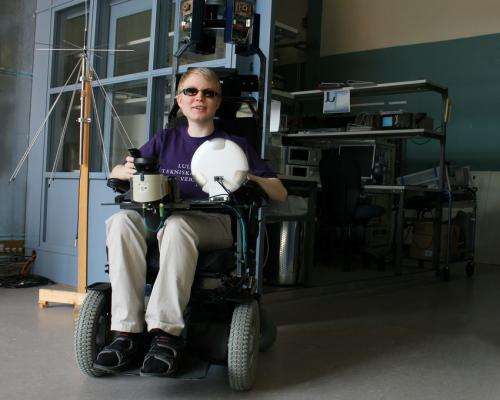
Daniel Innala Ahlmark

Research on an electric wheelchair that can sense it's environment and transmit information to a person who is visually impaired, has been tested at Lulea University of Technology, Sweden. Daniel Innala Ahlmark, a prospective graduate student in the research project, and himself visually impaired, dared to make the first public test.

The has a for steering and a haptic robot that acts as a virtual white cane. With the help of a laser scanner a simplified 3D map is created of the wheelchair surroundings. The laser scanner uses Time-of-flight technique. The 3D map is transferred to the haptic robot so that a visually impaired wheelchair driver can "feel or see" obstacles such as open doors or oncoming people, and navigate past them.

The “sighted” wheelchair has been developed by Kalevi Hyyppa, a professor at Lulea University of Technology and his research team at the LTU division EISLAB. The other members of the research team are prospective Ph.D. student Daniel Innala Ahlmark, assistant professor Hakan Fredriksson and Ph.D. student Fredrik Broström.

"This may be important aids for the visually impaired who are wheelchair users. Many have already been in touch with me and asked if they can come for a test drive," says Kalevi Hyyppa.

The first test of the “sighted” wheelchair for an audience was carried out in one of the corridors of the Department of Computer Science, Electrical- and Space Engineering at Luleå University of Technology. 

There are several classrooms in the corridor, which means that students often pass there. For those who are visually impaired or blind, it is quite a changing environment to move in. Daniel Innala Ahlmark, who is , dared to test the wheelchair while explaining how he experienced it - and he did so before the entire local and even national media in Sweden.

"I feel safe when I run it, it is like using a white cane," he said as he avoided various obstacles along the corridor.

There is much left when it comes to improving the 3D sensor and the haptic . The laser beam that sweeps in front of the wheelchair hits only objects which are a certain height. It has not the capacity to see things that are higher or lower than that height. Now the research team plan to develop a 3D camera that can do a full 3D measurement. Then the sighted wheelchair can be manufactured and used for real. This might be possible in approximately five years.

Provided by Lulea University of Technology


Rank not rated yet
Relevant PhysicsForums posts

More news stories

Browser wars flare in mobile space

The browser wars are heating up again, but this time the fight is for dominance of the mobile Internet.

Technology / Software

created 32 minutes ago | popularity not rated yet | comments 0

SpotterRF debuts Radar Backpack Kit (w/ Video)

(Phys.org) -- SpotterRF has announced a special radar backpack kit designed to enhance situational awareness for soldiers on the ground. The company says its special radar is designed for warfighters as part ...

Technology / Hi Tech & Innovation

created 21 hours ago | popularity 5 / 5 (5) | comments 12 | with audio podcast report

Computers excel at identifying smiles of frustration (w/ Video)

(Phys.org) -- Researchers at the Massachusetts Institute of Technology (MIT) in the US have trained computers to recognize smiles, and they have turned out to be more adept at recognizing smiles of frustration ...

Technology / Computer Sciences

created May 25, 2012 | popularity 4.3 / 5 (3) | comments 1 | with audio podcast report

HyperSolar shows dirty water no barrier to power world

(Phys.org) -- The Santa Barbara, California, company, HyperSolar, is set to transparently share the ups and downs of its research experiences toward the company’s ultimate vision, successfully producing ...

Technology / Energy & Green Tech

created May 24, 2012 | popularity 4.8 / 5 (15) | comments 17 | with audio podcast report

New inexpensive, environmentally friendly solar cell shines with potential

(Phys.org) -- The limitations of conventional and current solar cells include high production cost, low operating efficiency and durability, and many cells rely on toxic and scarce materials. Northwestern University researchers ...

Technology / Energy & Green Tech

created May 23, 2012 | popularity 4.8 / 5 (12) | comments 4 | with audio podcast


Nvidia trumpets Tegra 3 phone design wins for 2012

(Phys.org) -- Nvidia’s competitive war paint has a name, Tegra 3. On the heels of Nvidia announcements about lowering costs of its Tegra 3 processors and Nvidia-enabled tablets running Android Ice Cream ...

Dell tablet leak: 10.1-inch display, two-battery choice

(Phys.org) -- Headline after headline talks about vendors’ tablets in the wings as likely number-one contenders for the iPad. Such claims have justifiably been taken with a grain of salt, considering ...

Scientist: Evolution debate will soon be history

(AP) -- Richard Leakey predicts skepticism over evolution will soon be history. Not that the avowed atheist has any doubts himself.

SpaceX capsule has 'new car' smell, astronauts say (Update)

SpaceX's Dragon cargo vessel smells like a new car, said astronauts at the International Space Station after opening the hatches Saturday following the spacecraft's landmark mission to the orbiting lab.

Of mice and mental models: Neuroscientific implications of risk-optimized behavior in the mouse

(Medical Xpress) -- Regardless of an organism’s biological complexity, every encephalized animal continuously makes under-informed behavioral choices that can have serious consequences. Despite its ubiquity, ...

Is a classical electrodynamics law incompatible with special relativity?

(Phys.org) -- The laws of classical electromagnetism that were developed in the 19th century are the same laws that scientists use today. They include Maxwell’s four equations along with the Lorentz la ...