Satellites discover lost Egyptian pyramids
May 26, 2011 by Deborah Braconnier
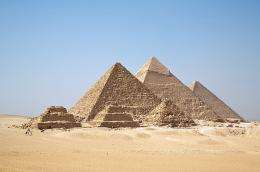
A view of the pyramids at Giza from the plateau to the south of the complex. Image: Ricardo Liberato/Wikipedia
(PhysOrg.com) -- In a new documentary soon to air on BBC, space archaeologist Sarah Parcak from the University of Alabama in Birmingham shares her recent discovery in the relatively new field of space archaeology. With the use of satellites and infra-red imaging, Parcak and her team have discovered 17 lost pyramids, over 1,000 tombs and 3,000 ancient settlements in Egypt.
Using NASA satellites orbiting 435 miles above Earth that were equipped with cameras capable of pinpointing objects less than three feet in diameter on the Earths surface, Parcak and her team were able to identify materials that where just under the Earths surface.
Because ancient Egyptians built their homes and structures, including pyramids, out of mud brick, it is much denser than the sand that has covered it over time. The infra-red camera was able to highlight these areas and locate the structures.
In the area of Saqqara, Parcak had identified what she thought to be two potential pyramids. The documentary covers her journey to this area where local archaeologists began test excavations to test her findings. The pyramids were discovered and it is now believed to be one of the most important finds in Egypt.
Parcak visited another location in Tanis where here imagery had located a 3,000-year-old house. Excavation revealed the house and the measurements almost perfectly matched what was shown in the images.
The findings of actual sites gave validation to Parcak and her technology and she hopes to use it to locate many more sites in the future. Egyptian authorities hope to use the technology to aid in the protection of their national antiquities. With the recent revolution, looting has become a problem and the ability to compare images through time will allow them to alert Interpol to be on the watch for particular antiquities that could be out on the market for sale.
More information: BBC
© 2010 PhysOrg.com
-
From lemons to lemonade: Reaction uses carbon dioxide to make carbon-based semiconductor,
32 comments
-
Thioridazine kills cancer stem cells in human while avoiding toxic side-effects of conventional cancer treatments,
3 comments
-
SpaceX private rocket blasts off for space station (Update),
42 comments
-
Climate scientists say they have solved riddle of rising sea,
31 comments
-
Research team claims to have found evidence Lake Cheko is impact crater for Tunguska Event,
18 comments
-
What would stain as translucent on light-coloured fabric?
12 hours ago
-
How do I identify different bacteria on culture plates?
22 hours ago
-
Why Do Dogs do Strange things...
May 25, 2012
-
What does exophillic and endophillic mean in terms of mosquito and their control?
May 24, 2012
-
Semen stains glows under black lights (uv light)?
May 23, 2012
-
Question on Human Chromosome 2
May 23, 2012
- More from Physics Forums - Biology
More news stories
Math predicts size of clot-forming cells
UC Davis mathematicians have helped biologists figure out why platelets, the cells that form blood clots, are the size and shape that they are. Because platelets are important both for healing wounds and in strokes and other ...
May 25, 2012 |
not rated yet |
0
|
Dinosaur with tiny arms unearthed in Argentina
Argentine experts have discovered the near-complete remains of a new species of Jurassic-era dinosaur that stood on its rear legs and had tiny arms, according to a leading paleontologist.
Other Sciences / Archaeology & Fossils
May 25, 2012 |
5 / 5 (2) |
0
Relatively speaking: Researchers identify principles that shape kinship categories across languages
Different languages refer to family relationships in different ways. For example, English speakers use two terms grandmother and grandfather to refer to grandparents, while Mandarin Chinese uses four terms. ...
Other Sciences / Social Sciences
May 24, 2012 |
4 / 5 (5) |
0
|
Oldest Jewish archaeological evidence on the Iberian Peninsula
German archaeologists of the Friedrich Schiller University Jena found one of the oldest archaeological evidence so far of Jewish Culture on the Iberian Peninsula at an excavation site in the south of Portugal, ...
Other Sciences / Archaeology & Fossils
May 25, 2012 |
4.3 / 5 (4) |
12
Earliest musical instruments in Europe 40,000 years ago
The first modern humans in Europe were playing musical instruments and showing artistic creativity as early as 40,000 years ago, according to new research from Oxford and Tübingen universities.
Other Sciences / Archaeology & Fossils
May 25, 2012 |
5 / 5 (3) |
1
Nvidia trumpets Tegra 3 phone design wins for 2012
(Phys.org) -- Nvidias competitive war paint has a name, Tegra 3. On the heels of Nvidia announcements about lowering costs of its Tegra 3 processors and Nvidia-enabled tablets running Android Ice Cream ...
Browser wars flare in mobile space
The browser wars are heating up again, but this time the fight is for dominance of the mobile Internet.
Dell tablet leak: 10.1-inch display, two-battery choice
(Phys.org) -- Headline after headline talks about vendors tablets in the wings as likely number-one contenders for the iPad. Such claims have justifiably been taken with a grain of salt, considering ...
Scientist: Evolution debate will soon be history
(AP) -- Richard Leakey predicts skepticism over evolution will soon be history. Not that the avowed atheist has any doubts himself.
SpaceX capsule has 'new car' smell, astronauts say (Update)
SpaceX's Dragon cargo vessel smells like a new car, said astronauts at the International Space Station after opening the hatches Saturday following the spacecraft's landmark mission to the orbiting lab.
Of mice and mental models: Neuroscientific implications of risk-optimized behavior in the mouse
(Medical Xpress) -- Regardless of an organism’s biological complexity, every encephalized animal continuously makes under-informed behavioral choices that can have serious consequences. Despite its ubiquity, ...
May 26, 2011
Rank: 5 / 5 (5)
May 26, 2011
Rank: 4.5 / 5 (2)
And thanks to this article, I've found a new favorite job title:
Space Archaeologist!
May 26, 2011
Rank: 3 / 5 (1)
May 26, 2011
Rank: 5 / 5 (2)
May 26, 2011
Rank: 4.5 / 5 (2)
I have to wonder if their study covered this area or just focused on areas further north?
Enjoy your favorite mapping program!
May 26, 2011
Rank: 1 / 5 (2)
May 26, 2011
Rank: 1 / 5 (6)
May 27, 2011
Rank: 1 / 5 (3)
@koondoo there is no secret , thruth is taken as a joke.
May 27, 2011
Rank: 1 / 5 (3)
May 27, 2011
Rank: 5 / 5 (3)
May 30, 2011
Rank: 5 / 5 (1)
The process turned up literally thousands of 'lost' sites, and should keep archaeologists busy for the rest of the century...
===
"...used to discover atlantis..."
Huh ? I thought Santorini / Thera had scooped the pot ??