Rugged nano computer for industrial applications
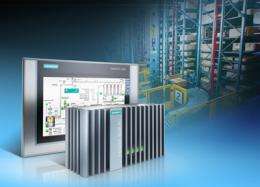
A particularly compact design and the Atom processors of the power-optimized E6xx series from Intel are the key features of the new Simatic IPC227D Nanobox PCs and the Simatic HMI IPC277D Nanopanel PCs from the Siemens Industry Automation Division. The devices belong to a new product line of particularly compact and energy-saving industrial PCs in the nano-format.
Siemens has launched an industrial computer about the size of a one-quart container: the Simatic IPC227D Nanobox PC.
Because the tiny device takes up less space than previous systems, industrial control cabinets can be made smaller, which cuts costs. Industrial PCs are used on production lines to process image data for quality assurance purposes, for example, or to control display and operating panels. In recognition of its innovative design, the Simatic IPC227D Nanobox PC has received the renowned iF product design award.
Siemens is one of the leading manufacturers of industrial computers in Europe. The companys plant in Karlsruhe develops and manufactures all of the computer parts on its own from the motherboard to the housing. These computers are used in industrial facilities, for building management, and in transportation systems. The devices frequently collect and process measurement data from a variety of sensors. Many of the computers are located directly in machines, where they are not protected by control cabinets. The devices nevertheless have to operate reliably, despite having to contend with vibrations, mechanical shocks, high temperatures, or strong stray electrical fields. This is why Siemens tests each PC for 36 hours at 40 degrees Celsius a temperature the systems often encounter in practice. The components used for the computers are very robust and available for delivery over a period of many years.
The nano-format PC uses new, high-performance Atom processors from Intel. These processors consume little energy and generate almost no heat, which is why the computer doesnt need a fan and can be installed practically anywhere. In its basic configuration, the computer measures only 19 x 10 x 6 centimeters and is completely maintenance-free. Instead of a hard disk, it has temperature-resistant CompactFlash cards with up to eight gigabytes of capacity or solid-state drives (SSDs) of at least 50 gigabytes. Whats more, the BIOS setup data is magnetically stored so that no batteries are needed as a safeguard.
The compact computer is also available for display and operating systems. Known as the Simatic HMI IPC277D Nanopanel PC, this version is embedded with 7-inch, 9-inch, or 12-inch high-resolution industrial touch displays. The displays consume very little power, thanks to LED backlighting that can be dimmed by up to 100 percent.
Source: Siemens
-
From lemons to lemonade: Reaction uses carbon dioxide to make carbon-based semiconductor,
32 comments
-
Thioridazine kills cancer stem cells in human while avoiding toxic side-effects of conventional cancer treatments,
3 comments
-
SpaceX private rocket blasts off for space station (Update),
42 comments
-
Climate scientists say they have solved riddle of rising sea,
31 comments
-
Research team claims to have found evidence Lake Cheko is impact crater for Tunguska Event,
18 comments
-
Need a rigid insulation material???
8 hours ago
-
magnets or EMF in car bumpers to protect from fender bender
May 26, 2012
-
length of wire in a coil of known dimensions?
May 25, 2012
-
India Engineering Powerhouse
May 25, 2012
-
electromagnet core dereference between hard and soft iron
May 25, 2012
-
Measuring water pressure in an open tank
May 24, 2012
- More from Physics Forums - General Engineering
More news stories
Nvidia trumpets Tegra 3 phone design wins for 2012
(Phys.org) -- Nvidias competitive war paint has a name, Tegra 3. On the heels of Nvidia announcements about lowering costs of its Tegra 3 processors and Nvidia-enabled tablets running Android Ice Cream ...
Dell tablet leak: 10.1-inch display, two-battery choice
(Phys.org) -- Headline after headline talks about vendors tablets in the wings as likely number-one contenders for the iPad. Such claims have justifiably been taken with a grain of salt, considering ...
Nvidia says Kai platform will turn price tide for tablets
(Phys.org) -- In March, Nvidia gave some signs that they were working to lower the cost of their Tegra 3 processors and they suggested consumers might see prices for Android tablets as low as $199. Connect ...
OmniVision tops up sensors for cameras, phones
(Phys.org) -- OmniVision has announced two high-resolution image sensors for the digital still and digital video camera market (DS/DVC) and higher end smartphones. In end-user language, it is a claim for superior ...
MIT researchers devise new means to synchronize a group of robots (w/ Video)
(Phys.org) -- For several years, roboticists have been working out ways to get a group of robots to perform synchronized activities as demonstrated most often in dance routines. Its not just about trying ...
Browser wars flare in mobile space
The browser wars are heating up again, but this time the fight is for dominance of the mobile Internet.
Scientist: Evolution debate will soon be history
(AP) -- Richard Leakey predicts skepticism over evolution will soon be history. Not that the avowed atheist has any doubts himself.
SpotterRF debuts Radar Backpack Kit (w/ Video)
(Phys.org) -- SpotterRF has announced a special radar backpack kit designed to enhance situational awareness for soldiers on the ground. The company says its special radar is designed for warfighters as part ...
SpaceX capsule has 'new car' smell, astronauts say (Update)
SpaceX's Dragon cargo vessel smells like a new car, said astronauts at the International Space Station after opening the hatches Saturday following the spacecraft's landmark mission to the orbiting lab.
Thousands of shellfish found dead in Peru
Thousands of crustaceans were found dead off the coast of Lima following the mystery mass death of dolphins and pelicans, the Peruvian Navy said Friday.
Australia hails surprise super-telescope decision
Australia has hailed a surprise decision giving it a role in a radio telescope project aimed at revolutionising astronomy, vowing to draw on its decades of experience in space science.
May 20, 2011
Rank: not rated yet
You can turn off the backlight.