Reindeer see a weird and wonderful world of ultraviolet light
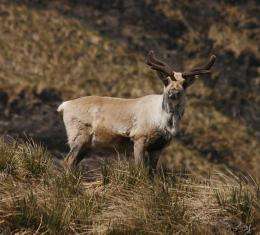
A wild reindeer with velvet covered antlers. Part of the southern herd on the island of South Georgia in the South Atlantic. Image: Wikipedia
Researchers have discovered that the ultraviolet (UV) light that causes the temporary but painful condition of snow blindness in humans is life-saving for reindeer in the arctic.
A BBSRC-funded team at UCL has published a paper today (12 May) in the Journal of Experimental Biology that shows that this remarkable visual ability is part of the reindeer's unique adaptation to the extreme arctic environment where they live. It allows them to take in live-saving information in conditions where normal mammalian vision would make them vulnerable to starvation, predators and territorial conflict. It also raises the question of how reindeer protect their eyes from being damaged by UV, which is thought to be harmful to human vision.
Lead researcher Professor Glen Jeffery said "We discovered that reindeer can not only see ultraviolet light but they can also make sense of the image to find food and stay safe. Humans and almost all other mammals could never do this as our lenses just don't let UV through into the eye.
"In conditions where there is a lot of UV when surrounded by snow, for example it can be damaging to our eyes. In the process of blocking UV light from reaching the retina, our cornea and lens absorb its damaging energy and can be temporarily burned. The front of the eye becomes cloudy and so we call this snow blindness. Although this is normally reversible and plays a vital role to protect our sensitive retinas from potential damage, it is very painful."
Human beings are able to see light with wavelengths ranging from around 700nm, which corresponds to the colour red, right through all the colours of the rainbow in sequence to 400nm, which corresponds to violet. Professor Jeffery and his team tested the reindeer's vision to see what wavelengths they could see and found that they can handle wavelengths down to around 350-320nm, which is termed ultraviolet, or UV, because it exceeds the extreme of the so-called visible spectrum of colours.
The winter conditions in the arctic are very severe; the ground is covered in snow and the sun is very low on the horizon. At times the sun barely rises in the middle of the day, making it dark for most of the time. Under these conditions light is scattered such that the majority of light that reaches objects is blue or UV. In addition to this, snow can reflect up to 90% of the UV light that falls on it.
Professor Jeffery continued "When we used cameras that could pick up UV, we noticed that there are some very important things that absorb UV light and therefore appear black, contrasting strongly with the snow. This includes urine - a sign of predators or competitors; lichens - a major food source in winter; and fur, making predators such as wolves very easy to see despite being camouflaged to other animals that can't see UV."
This research raises some interesting questions about the effect of UV on eye health. It had always been assumed that human eyes don't let UV in because of the potential that it will cause damage, just as it does to our skin. In our eyes, UV could damage our sensitive photoreceptors that cannot be replaced. This would lead to irreversible damage to our vision. Arctic reindeer are able to let UV into their eyes and use the information effectively in their environment without suffering any consequences.
Professor Jeffery added "The question remains as to why the reindeer's eyes don't seem to be damaged by UV. Perhaps it's not as bad for eyes as we first thought? Or maybe they have a unique way of protecting themselves, which we could learn from and perhaps develop new strategies to prevent or treat the damage the UV can cause to humans."
Professor Douglas Kell, Chief Executive, BBSRC said "We can learn a lot from studying the fundamental biology of animals and other organisms that live in extreme environments. Understanding their cell and molecular biology, neuroscience, and other aspects of how they work can uncover the biological mechanism that meant they can cope with severe conditions. This knowledge can have an impact on animal welfare and has the potential to be taken forward to new developments that underpin human health and wellbeing."
Provided by
Biotechnology and Biological Sciences Research Council
-
From lemons to lemonade: Reaction uses carbon dioxide to make carbon-based semiconductor,
32 comments
-
Thioridazine kills cancer stem cells in human while avoiding toxic side-effects of conventional cancer treatments,
3 comments
-
SpaceX private rocket blasts off for space station (Update),
42 comments
-
Climate scientists say they have solved riddle of rising sea,
31 comments
-
Research team claims to have found evidence Lake Cheko is impact crater for Tunguska Event,
18 comments
-
What would stain as translucent on light-coloured fabric?
12 hours ago
-
How do I identify different bacteria on culture plates?
22 hours ago
-
Why Do Dogs do Strange things...
May 25, 2012
-
What does exophillic and endophillic mean in terms of mosquito and their control?
May 24, 2012
-
Semen stains glows under black lights (uv light)?
May 23, 2012
-
Question on Human Chromosome 2
May 23, 2012
- More from Physics Forums - Biology
More news stories
Scientist: Evolution debate will soon be history
(AP) -- Richard Leakey predicts skepticism over evolution will soon be history. Not that the avowed atheist has any doubts himself.
11 hours ago |
3.5 / 5 (11) |
29
It's in the genes: Research pinpoints how plants know when to flower
Scientists believe they've pinpointed the last crucial piece of the 80-year-old puzzle of how plants "know" when to flower.
May 25, 2012 |
3.9 / 5 (9) |
1
|
Researchers solve structure of human protein critical for silencing genes
In a study published in the journal Cell on May 24, Cold Spring Harbor Laboratory (CSHL) scientists describe the three-dimensional atomic structure of a human protein bound to a piece of RNA that "guides" the pr ...
May 25, 2012 |
4.7 / 5 (7) |
0
|
Thousands of shellfish found dead in Peru
Thousands of crustaceans were found dead off the coast of Lima following the mystery mass death of dolphins and pelicans, the Peruvian Navy said Friday.
21 hours ago |
4.8 / 5 (4) |
6
Copy of the genetic makeup travels in a protein suitcase
Scientists from the Institute for Physical and Theoretical Chemistry at the University of Bonn have succeeded for the first time in the real time filming of the transport of an important information carrier in biological ...
May 25, 2012 |
not rated yet |
0
|
Nvidia trumpets Tegra 3 phone design wins for 2012
(Phys.org) -- Nvidias competitive war paint has a name, Tegra 3. On the heels of Nvidia announcements about lowering costs of its Tegra 3 processors and Nvidia-enabled tablets running Android Ice Cream ...
Browser wars flare in mobile space
The browser wars are heating up again, but this time the fight is for dominance of the mobile Internet.
Dell tablet leak: 10.1-inch display, two-battery choice
(Phys.org) -- Headline after headline talks about vendors tablets in the wings as likely number-one contenders for the iPad. Such claims have justifiably been taken with a grain of salt, considering ...
SpaceX capsule has 'new car' smell, astronauts say (Update)
SpaceX's Dragon cargo vessel smells like a new car, said astronauts at the International Space Station after opening the hatches Saturday following the spacecraft's landmark mission to the orbiting lab.
Of mice and mental models: Neuroscientific implications of risk-optimized behavior in the mouse
(Medical Xpress) -- Regardless of an organism’s biological complexity, every encephalized animal continuously makes under-informed behavioral choices that can have serious consequences. Despite its ubiquity, ...
SpotterRF debuts Radar Backpack Kit (w/ Video)
(Phys.org) -- SpotterRF has announced a special radar backpack kit designed to enhance situational awareness for soldiers on the ground. The company says its special radar is designed for warfighters as part ...
May 26, 2011
Rank: not rated yet
People living in northern countries have more occurrence of non-brown eyes, ie blue or green or gray. Are they more adapted to these snow covered conditions?
May 27, 2011
Rank: not rated yet
May 27, 2011
Rank: 5 / 5 (1)
Filters that pass UV but block visible light are available (& you should be able to find mounted filters that fit your camera)*. Ex: http://www.maxmax...rder.asp
*note that you may need to add an IR blocking filter[ http://www.maxmax...ters.htm ] to the stack to produce UV-only images.
May 28, 2011
Rank: not rated yet
Blue eyes were a random mutation that was selected for 10,000 years ago near the Black Sea. It's a coincidence that the ancestors of those tribes moved North. The Inuit all have brown eyes.