Swimming led to flying, physicists say
May 3, 2011 By Anne Ju

Swimming led to flying, physicists say

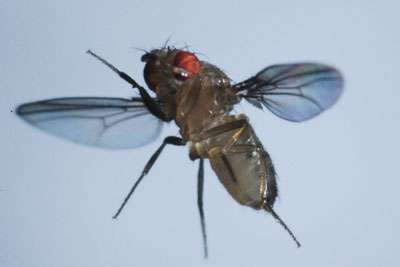
A fruit fly in mid flight.

(PhysOrg.com) -- Like a fish paddles its pectoral fins to swim through water, flying insects use the same physics laws to "paddle" through the air, say Cornell physicists.

Using high-speed videography and a precision algorithm for 3-D motion tracking, Cornell researchers have demonstrated that swimmers and flyers share similar force generation methods to propel themselves through water or air. This finding goes against conventional theories that the "paddling" motion common to swimmers, which use drag forces to propel forward, only occurs in water.

and other flyers also use drag to "swim" through the air, the scientists say. Their discovery lends support to the evolutionary theory that flight in insects emerged from swimming.

Led by Itai Cohen, Cornell assistant professor of physics, the research was published online April 26 by . The experiments were performed by first author and former graduate student Leif Ristroph; other collaborators were former graduate student Attila Bergou; Cornell professor of mathematics John Guckenheimer; and Cornell professor of mechanical and aerospace engineering Jane Wang.

Flight, as explained in any physics textbook, is made possible by lift forces. Man-made aircraft use lift forces to create thrust. In helicopters, for example, the blades are tilted to redirect the lift force in the forward direction. In jetliners, the in the engines use the same principle to generate a propulsive force.

When a fish swims, it uses its back fins to create propulsive lift forces. However, it also uses paddling pectoral fins to create drag to propel forward. This combination of lift and drag are characteristic of evolved swimmers. Insects, it was always thought, rely exclusively on lift and redirected lift to make in-air -- such as when a fruit fly dodges a swatter. The Cornell researchers say they also use drag.
Swimming led to flying, physicists say

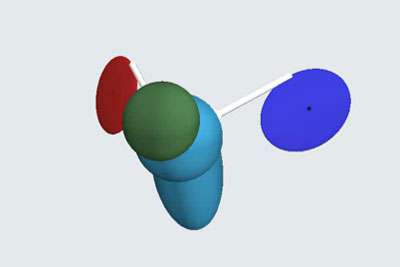
Researchers used computers to simulate a fruit fly's in-air maneuvers to demonstrate the theory that swimming led to flying.

In the transition from swimming to flying, "it was previously thought that several evolutionary hurdles would need to be overcome," Cohen said. "Our findings suggest that some of these intermediary steps would not be needed to make the leap from swimming to flying."

Ristroph and collaborators used a 3-D motion capture setup and a computer program that simulates insect flight to compare experimental data with computer simulations for forward flight in insects. By breaking up the experimentally determined wing motions into different components and simulating each component's effect on forward thrust generation, they were able to determine that the most important aspect of the wing motion was the angle with which the wings slice through the air.

By having a small angle of attack during the forward stroke and a large angle of attack during the backward portion of the stroke, the flies created a forward-propulsive force by literally paddling through the air. As the insect speeds up, an additional drag force due to the oncoming air balances the wing-generated thrust and sets the "terminal forward velocity" of the insect.

A key finding of the research is that because both the propulsive force and the force due to the oncoming air arise from drag, the control law for setting the final forward velocity is independent of the properties of the medium -- say the density of air or water. To fly faster, the animal need only adjust the difference in angle of attack between the forward and backward strokes.

This video is not supported by your browser at this time.

2009 video

That's why these laws should hold up on, say, the surface of Mars, Cohen says. He imagines robotic flyers exploring the planet's surface, for example, whose physics of in-plane maneuvering would be the same as on Earth (though the lift force would need to be substantially different on Mars).

In fact, a company in California called Aerovironment is developing prototypes of hovering robotic flyers that make use of the physics principles demonstrated in Cohen's papers. "This is no longer science fiction," Cohen said. "At the moment these flying robots are large, but imagine a future where they can be made as small as a fly."

More information: Paddling Mode of Forward Flight in Insects, Phys. Rev. Lett. 106, 178103 (2011), http://prl.aps.org … /i17/e178103

Abstract
By analyzing high-speed video of the fruit fly, we discover a swimminglike mode of forward flight characterized by paddling wing motions. We develop a new aerodynamic analysis procedure to show that these insects generate drag-based thrust by slicing their wings forward at low angle of attack and pushing backwards at a higher angle. Reduced-order models and simulations reveal that the law for flight speed is determined by these wing motions but is insensitive to material properties of the fluid. Thus, paddling is as effective in air as in water and represents a common strategy for propulsion through aquatic and aerial environments.

Provided by Cornell University search and more info website

Filter


Move the slider to adjust rank threshold, so that you can hide some of the comments.


Display comments: newest first

axemaster
May 03, 2011

Rank: 1 / 5 (1)
"This is no longer science fiction," Cohen said. "At the moment these flying robots are large, but imagine a future where they can be made as small as a fly."


I'd rather not imagine it. The potential for misuse of such devices vastly exceeds any benefits. I mean seriously, they'll be used to spy on people, assassination, pornography, you name it. No way should they be made, ever.

I mean, every time you hear a fly buzzing around, you'll have to wonder if it's someone else watching you. Horrible. People won't be able to feel safe in their own homes.
Objectivist
May 03, 2011

Rank: 3.5 / 5 (2)
I'd rather not imagine it. The potential for misuse of such devices vastly exceeds any benefits. I mean seriously, they'll be used to spy on people, assassination, pornography, you name it. No way should they be made, ever.

I mean, every time you hear a fly buzzing around, you'll have to wonder if it's someone else watching you. Horrible. People won't be able to feel safe in their own homes.

Let me get this straight. Your imagination stretched as far as the world being exactly the way it is as you know it except with these flying inventions. It never occurred to you that there could be any type of counter measurement invented as a reaction to these inventions, or that perhaps something similar had already been invented first ( http://www.physor...943.html )? Also now I'm curious to know what you're hiding -- axemaster -- if that is your real name. ;)
Quantum_Conundrum
May 03, 2011

Rank: 1.5 / 5 (2)
Swimmers and flyers were created on the same day, with the possible exception of bats.

This also is not even a stretch, since most anyone has heard of "flying fish".
Isaacsname
May 03, 2011

Rank: not rated yet
Interesting. Did it lead to gliding too ?
Beard
May 05, 2011

Rank: not rated yet
I'd rather not imagine it. The potential for misuse of such devices vastly exceeds any benefits. I mean seriously, they'll be used to spy on people, assassination, pornography, you name it. No way should they be made, ever.


I can imagine a 17th century Dutchman saying exactly the same thing about telescopes. I'm glad no one listened to him.
Rank 5 /5 (6 votes)
Relevant PhysicsForums posts
  • The Global Positioning System !
    created1 hour ago
  • A Question relating Power
    created2 hours ago
  • Writing a book so im learning about things, i have some general questions please read
    created4 hours ago
  • Question about induced E field.
    created5 hours ago
  • Charging a capacitor in a tesla coil
    created5 hours ago
  • Water Rocket
    created9 hours ago
  • More from Physics Forums - General Physics

More news stories

Is a classical electrodynamics law incompatible with special relativity?

(Phys.org) -- The laws of classical electromagnetism that were developed in the 19th century are the same laws that scientists use today. They include Maxwell’s four equations along with the Lorentz la ...

Physics / General Physics

created May 24, 2012 | popularity 4.7 / 5 (15) | comments 40 | with audio podcast feature

Landmark calculation clears the way to answering how matter is formed

(Phys.org) -- An international collaboration of scientists, including Thomas Blum, associate professor of physics, is reporting in landmark detail the decay process of a subatomic particle called a kaon – ...

Physics / General Physics

created May 25, 2012 | popularity 4.2 / 5 (21) | comments 47 | with audio podcast

Lying in wait for WIMPs: Researchers seek to dramatically increase sensitivity of Large Underground Xenon detector

Although it's invisible, dark matter accounts for at least 80 percent of the matter in the universe. No one knows what it is, but most scientists would bet on weakly interacting massive particles, or WIMPs.

Physics / General Physics

created May 23, 2012 | popularity 4 / 5 (7) | comments 15 | with audio podcast

Hall effect at the speed of light: How can you demonstrate relativistic effects with your mobile phone?

The relativistic Hall effect describing objects rotating at speeds comparable with the speed of light has been reported.

Physics / General Physics

created May 21, 2012 | popularity 4.3 / 5 (3) | comments 8

Cloak of invisibility: Engineers use plasmonics to create an invisible photodetector

A team of engineers at Stanford and the University of Pennsylvania has for the first time used "plasmonic cloaking" to create a device that can see without being seen - an invisible machine that detects light. It is the first ...

Physics / General Physics

created May 21, 2012 | popularity 4.8 / 5 (16) | comments 7 | with audio podcast


Browser wars flare in mobile space

The browser wars are heating up again, but this time the fight is for dominance of the mobile Internet.

Scientist: Evolution debate will soon be history

(AP) -- Richard Leakey predicts skepticism over evolution will soon be history. Not that the avowed atheist has any doubts himself.

Dell tablet leak: 10.1-inch display, two-battery choice

(Phys.org) -- Headline after headline talks about vendors’ tablets in the wings as likely number-one contenders for the iPad. Such claims have justifiably been taken with a grain of salt, considering ...

SpotterRF debuts Radar Backpack Kit (w/ Video)

(Phys.org) -- SpotterRF has announced a special radar backpack kit designed to enhance situational awareness for soldiers on the ground. The company says its special radar is designed for warfighters as part ...

SpaceX capsule has 'new car' smell, astronauts say (Update)

SpaceX's Dragon cargo vessel smells like a new car, said astronauts at the International Space Station after opening the hatches Saturday following the spacecraft's landmark mission to the orbiting lab.

Thousands of shellfish found dead in Peru

Thousands of crustaceans were found dead off the coast of Lima following the mystery mass death of dolphins and pelicans, the Peruvian Navy said Friday.