NPL helps Senceive to offer improved monitoring of structural assets across the UK
May 16, 2011

NPL helps Senceive to offer improved monitoring of structural assets across the UK

Enlarge

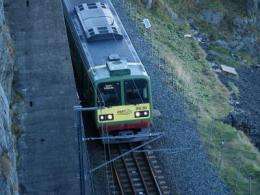
Senceive sensors monitor UK rail infrastructure. Credit: Senceive

The National Physical Laboratory (NPL) has worked with wireless sensor network developers Senceive, to help them deliver improved monitoring of degradation across critical structures in the UK that will save costs and improve safety levels.

London-based Senceive's main application area is long-term infrastructure monitoring. The company's meshed systems of wireless sensors are used to assess the condition of railway structures, track, bridges, culturally significant buildings and even historical artefacts. The sensors enable managers to plan essential maintenance rather than reacting to problems when they occur, prolonging the lifetime of structures and lessening the likelihood of accidents.

Senceive's networks are highly complex embedded systems, so it can be a challenge to quantify the uncertainties involved. As the system is designed for structural health monitoring-type applications, generating reliable data is critical so Senceive asked NPL to help them improve their products by understanding their measurement challenges.

Initially Senceive needed NPL's help to improve their tilt sensing system and verify its accuracy, precision and limits. NPL characterised the output of Senceive's tilt sensors in terms of linearity, jitter and overall uncertainty. NPL also advised Senceive on system improvements and on future deployments. This has given Senceive a greater understanding of the measurement issues they face, and prepared them for an upcoming large-scale deployment.

The results from the work have given Senceive the confidence of knowing how well their sensors perform with real data to back up their datasheets.

Michael Collett from NPL said:

"NPL provides companies with access to world-leading support and expertise across a wide range of technical areas. By working with NPL, Senceive have been able to understand how to get the most out of their system and validate their results. NPL has also learned a lot by working with a commercial company in the fast moving sector of networks."

Michael Gois at Senceive said:

"Working closely with Michael Collett and tapping into the great depth of expertise at NPL has been invaluable in helping us understand the measurement challenges we are faced with, and enabled us to incorporate some significant improvements into our system design."

Senceive has been working with NPL since 2009. It has supplied the Laboratory with wireless sensors to monitor a 14 tonne footbridge that is 20 metres long and 5 metres high. NPL is loading the bridge to destruction and the effects monitored to find new ways of maximising the lifetimes of civil structures.

Provided by National Physical Laboratory


Rank not rated yet
Relevant PhysicsForums posts

More news stories

Browser wars flare in mobile space

The browser wars are heating up again, but this time the fight is for dominance of the mobile Internet.

Technology / Software

created 2 minutes ago | popularity not rated yet | comments 0

SpotterRF debuts Radar Backpack Kit (w/ Video)

(Phys.org) -- SpotterRF has announced a special radar backpack kit designed to enhance situational awareness for soldiers on the ground. The company says its special radar is designed for warfighters as part ...

Technology / Hi Tech & Innovation

created 21 hours ago | popularity 5 / 5 (5) | comments 12 | with audio podcast report

Probability of contamination from severe nuclear reactor accidents is higher than expected: study

Catastrophic nuclear accidents such as the core meltdowns in Chernobyl and Fukushima are more likely to happen than previously assumed. Based on the operating hours of all civil nuclear reactors and the number ...

Technology / Energy & Green Tech

created May 22, 2012 | popularity 3.6 / 5 (21) | comments 56 | with audio podcast

Delphi gasoline-injection engine technique rivals hybrid's edge

(Phys.org) -- Running a diesel like engine on gasoline is something Delphi is doing in notable fashion. They claim they are on to a promising way to enjoy an engine that gives the vehicle owner high efficiency ...

Technology / Energy & Green Tech

created May 21, 2012 | popularity 4.7 / 5 (18) | comments 38 | with audio podcast report

HyperSolar shows dirty water no barrier to power world

(Phys.org) -- The Santa Barbara, California, company, HyperSolar, is set to transparently share the ups and downs of its research experiences toward the company’s ultimate vision, successfully producing ...

Technology / Energy & Green Tech

created May 24, 2012 | popularity 4.8 / 5 (15) | comments 17 | with audio podcast report


Scientist: Evolution debate will soon be history

(AP) -- Richard Leakey predicts skepticism over evolution will soon be history. Not that the avowed atheist has any doubts himself.

Dell tablet leak: 10.1-inch display, two-battery choice

(Phys.org) -- Headline after headline talks about vendors’ tablets in the wings as likely number-one contenders for the iPad. Such claims have justifiably been taken with a grain of salt, considering ...

SpaceX capsule has 'new car' smell, astronauts say (Update)

SpaceX's Dragon cargo vessel smells like a new car, said astronauts at the International Space Station after opening the hatches Saturday following the spacecraft's landmark mission to the orbiting lab.

Thousands of shellfish found dead in Peru

Thousands of crustaceans were found dead off the coast of Lima following the mystery mass death of dolphins and pelicans, the Peruvian Navy said Friday.

Australia hails surprise super-telescope decision

Australia has hailed a surprise decision giving it a role in a radio telescope project aimed at revolutionising astronomy, vowing to draw on its decades of experience in space science.

Astronomers seize last chance in lifetime for Venus Transit

Astronomers are gearing for one the rarest events in the Solar System: an alignment of Earth, Venus and the Sun that will not be seen for another 105 years.