No link between tornadoes and climate change: US
May 23, 2011 by Kerry Sheridan
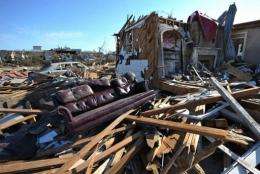
A sofa is seen next to a collapsed house in a tornado stricken neighbourhood in April 2011 in Tuscaloosa, Alabama. The United States is experiencing the deadliest year for tornadoes in nearly six decades, but a top US weather expert said there is no link between the violent twisters and climate change.
The United States is experiencing the deadliest year for tornadoes in nearly six decades, but a top US weather expert said Monday there is no link between the violent twisters and climate change.
Instead, the reasons for the spiking death tolls are more likely due to the rise in the number of mobile homes and the chance paths taken by a series of tornadoes that have happened to target populated areas.
"This year is an extraordinary outlier," said Harold Brooks, research meteorologist at the National Oceanic and Atmospheric Administration's (NOAA) National Severe Storms Laboratory in Norman, Oklahoma.
"This is the deadliest year for tornadoes in the US since 1953," he said, referring to June of that year when a tornado killed 90 people in Worcester, Massachusetts.
A massive tornado tore though the Missouri town of Joplin over the weekend, killing at least 89 people, less than a month a spate of the storms struck across seven states and killed 354 people.
Brooks said the contemporary US tornado record, which dates back to 1950, "can be a difficult thing to work with."
But when scientists examine the most complete records available and adjust for changes in how tornadoes were reported over time, "we see no correlation between global or US national temperature and tornado occurrence," Brooks said.
Nor are the storms themselves getting larger than they used to be, even though it may seem so after learning of massive twisters like the one in Missouri that tore apart a six-mile (10 kilometer) long, half-mile deep stretch of land.
"Tornado deaths require two things. You have to have the tornado and you have to have people in the right or the wrong place," Brooks said.
"The biggest single demographic change that probably affects things is that the fraction of mobile homes in the United States has increased over the years," he said.
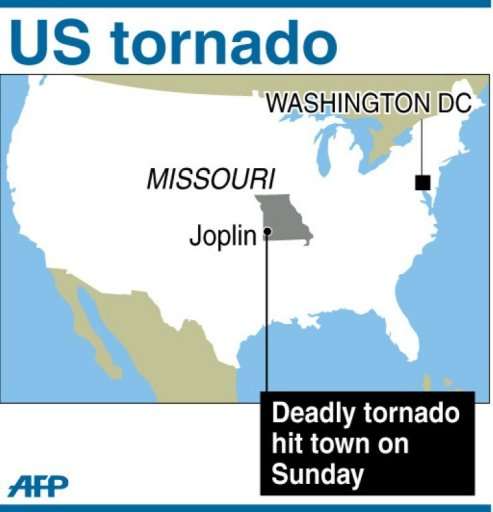
Map of US locating Joplin in the state of Missouri, where a tornado killed at least 24 people on Sunday.
Anything that can be tossed into the air, like cars and mobile homes, can prove deadly in a tornado and people are urged to take shelter underground if possible.Twisters are formed when atmospheric conditions come together in a certain way. At low levels, the atmosphere is warm and moist, coupled with cold dry air above.
Winds must be increasing in speed from the Earth's surface up to elevations of about 20,000 feet, with directional changes, known as wind shear, so that the southerly wind blows near the surface and gains speed at higher altitude.
"In April, essentially we were stuck in a pattern where that was the way things were for a couple of weeks, and that pattern didn't move so we had repeated episodes that were favorable for producing significant tornadoes," Brooks explained.
The weather phenomenon known as La Nina, which produces cooler than normal temperatures in the equatorial Pacific Ocean, may have had a "relatively small impact" on producing that pattern, but that is not the full picture, he said.
"It's an area of research to try to identify why the pattern was so favorable and why it was favorable for so long."
The tornado record does not show a steadily increasing trend toward bigger deadlier storms, he said. For instance, "2009 was a really low year for tornadoes. Some recent years have been big, some recent years have been small," he said.
Since modern records on tornadoes began, the deadliest outbreak was on April 3, 1974. The "Super Outbreak" claimed 310 lives when 148 tornadoes over a 24-hour period swept across 13 states.
The single deadliest tornado in US history, described in early accounts, killed 695 people when a massive twister tore up parts of Missouri, southern Illinois and southwestern Indiana in 1925.
(c) 2011 AFP
-
From lemons to lemonade: Reaction uses carbon dioxide to make carbon-based semiconductor,
32 comments
-
Thioridazine kills cancer stem cells in human while avoiding toxic side-effects of conventional cancer treatments,
3 comments
-
SpaceX private rocket blasts off for space station (Update),
42 comments
-
Climate scientists say they have solved riddle of rising sea,
31 comments
-
Research team claims to have found evidence Lake Cheko is impact crater for Tunguska Event,
18 comments
-
Hypothetical desert earth
7 hours ago
-
More human population = greater mass?
May 25, 2012
-
Conversion from aircraft bearing to normal degrees
May 23, 2012
-
Interpretation/Analysis of the Lab results(HEPA filter)
May 22, 2012
-
Has anyone here attended the The Urbino Summer School in Paleoclimatology?
May 22, 2012
-
Earthquakes: Mag 6 N. Italy and Mag 5.6 W. Bulgaria
May 21, 2012
- More from Physics Forums - Earth
More news stories
SpaceX capsule has 'new car' smell, astronauts say (Update)
SpaceX's Dragon cargo vessel smells like a new car, said astronauts at the International Space Station after opening the hatches Saturday following the spacecraft's landmark mission to the orbiting lab.
Space & Earth / Space Exploration
21 hours ago |
4.5 / 5 (20) |
1
Australia hails surprise super-telescope decision
Australia has hailed a surprise decision giving it a role in a radio telescope project aimed at revolutionising astronomy, vowing to draw on its decades of experience in space science.
21 hours ago |
5 / 5 (4) |
2
Astronomers seize last chance in lifetime for Venus Transit
Astronomers are gearing for one the rarest events in the Solar System: an alignment of Earth, Venus and the Sun that will not be seen for another 105 years.
21 hours ago |
5 / 5 (3) |
2
Astronauts enter world's 1st private supply ship
(AP) -- Space station astronauts floated into the Dragon on Saturday, a day after its heralded arrival as the world's first commercial supply ship.
Space & Earth / Space Exploration
21 hours ago |
5 / 5 (6) |
0
Sophisticated simulations predict future warming
The chances of our planet being hit by a global warming of 3 degrees Celsius by 2050 is as likely as it being hit by an increase of 1.4 degrees, new research shows. Presented in the journal Nature Geoscience, the British study ...
Space & Earth / Earth Sciences
May 22, 2012 |
4.4 / 5 (9) |
51
Browser wars flare in mobile space
The browser wars are heating up again, but this time the fight is for dominance of the mobile Internet.
Scientist: Evolution debate will soon be history
(AP) -- Richard Leakey predicts skepticism over evolution will soon be history. Not that the avowed atheist has any doubts himself.
Dell tablet leak: 10.1-inch display, two-battery choice
(Phys.org) -- Headline after headline talks about vendors tablets in the wings as likely number-one contenders for the iPad. Such claims have justifiably been taken with a grain of salt, considering ...
SpotterRF debuts Radar Backpack Kit (w/ Video)
(Phys.org) -- SpotterRF has announced a special radar backpack kit designed to enhance situational awareness for soldiers on the ground. The company says its special radar is designed for warfighters as part ...
Thousands of shellfish found dead in Peru
Thousands of crustaceans were found dead off the coast of Lima following the mystery mass death of dolphins and pelicans, the Peruvian Navy said Friday.
Keep food safety in mind this memorial day weekend
(HealthDay) -- Picnics, parades and cookouts are as much a part of Memorial Day weekend as tributes to the United States' war veterans.
May 23, 2011
Rank: 3 / 5 (4)
May 24, 2011
Rank: 4 / 5 (3)
May 24, 2011
Rank: not rated yet
@MikeyK no it really doesn't, but what evidence would convince people who don't believe in global warming (global weirding) that it is happening?
May 24, 2011
Rank: 5 / 5 (2)
It's probably also worth pointing out that overall population in the South is increasing because there's been a trend of people moving from North to South in the past couple decades. That places a lot more people in tornado alley. The Birmingham/Huntsville area that got hit in the last bout of storms has expanded so much in the past 10 years that I hardly recognize the area each time I return to visit my brother there. The next time we get a hurricaine landfall we'll see the same effect as more and more people place themselves in vulnerable situations. From what I read, it's the same way in many places around the world.
As far as global warming influencing the weather, well duh? What the guy above is saying is that there's no statistically significant trend. That doesn't mean that there's no influence, it's just chaotic.
May 24, 2011
Rank: not rated yet
May 24, 2011
Rank: 1 / 5 (4)
There is a way to fix this, but the socialists won't do it as they will loose power.
It is a step in the correct direction when physorg posts an article that does NOT blame something on AGW.
May 24, 2011
Rank: not rated yet
If AGW proponents would change their rhetoric from "believe in", as if it's some sort of religion, to "scientific proof" would be a good start for me. AGW theory should never be discussed in terms of "belief", it should be discussed as either there is or is not satisfactory evidence to justify engineering national policy towards addressing it.
It's interesting though, because more regular extreme weather events would be something I would expect to see in a significantly rising average global temperature, by virtue of the simple physical property of interactions occuring in a warmer system will be more energetic/occur faster than those occuring in a cooler system, no?
Interesting that they've found no statistical link.
May 24, 2011
Rank: 5 / 5 (1)
When I attended Auburn I frequently visited Atlanta. On one trip my roommate and I were in seperate cars, driving back to Auburn on a dark stormy night. He was no more than 5-10 minutes behind me on the freeway. I passed through the storm without incident. He had to stop because of all the debris on the freeway. I never saw it, but must have driven right past a cat 4 tornado. On the news the next day they showed the remarkable part of the story. The tornado had touched down right at the end of a trailer park. It followed the path of the trailer park for about a mile along the north side of the freeway. Then it jumped over to the south side of the freeway right at the end of the north trailer park. On the south side there was another trailer park that went on for another mile or so. The tornado followed that one too, and it ended after precicely destroying those two trailer parks. Nobody died though. Very odd.
May 24, 2011
Rank: 5 / 5 (1)
Seasonal weather is so strongly dominated by ocean oscillations that it's not easy to see any change on a scale of 50 years. That's just not a long enough time to pick out such a small change as the one predicted by the IPCC (in storm strength that is) . They (the IPCC et al) have always said not to expect to see very much in terms of statistically significant change in seasonal weather events for a long time. I could go find a link to it in AR4 but I'm feeling lazy today. Not all effects are created equally, so while some things are easy to see, if global warming affects tornados we're going to need a bit more time to prove it through observation.
May 24, 2011
Rank: not rated yet
I think we need to investigate whether there's a statistically significant relationship between land use and tornados. For instance, do trailer parks really attract them?
Serious:
I lived in kansas city for over 10 years. You can clearly see how the major land features influence the storms there. Some parts of the area always get hit. The river and lakes have a strong effect. I would be surprised if urban developement and farming don't also. Many of the storms I saw seemed to follow interstate 35 also.
May 24, 2011
Rank: 1 / 5 (1)
You would think that initially, but it isn't necessarily the case.
Global warming would increase average absolute humidity (not necessarily relative humidity,) at all altitudes, which would hinder tornado development.
Global warming would increase vertical shear, which would hinder tropical cyclone development, decreasing the average number of them.
However, when cyclones do manage to develop, the maximum potential intensity would be higher on average, though not everything reaches it's maximum potential intensity, further, if the upper atmosphere warms it would cancel this effect.
May 24, 2011
Rank: 5 / 5 (1)
I don't think there's any joke to this principle. For instance I would think urban heat islands and the upper and lower level air current disturbances presented by multi-story buildings are bound to have some sort of effect. As for rural towns and farming operations, it may just be that they are more likely to be near bodies of water...
Which I don't think lakes and rivers, and the valleys they run through, are any surprise to be associated with tornadic activity. The geographic elevation gradients could hep facilitate the temperature, pressure and multi-level wind velocity gradients that characterize certain aspects of tornado formation like downdrafts and subsequent vorticity?
May 24, 2011
Rank: 1 / 5 (2)
Once you have more cloud cover, you would be slightly warmer than we are today, but would hit an equilibrium point where the increased albedo due to increased cloud cover would cancel the increased greenhouse effects due to CO2 or any other greenhouse effects.
Effectively, the Inter-tropical Convergeance Zone would expand northward and southward proportional to temperature increase, which would cool a larger and larger area of the planet via increased albedo. It would become an almost un-broken banding feature, perhaps 10 to 20 degrees wider in lattitude than it is now.
May 24, 2011
Rank: 5 / 5 (1)
That's an extremely extreme statement, 10-20 degrees is massive, citation or math, please? Otherwise save such speculation for your blog.
Also, as the ITCZ expands, I'm thinking so too would the equitorial tropical zone and definitely temperate zones. Don't forget to tell the whole story if you want to have any sort of credibility.
May 25, 2011
Rank: 5 / 5 (1)
Yeah, the 10-20 degrees thing isn't the only part of his comments that is speculation.
citation plz.
no source I can fine agrees. citation plz. snow cover?
Wiki has a nice chart if you want to correct that. Land excluding snow cover has an albedo ranging from about 7-43%. Water around 8%. Desert around 28% (no different than other land types). Snow, which is on land, is 41-83%. Clouds range from about 38-78% (about the same as snow, and from 4 to 10 times higher than water).
Geez dude, at least bother to do a google search before vomiting junk into the thread. There's a couple other things wrong as well, but I'm out of space.
May 26, 2011
Rank: 5 / 5 (2)
Expect more tornadoes than average until the wind from the north warms up.
May 26, 2011
Rank: not rated yet
the US midwest is a convergeance zone. The cold air flows down from the Washington area and warm gulf air flows up from the Texas area. They meet over kansas (hence tornado alley) and missouri then it follows the prevailing winds to the east till it hits the apalaccian mountains. La Nina tends to strengthen it, but it's not 100% correlation. Weather is still chaotic. The idea that global warming would change the number or strength of tornados (up or down) in that area is a bit hard to prove I would guess. If anything, I would think that since they claim that the north is warming faster, then you'll have less of a contrast between those converging air masses, so less strong storms. Just a guess though. I didn't look up any reference.