Researchers release first large observational study of 9.0 Tohoku-Oki earthquake
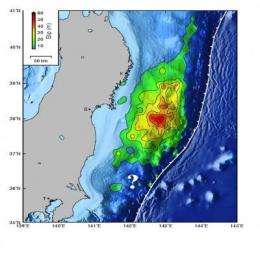
When the magnitude 9.0 Tohoku-Oki earthquake and resulting tsunami struck off the northeast coast of Japan on March 11, they caused widespread destruction and death. Using observations from a dense regional geodetic network (allowing measurements of earth movement to be gathered from GPS satellite data), globally distributed broadband seismographic networks, and open-ocean tsunami data, researchers have begun to construct numerous models that describe how the earth moved that day.
Now, a study led by researchers at the California Institute of Technology (Caltech), published online in the May 19 issue of Science Express, explains the first large set of observational data from this rare megathrust event.
"This event is the best recorded great earthquake ever," says Mark Simons, professor of geophysics at Caltech's Seismological Laboratory and lead author of the study. For scientists working to improve infrastructure and prevent loss of life through better application of seismological data, observations from the event will help inform future research priorities.
Simons says one of the most interesting findings of the data analysis was the spatial compactness of the event. The megathrust earthquake occurred at a subduction zone where the Pacific Plate dips below Japan. The length of fault that experienced significant slip during the Tohoku-Oki earthquake was about 250 kilometers, about half of what would be conventionally expected for an event of this magnitude.
Furthermore, the area where the fault slipped the most—30 meters or more—happened within a 50- to 100-kilometer-long segment. "This is not something we have documented before," says Simons. "I'm sure it has happened in the past, but technology has advanced only in the past 10 to 15 years to the point where we can measure these slips much more accurately through GPS and other data."
For Jean Paul Ampuero, assistant professor of seismology at Caltech's Seismological Laboratory who studies earthquake dynamics, the most significant finding was that high- and low-frequency seismic waves can come from different areas of a fault. "The high-frequency seismic waves in the Tohoku earthquake were generated much closer to the coast, away from the area of the slip where we saw low-frequency waves," he says.
Simons says there are two factors controlling this behavior; one is because the largest amount of stress (which is what generates the highest-frequency waves) was found at the edges of the slip, not near the center of where the fault began to break. He compares the finding to what happens when you rip a piece of paper in half. "The highest amounts of stress aren't found where the paper has just ripped, but rather right where the paper has not yet been torn," he explains. "We had previously thought high-frequency energy was an indicator of fault slippage, but it didn't correlate in our models of this event." Equally important is how the fault reacts to these stress concentrations; it appears that only the deeper segments of the fault respond to these stresses by producing high-frequency energy.
Ampuero says the implications of these observations of the mechanical properties of tectonic faults need to be further explored and integrated in physical models of earthquakes, which will help scientists better quantify earthquake hazards.
"We learn from each significant earthquake, especially if the earthquake is large and recorded by many sensors," says Ampuero. "The Tohoku earthquake was recorded by upwards of 10 times more sensors at near-fault distances than any other earthquake. This will provide a sharper and more robust view of earthquake rupture processes and their effects."
For seismologist Hiroo Kanamori, Caltech's Smits Professor of Geophysics, Emeritus, who was in Japan at the time of the earthquake and has been studying the region for many years, the most significant finding was that a large slip occurred near the Japan Trench. While smaller earthquakes have happened in the area, it was believed that the relatively soft material of the seafloor would not support a large amount of stress. "The amount of strain associated with this large displacement is nearly five to 10 times larger than we normally see in large megathrust earthquakes," he notes. "It has been generally thought that rocks near the Japan Trench could not accommodate such a large elastic strain."
The researchers are still unsure why such a large strain was able to accumulate in this area. One possibility is that either the subducting seafloor or the upper plate (or both) have some unusual structures—such as regions that were formerly underwater mountain ranges on the Pacific Plate—that have now been consumed by the subduction zone and cause the plates to get stuck and build up stress.
"Because of this local strengthening—whatever its cause—the Pacific Plate and the Okhotsk Plate had been pinned together for a long time, probably 500 to 1000 years, and finally failed in this magnitude 9.0 event," says Kanamori. "Hopefully, detailed geophysical studies of seafloor structures will eventually clarify the mechanism of local strengthening in this area."
Simons says researchers knew very little about the area where the earthquake occurred because of limited historical data.
"Instead of saying a large earthquake probably wouldn't happen there, we should have said that we didn't know," he says. Similarly, he says the area just south of where the fault slipped is in a similar position; researchers don't yet know what it might do in the future.
"It is important to note that we are not predicting an earthquake here," emphasizes Simons. "However, we do not have data on the area, and therefore should focus attention there, given its proximity to Tokyo."
He says that the relatively new Japanese seafloor observation systems will prove very useful in scientists' attempts to learn more about the area.
"Our study is only the first foray into what is an enormous quantity of available data," says Simons. "There will be a lot more information coming out of this event, all of which will help us learn more in order to help inform infrastructure and safety procedures."
More information: "The 2011 Magnitude 9.0 Tohoku-Oki Earthquake: Mosaicking the Megathrust from Seconds to Centuries," Science Express (2011)
Provided by California Institute of Technology


