Jellyfish 'fingerprints'
May 13, 2011

Jellyfish 'fingerprints'

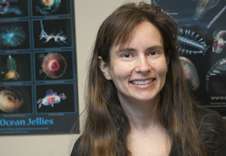
Annette Govindarajan's research involves studying the complex life cycles of jellyfish. Photo by Lauren McFalls.

Annette Govindarajan is fascinated with studying jellyfish, specifically their complex life cycles. That passion was forged years ago after working with hydrozoans, a jelly of the stinging variety.

“I was intrigued by how they could occupy different parts of the marine environment,” said Govindarajan, a lecturer in Northeastern University’s Department of Earth and Environmental Sciences, referring to their polyp, jelly and larval life cycle stages.

Govindarajan is primarily interested in researching the genetic and evolutionary differences between as well as other gelatinous animals, and she recently coauthored a paper featured on the cover of the Journal of Plankton Research that explores these evolutionary relationships in thaliaceans —gelatinous, planktonic invertebrates that drift along in the ocean. She is also working on a project to barcode species of jellyfish with colleagues at the University of Connecticut and the Woods Hole Oceanographic Institution, where she is a research associate.

The first step in barcoding involves extracting a jellyfish’s DNA, and using a technique to amplify copies of the target gene. Govindarajan said these copies make it possible to sequence the DNA and determine which are unique to a particular species. These “genetic fingerprints” ultimately help to improve species identification, she said, and build upon existing DNA barcode databases that scientists can utilize in their research.

This work aligns with a larger push among researchers to increase efforts to barcode a wide spectrum of living beings, which can complement classification and advance other areas of science such as ecology. “In many groups of animals, there often aren’t a lot of specialists capable of identifying them down to the species level. Having a genetic tool to do this fairly easily would really help,” Govindarajan said.

However, she said researching gelatinous animals can be tricky given the challenges associated with collecting them since they are a delicate structure and can break apart at the softest touch. “They can be hard to work with,” she said. “The samples we’ve used are collected by divers by hand.”

Govindarajan is also interested in how large blooms of jellyfish form in the ocean. She said reports of these blooms are increasing in different parts of the world, and they often happen in polluted waters where algae have died and decomposed. While many animals can’t survive in these low-oxygen zones, jellyfish are found to have a tolerance to those waters.

Provided by Northeastern University search and more info website


Rank not rated yet
Relevant PhysicsForums posts

More news stories

Scientist: Evolution debate will soon be history

(AP) -- Richard Leakey predicts skepticism over evolution will soon be history. Not that the avowed atheist has any doubts himself.

Biology / Evolution

created 12 hours ago | popularity 3.5 / 5 (11) | comments 30

Thousands of shellfish found dead in Peru

Thousands of crustaceans were found dead off the coast of Lima following the mystery mass death of dolphins and pelicans, the Peruvian Navy said Friday.

Biology / Ecology

created 22 hours ago | popularity 4.8 / 5 (4) | comments 7

More plant species responding to global warming than previously thought

(Phys.org) -- Far more wild plant species may be responding to global warming than previous large-scale estimates have suggested.

Biology / Ecology

created May 22, 2012 | popularity 4.6 / 5 (14) | comments 18 | with audio podcast

For monogamous sparrows, it doesn't pay to stray (but they do it anyway)

It's quite common for a female song sparrow to stray from her breeding partner and mate with the male next door, but a new study shows that sleeping around can be costly.

Biology / Plants & Animals

created May 22, 2012 | popularity 5 / 5 (1) | comments 7 | with audio podcast

Study uncovers secret to speedy burrowing by razor clams

(Phys.org) -- If you look at a razor burrowing clam sitting in a bucket, you’d never guess that it could burrow itself down into the soil, much less do it with any speed. Razor clams look like fat straws, ...

Biology / Plants & Animals

created May 25, 2012 | popularity 1 / 5 (1) | comments 3 | with audio podcast report


Nvidia trumpets Tegra 3 phone design wins for 2012

(Phys.org) -- Nvidia’s competitive war paint has a name, Tegra 3. On the heels of Nvidia announcements about lowering costs of its Tegra 3 processors and Nvidia-enabled tablets running Android Ice Cream ...

Browser wars flare in mobile space

The browser wars are heating up again, but this time the fight is for dominance of the mobile Internet.

Dell tablet leak: 10.1-inch display, two-battery choice

(Phys.org) -- Headline after headline talks about vendors’ tablets in the wings as likely number-one contenders for the iPad. Such claims have justifiably been taken with a grain of salt, considering ...

SpotterRF debuts Radar Backpack Kit (w/ Video)

(Phys.org) -- SpotterRF has announced a special radar backpack kit designed to enhance situational awareness for soldiers on the ground. The company says its special radar is designed for warfighters as part ...

SpaceX capsule has 'new car' smell, astronauts say (Update)

SpaceX's Dragon cargo vessel smells like a new car, said astronauts at the International Space Station after opening the hatches Saturday following the spacecraft's landmark mission to the orbiting lab.

Australia hails surprise super-telescope decision

Australia has hailed a surprise decision giving it a role in a radio telescope project aimed at revolutionising astronomy, vowing to draw on its decades of experience in space science.