Holographic dark information energy
May 30, 2011 By Steve Nerlich, Universe Today
The bubble nebula NGC 7635 - it doesn't have a lot to do with Holographic Dark Information Energy, but you have to start these articles with an image. Credit: Croman/an APOD for November 7 2005.
Holographic Dark Information Energy gets my vote for the best mix of arcane theoretical concepts expressed in the shortest number of words and just to keep it interesting, its mostly about entropy.
The second law of thermodynamics requires that the entropy of a closed system cannot decrease. So drop a chunk of ice in a hot bath and the second law requires that the ice melts and the bath water cools moving the system from a state of thermal disequilibrium (low entropy) towards a state of thermal equilibrium (high entropy). In an isolated system (or an isolated bath) this process can only move in one direction and is irreversible.
A similar idea exists within information theory. Landauers principle has it that any logically irreversible manipulation of information, such as erasing one bit of information, equates to an increase in entropy.
So for example, if you keep photocopying the photocopy you just made of an image, the information in that image degrades and is eventually lost. But Landauers principle has it that the information is not so much lost, as converted into energy that is dissipated away by the irreversible act of copying a copy.
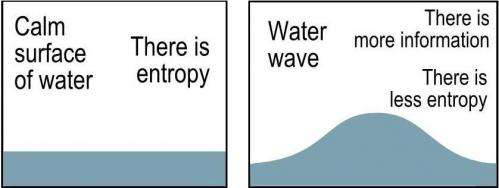
The link between entropy and information - more interesting and information-rich things occur in low entropy states than in high entropy states.
Translating this thinking into a cosmology, Gough proposes that as the universe expands and density declines, information-rich processes like star formation also decline. Or to put it in more conventional terms as the universe expands, entropy increases since the energy density of the universe is being steadily dissipated across a greater volume. Also, there are less opportunities for gravity to generate low entropy processes like star formation.So in an expanding universe there is a loss of information and by Landauers principle this loss of information should release dissipated energy and Gough claims that this dissipated energy accounts for the dark energy component of the current standard model of universe.
There are rational objections to this proposal. Landauers principle is really an expression of entropy in information systems which can be mathematically modeled as though they were thermodynamic systems. Its a bold claim to say this has a physical reality and a loss of information actually does release energy and since Landauers principle expresses this as heat energy, wouldnt it then be detectable (i.e. not dark)?
There is some experimental evidence of information loss releasing energy, but arguably it is just conversion of one form of energy to another the information loss aspect of it just representing the transition from low to high entropy, as required by the second law of thermodynamics. Goughs proposal requires that new energy is introduced into the universe out of nowhere although to be fair, that is pretty much what the current mainstream dark energy hypothesis requires as well.
Nonetheless, Gough alleges that the math of information energy does a much better job of accounting for dark energy than the traditional quantum vacuum energy hypothesis which predicts that there should be 120 orders of magnitude more dark energy in the universe than there apparently is.
Gough calculates that the information energy in the current era of the universe should be about 3 times its current mass-energy contents which closely aligns with the current standard model of 74% dark energy + 26% everything else.
Invoking the holographic principle doesnt add a lot to the physics of Goughs argument presumably its in there to make the math easier to manage by removing one dimension. The holographic principle has it that all the information about physical phenomena taking place within a 3D region of space can be contained on a 2D surface bounding that region of space. This, like information theory and entropy, is something that string theorists spend a lot of time grappling with not that theres anything wrong with that.
Source: Universe Today
-
From lemons to lemonade: Reaction uses carbon dioxide to make carbon-based semiconductor,
32 comments
-
Thioridazine kills cancer stem cells in human while avoiding toxic side-effects of conventional cancer treatments,
3 comments
-
SpaceX private rocket blasts off for space station (Update),
42 comments
-
Climate scientists say they have solved riddle of rising sea,
31 comments
-
Research team claims to have found evidence Lake Cheko is impact crater for Tunguska Event,
18 comments
-
distribution of molecules throughout the atmosphere
1 hour ago
-
The Global Positioning System !
2 hours ago
-
A Question relating Power
3 hours ago
-
Writing a book so im learning about things, i have some general questions please read
6 hours ago
-
Question about induced E field.
7 hours ago
-
Charging a capacitor in a tesla coil
7 hours ago
- More from Physics Forums - General Physics
More news stories
Is a classical electrodynamics law incompatible with special relativity?
(Phys.org) -- The laws of classical electromagnetism that were developed in the 19th century are the same laws that scientists use today. They include Maxwell’s four equations along with the Lorentz la ...
Landmark calculation clears the way to answering how matter is formed
(Phys.org) -- An international collaboration of scientists, including Thomas Blum, associate professor of physics, is reporting in landmark detail the decay process of a subatomic particle called a kaon ...
May 25, 2012 |
4.2 / 5 (21) |
47
|
Lying in wait for WIMPs: Researchers seek to dramatically increase sensitivity of Large Underground Xenon detector
Although it's invisible, dark matter accounts for at least 80 percent of the matter in the universe. No one knows what it is, but most scientists would bet on weakly interacting massive particles, or WIMPs.
May 23, 2012 |
4 / 5 (7) |
15
|
Hawaii lab turns laser-powered bubbles into microrobots
(Phys.org) -- A team of scientists from the University of Hawaii are working on microrobots created from bubbles of air in a saline solution. The bubbles take on their title of robots as a laser ...
Sound increases the efficiency of boiling
Scientists at the Georgia Institute of Technology achieved a 17-percent increase in boiling efficiency by using an acoustic field to enhance heat transfer. The acoustic field does this by efficiently removing vapor bubbles ...
May 24, 2012 |
5 / 5 (2) |
2
Nvidia trumpets Tegra 3 phone design wins for 2012
(Phys.org) -- Nvidias competitive war paint has a name, Tegra 3. On the heels of Nvidia announcements about lowering costs of its Tegra 3 processors and Nvidia-enabled tablets running Android Ice Cream ...
Browser wars flare in mobile space
The browser wars are heating up again, but this time the fight is for dominance of the mobile Internet.
Scientist: Evolution debate will soon be history
(AP) -- Richard Leakey predicts skepticism over evolution will soon be history. Not that the avowed atheist has any doubts himself.
Dell tablet leak: 10.1-inch display, two-battery choice
(Phys.org) -- Headline after headline talks about vendors tablets in the wings as likely number-one contenders for the iPad. Such claims have justifiably been taken with a grain of salt, considering ...
SpotterRF debuts Radar Backpack Kit (w/ Video)
(Phys.org) -- SpotterRF has announced a special radar backpack kit designed to enhance situational awareness for soldiers on the ground. The company says its special radar is designed for warfighters as part ...
SpaceX capsule has 'new car' smell, astronauts say (Update)
SpaceX's Dragon cargo vessel smells like a new car, said astronauts at the International Space Station after opening the hatches Saturday following the spacecraft's landmark mission to the orbiting lab.

May 30, 2011
Rank: 5 / 5 (16)
HAHAHHAA WHAT??? Nicely done.
May 30, 2011
Rank: 5 / 5 (4)
May 30, 2011
Rank: not rated yet
May 30, 2011
Rank: 2.6 / 5 (5)
May 31, 2011
Rank: 1 / 5 (4)
DNA is copied, so I suppose in the last few billion years bacteria DNA has degraded into human form...
May 31, 2011
Rank: 1 / 5 (5)
This is not true and can be trivially demonstrated using the second law:
1) A closed system will tend toward and remain at equilibrium;
2) The equilibrious point will remain within some range (because molecules move about);
3) The maximum instantaneous entropy is always higher than the average entropy defined by the equilibrious state;
4) Any initial condition can be arbitrarily selected;
5) An initial condition or maximum entropy can be selected after which the system will tend toward equilibrium which is exactly equal to the average entropy of the system.
6) The average entropy of the same system in an ever larger spatial and/or temporal extension is ever lower;
7) From (3) we note that for the given initial condition in (5), entropy always falls, and considering (7) this interval in an infinite universe would tend toward infinity...
May 31, 2011
Rank: 1 / 5 (5)
And the truth is that entropy always rises if the entropy at the initial condition is lower than the average entropy at equilibrium and will always fall if the entropy at the initial condition is higher than the average entropy at equilibrium.
And the second law agrees with me...where science has blundered is to always choose a low entropy initial condition to demonstrate the inevitable rise. It is like selecting a mass at zero Kelvin as the initial condition so that we can boldly claim that temperature always rises. In reality, temperatures always equalise regardless of the initial condition and it is the same for entropy ~ indeed, it was from the observation of heat that the second law and all the thermodynamic laws are deduced.
May 31, 2011
Rank: not rated yet
May 31, 2011
Rank: 2.6 / 5 (5)
May 31, 2011
Rank: 5 / 5 (2)
I think that some of these entropy arguments are silly to begin with, as we're not even sure if we'll have a 'Big Chill' a 'Big Crunch' or in M-theory we just bounce into another brane. There's not really any way to say whether entropy can be lost or not because we can't see the whole system.
Jun 01, 2011
Rank: 1 / 5 (1)
One can arbitrarily set any initial condition one likes; there are initial conditions which have a higher entropy than the final condition which is not static but where an average entropy can be observed.
Thus making the statement that entropy always rises (or stays the same) in a closed system is incorrect. If the system is always closed, average entropy never changes.
Regarding the entire universe: did the BB occur within a larger universe, are there other universes and is there no period before the BB where events can occur in some spatial extension? If so, then the observable universe is not a closed system.
So in making my statement and drawing my conclusions I remained faithful to the laws of thermodynamics throughout.
Jun 01, 2011
Rank: 1 / 5 (1)
Consider a whirlpool in a stream where some water appears to be going upstream. This can only occur if some water is going downstream faster than the average flow.
Maximum entropy is a particular set of configurations which are just as unlikely to be maintained as lower entropy configurations because particles move about and matter clumps for no other reason than it is statistically possible. Thus choosing a maximum entropy condition insures that entropy will fall to the average entropy level because, unless the configuration of atoms is frozen, the atoms are compelled to move about.
Feynman called this effect something like "the drunk's walk" whereby if there is a limiting factor, say a wall, the drunk's average path will be away from the wall. The wall, in this case, is maximum entropy.
Jun 05, 2011
Rank: not rated yet
Sounds likes mapping. Mapping out a one to one correspondence.
A one to one correspondence. Regardless of concept.
Everything mapped to one to one correspondence to Everything.
Anything mapped to a one to one correspondence to Anything.
Nothing mapped to a one to one correspondence to Nothing.
Each concentric circle centrally lying within the next 'larger' concentric circle and all the circles having the same shared point of origin.
And no way to establish a one to one correspondence to the points lying on the circumferences of each circle.
That is sad. Very sad. The maps of energy, entropy, space, and information.
All at a loss, for a lack of a one to one correspondence.
Or do you want me to solve this one for you too?
Sincerely yours,
God
Jun 05, 2011
Rank: not rated yet
If you stop a photon and observe it, will it to continue shed light for an unspecified period of time?
Jun 05, 2011
Rank: not rated yet
This is directly proportional to the rate of blinking.
Jun 05, 2011
Rank: not rated yet
Jun 05, 2011
Rank: not rated yet
By the way, may be a dumb idea but isn't that 'cosmic background radiation' like a standing wave that could be like an energy field? [I am not claiming that I know anything here, this is just a question that came to mind]
Jun 05, 2011
Rank: not rated yet
This is not religion. Scientific concepts defend themselves. Against all discourse, rational or otherwise. Your concern is insincere.
@jjoensuu
There is only ONE dumb idea. That is the idea of NOT asking a question or posing an idea.
My opinion: Yes. CMB IS a standing wave. If I knew the Fourier composition of this standing wave, then a reconstruction of the Universe is child's play.
@CaptBarbados
Photons 'stop' and 'start' all the time. Absorption and emission. Actually your question is a trick question. There is no such word as "stop" for a continuous wave. Not even for a discrete description of a wave is there such a word as "stop". You are not going to be able to tell if the photon is coherent or "background"(noise). Yes. Theoretically, it will continue to shed light forever.
@Walter Mrak
Get off your horse. The article is foremost mathematics frontier. Tell us what exactly separates the Fock states from coherent states. Serious enough?
Jun 06, 2011
Rank: not rated yet