Greenpeace warns of radioactive sea life off Japan

Environmental group Greenpeace warned Thursday that marine life it tested more than 20 kilometres (12 miles) off Japan's stricken Fukushima nuclear plant showed radiation far above legal limits.
The anti-nuclear group, which conducted the coastal and offshore tests this month, criticised Japanese authorities for their "continued inadequate response to the Fukushima nuclear crisis" sparked by the March 11 quake and tsunami.
Greenpeace said it detected radiation levels in seaweed 50 times higher than official limits, which it charged raised "serious concerns about continued long-term risks to people and the environment from contaminated seawater".
It also said that tests, which it said were independently verified by French and Belgian laboratories, showed above-legal levels of radioactive iodine-131 and caesium-137 in several species of fish and shellfish.
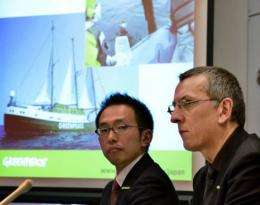
"Our data show that significant amounts of contamination continue to spread over great distances from the Fukushima nuclear plant," said Jan Vande Putte, a Greenpeace radiation expert, at a Tokyo news conference.
Japan's seafood safety limit for caesium-137 is 500 Becquerels per kilogram (227 per pound).
Greenpeace said it found levels of 740 Becquerels per kilogram in oysters, 857 in a fish species, 1,285 in sea cucumber and 1,640 in seaweed.
The maximum iodine-131 limit is 2,000 Becquerels per kilogram for seaweed, but Greenpeace said it found a level of 127,000 Becquerels per kilogram in the seaweed species Sargassum Horneri.
The group said that "eating one kilo of highly contaminated seaweed sampled by Greenpeace could increase the radiation dose by 2.8 millisievert -- almost three times the internationally recommended annual maximum".
"Despite what the authorities are claiming, radioactive hazards are not decreasing through dilution or dispersion of materials, but the radioactivity is instead accumulating in marine life," Vande Putte added.
"The concentration of radioactive iodine we found in seaweed is particularly concerning as it tells us how far contamination is spreading along the coast, and because several species of seaweed are widely eaten in Japan."
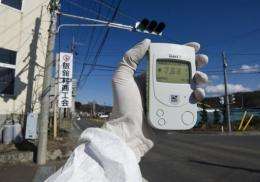
Vande Putte accused Japan of doing to little to measure and share data on marine life contamination and said "Japan's government is mistaken in assuming that an absence of data means there is no problem.
"This complacency must end now, and (the government must) instead mount a comprehensive and continuous monitoring programme of the marine environment along the Fukushima coast, along with full disclosure of all information about both past and ongoing releases of contaminated water."
The tests were conducted by Greenpeace monitoring teams on shore and from its Rainbow Warrior flagship, which was only allowed to test outside Japan’s 20-kilometre (12-mile) territorial waters.
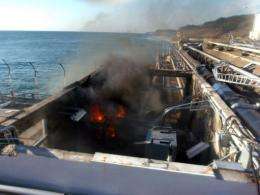
Japan has said ocean currents and tides are rapidly diluting contaminants from the tsunami-hit atomic plant, and Fukushima prefecture told AFP on Thursday that no fishing is going on at the moment in its waters.
"We have exercised self-restraint as (prefectural) safety tests have not been conducted yet," said a Fukushima official. "We will make a decision after confirming the results of the tests, which will take place shortly."
The official added: "People do not bother fishing now. If you caught fish or other marine products in waters near the plant, they wouldn't sell."
Japan's fisheries agency, and neighbouring prefectures, have been checking marine products at different spots, and the government has prohibited fishermen from catching some species found to have elevated radiation levels.
(c) 2011 AFP


