May 24, 2011 report
Study shows how external ecological communities can affect the coevolution of hosts and their parasites
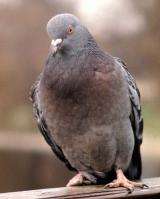
(PhysOrg.com) -- In a novel experiment running over three years, evolutionary biologists Christopher Harbison and Dale Clayton, both of the University of Utah in Salt Lake City, sought to show that a certain species of lice evolved the way it did, in part due to the way it’s hosts evolved; while another species of lice on the same hosts, did not. By studying two different types of lice that live in the feathers of doves and pigeons, the two researchers, as described in their paper in the Proceedings of the National Academy of Sciences (PNAS) show that one of the lice species had a similar evolutionary history to its host, while the other did not, due to its inability to migrate to other birds.
Pigeons and doves, as many people well know, play host to lice; but not all the lice are the same. In fact, there are two distinct species of lice aboard any given bird; one that lives in the wings or tail feathers and one that lives on the belly, eating downy feathers. But only one of the species share a similar evolutionary history with the host; those that live on the belly; a fact that has bothered evolutionary biologists for quite some time.
Harbison and Clayton suspected it had something to do with the hippoboscid fly, a species that survives by drinking bird blood; they suspected that the species of lice that lived on the wings of birds, because they have longer legs, were able to hop aboard the flies, which would then carry them to other birds of other species. The belly lice on the other hand, because they had shorter legs, would be unable to attach themselves and would thus be condemned to live out their whole lives on just one bird species, which would help explain why they were more closely tied evolutionary wise, with their host.
To prove their idea correct, the duo set up a shed that housed two groups of pigeons; on one side was a group already infested with both species of lice; on the other, pigeons that had no lice at all. The pigeons could not reach one another due to a partition, but the hippoboscid flies that were introduced could; they were able to hop from bird to bird on either side of the partition as they chose. After studying the results over a three year period, the team was able to very clearly see that the lice that lived in the pigeons’ wings were able to make their way over to the clean birds on a consistent basis, while the belly dwellers were not able to at all.
The results show that species interactions among communities can help explain evolutionary patterns, which suggests that further research among other species might yield new clues to help build a more accurate picture of how whole evolutionary systems might work.
More information: Community interactions govern host-switching with implications for host–parasite coevolutionary history, PNAS, Published online before print May 23, 2011, doi:10.1073/pnas.1102129108
Abstract
Reciprocal selective effects between coevolving species are often influenced by interactions with the broader ecological community. Community-level interactions may also influence macroevolutionary patterns of coevolution, such as cospeciation, but this hypothesis has received little attention. We studied two groups of ecologically similar feather lice (Phthiraptera: Ischnocera) that differ in their patterns of association with a single group of hosts. The two groups, “body lice” and “wing lice,” are both parasites of pigeons and doves (Columbiformes). Body lice are more host-specific and show greater population genetic structure than wing lice. The macroevolutionary history of body lice also parallels that of their columbiform hosts more closely than does the evolutionary history of wing lice. The closer association of body lice with hosts, compared with wing lice, can be explained if body lice are less capable of switching hosts than wing lice. Wing lice sometimes disperse phoretically on parasitic flies (Diptera: Hippoboscidae), but body lice seldom engage in this behavior. We tested the hypothesis that wing lice switch host species more often than body lice, and that the difference is governed by phoresis. Our results show that, where flies are present, wing lice switch to novel host species in sufficient numbers to establish viable populations on the new host. Body lice do not switch hosts, even where flies are present. Thus, differences in the coevolutionary history of wing and body lice can be explained by differences in host-switching, mediated by a member of the broader parasite community.
© 2010 PhysOrg.com


