Taking a close look at the eco-balance of coffee capsules
Exactly how environmentally friendly are the various capsule systems and other ways of making coffee? Empa researchers have taken a close look at the ecological balances of the various systems currently in use. The result: it all depends on the contents. The choice of coffee has a much stronger effect on the environmental friendliness than the capsule system, type of machine or method of preparation.
Capsule systems for making coffee are convenient and practical and therefore very popular. In terms of their environmental friendliness, however, a large question mark hangs over them. Roland Hischier, Empa's ecobalance expert, has just finished investigating various capsule systems as well as fully automatic machines, filter and soluble coffee making techniques, and has prepared a simplified life cycle analysis. This shows that it is the content which matters most. "A well-informed choice of coffee is in any case the best option for the environment,” according to Hischier. Those who want to enjoy their drink while doing their bit for the environment should choose coffee which bears an ecological label.
During the ecobalance evaluation Hischier weighed the different capsules and identified the main components of the contents. He then took values from the literature for the average material usage and energy consumption during the manufacture of the product. For filter coffee and instant coffee he similarly used values taken from the literature. A study from Brazil, which analyzed 56 coffee plantations, was used as the basis for the ecological evaluation of the coffee itself. Since it is not known precisely what type of coffee each of the capsules contains, Hischier took into account not just the average values reported in the Brazilian study but also the extreme values. This enabled him to show the influence of each coffee type – or rather each method of growing the crop – on the overall ecobalance of the coffee making procedure.
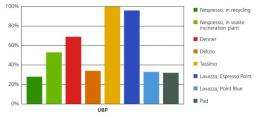
The environmental damage caused during the growth of the coffee crop is the largest single factor affecting the ecobalance. Depending on the amount of work done on the coffee plantation and the different levels of usage of farm machinery (i.e. diesel fuel for tractors), fertilizer and pesticides, environmental data for coffee varies significantly. In the worst case growing the coffee alone can represent about 70 per cent of the environmental damage caused by cup of the drink, while in the best case this value drops to just about 1 per cent.
A separate evaluation of the different (empty) capsules also brought to light large differences depending on the quantities of materials used for the capsules and for the packaging. A capsule of average coffee causes about a quarter of the total environmental damage. Relatively heavy plastic capsules and those which are individually packed fare worse in this respect. Aluminium capsules give the best results, but only when recycled.
To complete his investigation Hischier compared capsules with other methods making coffee. In the case of fully automatic machines the results depend strongly on how much coffee is used per cup. This is hardly a surprise given the level of influence that the coffee has on the overall ecobalance. When the maximum amount of average coffee is used the environmental effects of a fully automatic machine are even higher than the "best" capsule systems. Since capsules of different types contain different amounts of coffee – between six and nine grams, a variation of 50% – the ranking list in this case showed slight variations compared to that for empty capsules. Capsules containing a lot of coffee fare worse, as one might expect.
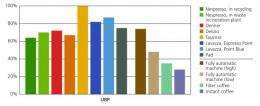
Independent of the type of coffee, however, there are also two clear winners. If one assumes that in the case of filter coffee the whole pot is drunk and in the case of soluble coffee only as much water is boiled as necessary, then these two methods of making a cup of coffee are by far the most environmentally friendly. Although not included in his evaluation, Hischier also reports that the good old espresso maker or caffettiera does just as well, on the condition that the same amount of coffee is used per cup as for filter coffee and that all the coffee is drunk – some consolation at least for true coffee fans.
Provided by Empa


