I control therefore I am: chimps self-aware, says study
May 4, 2011 by Laurent Banguet and Marlowe Hood
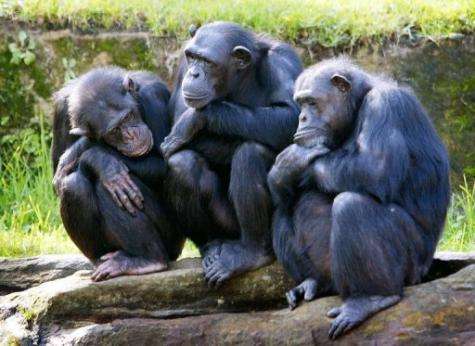
File photo of three female chimpanzees at the Taronga Zoo in Sydney. v
Chimpanzees are self-aware and can anticipate the impact of their actions on the environment around them, an ability once thought to be uniquely human, according to a study released Wednesday.
The findings, reported in the Proceedings of the Royal Society B, challenge assumptions about the boundary between human and non-human, and shed light on the evolutionary origins of consciousness, the researchers said.
Earlier research had demonstrated the capacity of several species of primates, as well as dolphins, to recognize themselves in a mirror, suggesting a fairly sophisticated sense of self.
The most common experiment consisted of marking an animal with paint in a place -- such as the face -- that it could only perceive while looking at its reflection.
If the ape sought to touch or wipe off the mark while facing a mirror, it showed that the animal recognised itself.
But even if this test revealed a certain degree self-awareness, many questions remained as to how animals were taking in the information. What, in other words, was the underlying cognitive process?
To probe further, Takaaki Kaneko and Masaki Tomonaga of the Primate Research Institute in Kyoto designed a series of three experiments to see if chimps, our closest cousins genetically, to some extent "think" like humans when they perform certain tasks.
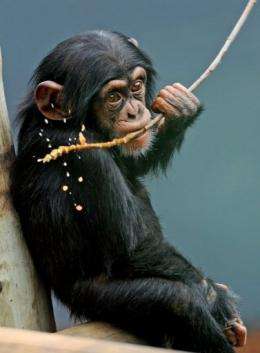
Photo illustration. Research has demonstrated the capacity of several species of primates, as well as dolphins, to recognize themselves in a mirror, suggesting a fairly sophisticated sense of self.
In the first, three females initiated a video game by placing a finger on a touch-sensitive screen and then used a trackball, similar to a computer mouse, to move one of two cursors.The movement of the second cursor, designed to distract or confuse the chimps, was a recording of gestures made earlier by the same animal and set in motion by the computer.
The "game" ended when the animal hit a target, or after a certain lapse of time.
At this point, the chimp had to identify with his finger which of the two cursors he had been manipulating, and received a reward if she chose correctly. All three animals scored above 90 percent.
"This indicates that the chimpanzees were able to distinguish the cursor actions controlled by themselves from those caused by other factors, even when the physical properties of those actions were almost identical," the researchers said.
But it was still not clear whether the good performance was truly due to the ability to discern "self-agency", or to observing visual cues and clues, so the researchers devised another set of conditions.
This time they compared two tests. The first was the same as in the previous experiment.
In the second, however, both cursors moved independently of efforts to control them, one a repeat of movements the chimp had generated in an earlier exercise, and the other a repeat of an "decoy" cursor. The trackball, in essence, was unplugged, and had no connection to the screen.
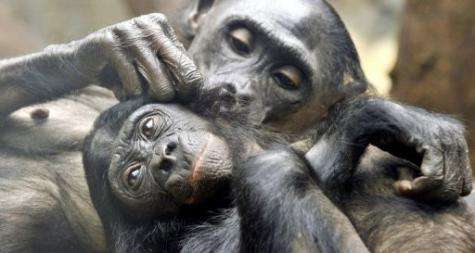
Two pygmy chimpanzees check for fleas on April 4, 2011 at the zoo in Frankfurt/M., western Germany. Takaaki Kaneko and Masaki Tomonaga of the Primate Research Institute in Kyoto designed a series of three experiments to see if chimps, our closest cousins genetically, to some extent "think" like humans when they perform certain tasks.
If the animals performed well on the first test but poorly on the second, the scientists reasoned, it would suggest that they were not simply responding to visual properties but knew they were in charge.The final experiment -- used only for the most talented of the chimps -- introduced a time delay between trackball and cursor, as if the two were out of sync, and a distortion in the direction the cursor moved on the screen.
All the results suggested that "chimpanzees and humans share fundamental cognitive processes underlying the sense of being an independent agent," the researchers concluded.
"We provide the first behavioural evidence that chimpanzees can perform distinctions between self and other for external events on the basis of a self-monitoring process."
(c) 2011 AFP
-
From lemons to lemonade: Reaction uses carbon dioxide to make carbon-based semiconductor,
32 comments
-
Thioridazine kills cancer stem cells in human while avoiding toxic side-effects of conventional cancer treatments,
3 comments
-
SpaceX private rocket blasts off for space station (Update),
42 comments
-
Climate scientists say they have solved riddle of rising sea,
31 comments
-
SpaceX capsule has 'new car' smell, astronauts say (Update),
2 comments
-
What would stain as translucent on light-coloured fabric?
14 hours ago
-
How do I identify different bacteria on culture plates?
May 26, 2012
-
Why Do Dogs do Strange things...
May 25, 2012
-
What does exophillic and endophillic mean in terms of mosquito and their control?
May 24, 2012
-
Semen stains glows under black lights (uv light)?
May 23, 2012
-
Question on Human Chromosome 2
May 23, 2012
- More from Physics Forums - Biology
More news stories
Scientist: Evolution debate will soon be history
(AP) -- Richard Leakey predicts skepticism over evolution will soon be history. Not that the avowed atheist has any doubts himself.
13 hours ago |
3.5 / 5 (11) |
30
Thousands of shellfish found dead in Peru
Thousands of crustaceans were found dead off the coast of Lima following the mystery mass death of dolphins and pelicans, the Peruvian Navy said Friday.
23 hours ago |
4.8 / 5 (4) |
7
More plant species responding to global warming than previously thought
(Phys.org) -- Far more wild plant species may be responding to global warming than previous large-scale estimates have suggested.
May 22, 2012 |
4.6 / 5 (14) |
18
|
For monogamous sparrows, it doesn't pay to stray (but they do it anyway)
It's quite common for a female song sparrow to stray from her breeding partner and mate with the male next door, but a new study shows that sleeping around can be costly.
May 22, 2012 |
5 / 5 (1) |
7
|
Study uncovers secret to speedy burrowing by razor clams
(Phys.org) -- If you look at a razor burrowing clam sitting in a bucket, youd never guess that it could burrow itself down into the soil, much less do it with any speed. Razor clams look like fat straws, ...
Nvidia trumpets Tegra 3 phone design wins for 2012
(Phys.org) -- Nvidias competitive war paint has a name, Tegra 3. On the heels of Nvidia announcements about lowering costs of its Tegra 3 processors and Nvidia-enabled tablets running Android Ice Cream ...
Browser wars flare in mobile space
The browser wars are heating up again, but this time the fight is for dominance of the mobile Internet.
Dell tablet leak: 10.1-inch display, two-battery choice
(Phys.org) -- Headline after headline talks about vendors tablets in the wings as likely number-one contenders for the iPad. Such claims have justifiably been taken with a grain of salt, considering ...
SpotterRF debuts Radar Backpack Kit (w/ Video)
(Phys.org) -- SpotterRF has announced a special radar backpack kit designed to enhance situational awareness for soldiers on the ground. The company says its special radar is designed for warfighters as part ...
SpaceX capsule has 'new car' smell, astronauts say (Update)
SpaceX's Dragon cargo vessel smells like a new car, said astronauts at the International Space Station after opening the hatches Saturday following the spacecraft's landmark mission to the orbiting lab.
Australia hails surprise super-telescope decision
Australia has hailed a surprise decision giving it a role in a radio telescope project aimed at revolutionising astronomy, vowing to draw on its decades of experience in space science.


May 04, 2011
Rank: 5 / 5 (3)
http://rspb.royal...pdf+html
May 04, 2011
Rank: 2.7 / 5 (3)
Here's a much simpler experiment that anyone can do at home or elsewhere. Try to hit any animal and see if they try to avoid being hit or not. Maybe the ones who let you hit them think that you are trying to hit "someone" else because they do not have the idea of self.
May 04, 2011
Rank: 5 / 5 (6)
Do you think bacteria are self aware? They certainly attempt to avoid the sources of pain and death just as you, I, and any animal would.
May 04, 2011
Rank: 3.6 / 5 (5)
May 04, 2011
Rank: 5 / 5 (7)
May 04, 2011
Rank: 4 / 5 (4)
May 04, 2011
Rank: 5 / 5 (4)
The Earth Shattering component is that they can anticipate what their actions bring about. That level of mental abstraction is very difficult to quantify in non-human animals. This means that the primate theory of mind is one step closer to oours.
May 04, 2011
Rank: 5 / 5 (6)
All I can say is that the more we study the life around us, it seems we most always find it more intelligent than first thought, rather than less.
May 04, 2011
Rank: 5 / 5 (3)
Make sure you show him your appreciation for his spam.
http://whois.doma...oods.com
http://www.linked.../3a1/405
Let's see how you like it, dickhead.
May 04, 2011
Rank: 5 / 5 (5)
Thanks SH!
Here's whois info that's got his registrar listed:
http://who.godadd...=GoDaddy
If we contact his registrar and report the spamming, they MIGHT be able to do something about it.
Scratch that. Looks like they're scammers too:
http://www.scam.c...t=124214
Report scams here:
http://www.consum...ting.php
And don't forget to use the phishing tools built into your modern browsers to report them so that other users of your browser get notified that the site is a scam.
Notify ICANN here:
http://reports.in...port.cgi
May 04, 2011
Rank: 5 / 5 (2)
http://whois.doma...yahcc.us
May 04, 2011
Rank: 5 / 5 (4)
I enjoy the fact that chimps understand the implications of their actions and I like having additional ammunition for arguments with cretinists. Porpoises, crows, african gray parrots, chimps, etc have all been shown to have the ability to understand ramifications already.
May 04, 2011
Rank: not rated yet
The conjecture is: That will not be any language you or I know.
Another words, what does not need defining?
Paint? What about lipstick? :)
May 04, 2011
Rank: not rated yet
Do bacteria have brains? and if they do, how big is it?
Self awareness is the product of a brain function. No brain, no self awareness. There is obviously a continuum of brain size in the animal world ( including us ), from the smallest to the largest. The size of the brain determines its functions. We have never determined the transition point between brain size and related functions. But chimps do have a big brain so I am not surprised that they are self aware. In fact I will be shocked if someone proves that they are not. Nature does not give you a big brain just for fun or because nature is generous. Big brain is synonymous with higher functions.
May 04, 2011
Rank: 5 / 5 (2)
May 04, 2011
Rank: not rated yet
The only real difference, imo, is that man strives to find purpose.
May 04, 2011
Rank: 1 / 5 (2)
so a stone, which we know does not have a brain, may be self aware? or is it that we just don't know like you said.
I agree that brain complexity is the important factor more than the size.
May 04, 2011
Rank: not rated yet
May 05, 2011
Rank: not rated yet
May 05, 2011
Rank: 5 / 5 (1)
Does anyone notice that self recognition tests select a sense which humans are good at (vision via mirror) and avoid senses in which humans are poor and in which other animals better us (the olfactory)??
May 05, 2011
Rank: not rated yet
Kudos. Your quotes (words!) shows what you anticipated with what you bring about with words - in your own species. Insight.
I can claim to have understood your insights (words).
No longer is there a way of knowing if the source - (my response, my words to you, me) - are human.
That is not important. Any non-human life form responding to you here in this form of understanding (language) is a threat and your greatest desire.
I understand. :)
May 05, 2011
Rank: not rated yet
Your car is "aware" due to the computer within the car. It takes signals from its sensors and processes them. The computer in a car works similar to a brain (in a very basic way).
May 05, 2011
Rank: not rated yet
May 08, 2011
Rank: not rated yet
That a plant might be aware of stimuli from its environment doesn't makes it self-aware. Failure to distinguish between awareness and self-awareness is muddling much of our scientific discourse today. If we posit that Einstein's "observer" possesses awareness of the frame of reference but not necessarily awareness of self, then we can more easily see how this awareness the frame of reference itself is a fundamental property of the universe. Even photons possess this rudimentary awareness according to the quantum interference and observation experiments. No anthropic principle necessary. Self-awareness might manifest itself when a mechanism of sufficient complexity, biological or otherwise, can act as capacitor and amplifier of awareness. This implies further evolutionary states beyond the self-awareness humanity experiences today.
May 08, 2011
Rank: 3 / 5 (1)
May 10, 2011
Rank: not rated yet