Utah rock art provides glimpse of Hawaiian life
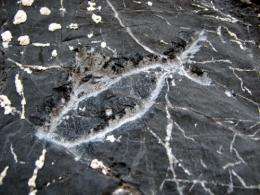
Halfway up Salt Mountain in Utah, petroglyphs on a limestone rock bear witness to an obscure twist of history: a Hawaiian Mormon settlement that flourished briefly more than a century ago.
A research team from New York has made the first effort to try to tease out possible meanings from this rock art, looking for themes from both Hawaiian petroglyphs and the traditions of The Church of Jesus Christ of Latter-day Saints.
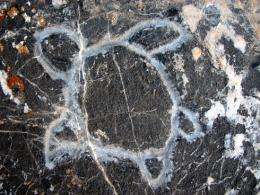
Some of the images, including lizards and turtles, could have evoked the sense that ancestors were still watching over these transplanted Hawaiians, according to Benjamin Pykles, an anthropology professor at the State University of New York at Potsdam.
Those animals were associated in Hawaii with "`aumakua," ancestral spirits who guard their descendants.
Pykles and Jonathan Reeves, an archeology student at SUNY Potsdam who traced the petroglyphs and recorded their positions, presented their findings during a Society for American Archeology conference on April 1 in Sacramento, Calif.
Along with the animal images, the researchers said that a carving that looks like a constellation, the Big Dipper, could have been especially significant. Often used by navigators to locate the North Star, it is a symbol that the Hawaiian Mormons would also have seen depicted on the Mormon Temple in Salt Lake City.
Pykles believes that one or more of the Hawaiians, using an unknown tool, carved the outlines of these 26 small petroglyphs, including a jackrabbit and a jellyfish, dogs, palm trees, and even a whale. Most are about the size of person's palm.
Petroglyphs are notoriously difficult to date, and Pykles cannot rule out that some or all of the images were made later, possibly by descendants who tend a nearby graveyard, or by other Pacific Islanders who visit the site for celebrations.
At some level, that doesn't matter, said Ian McNiven of Monash University in Melbourne, Australia, who is writing a book chapter on seascapes in rock art.
"I'm just fascinated that people living that far inland would wish to choose marine themes," said McNiven, who is not associated with Pykles' work. "It's almost more interesting if young people today are doing it."
The decorated rock is visible from what was once the settlement of Iosepa, named after Joseph F. Smith, a Mormon missionary to Hawaii who later became the church's leader.
Founded in 1889, when Hawaiian converts faced increasing difficulties in Salt Lake City, Iosepa grew slowly into a farming community of about 200 people. Residents spoke Hawaiian, and raised alfalfa, pumpkins and pigs. In the early days, tensions sometimes ran high, with strikes for better wages and some people pleading to return to the islands.
Pykles has been excavating parts of the Iosepa site, in Skull Valley about 50 miles west of Salt Lake City, since 2008. Although its buildings have vanished, foundations remain, either visible or just below the soil.
"The settlement they laid out was ambitious," said Pykles. "They were building to stay."
Instead, they left Iosepa nearly en masse in 1917, at the urging of the same Smith, who called on them to build a temple in Hawaii.
Few archeologists know about Iosepa, so Pykles' excavation there is especially significant, said Timothy Scarlett, an archeology professor at Michigan Technological University in Houghton.
"Iosepa is remarkable, because it's a totally unique story in American history," said Scarlett. "The rock art is so emblematic of all of this."
Reeves did most of the field research last summer hiking up to the site under the blazing July sun. It was so hot his clothes, which he had drenched in ice water to help keep cool, would be dry 20 minutes later.
Reeves told the archeology conference that these petroglyphs, with their blend of desert and marine images, show "…an intriguing persistence of original culture."
The presentation was among hundreds given during the five-day conference, which drew about 3,700 specialists in everything from early commerce and tool making to animal domestication.
Provided by Inside Science News Service


