Researcher to test new standard for stronger, more flexible pipe construction
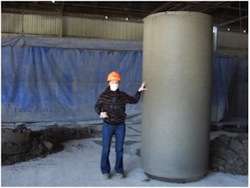
Researchers at The University of Texas at Arlington are partnering with a Belgian company to test new construction methods for reinforcing concrete pipes with steel fibers to build stronger, more durable pipes at a lower cost.
UT Arlington civil engineering professor Ali Abolmaali has been awarded a $155,000 grant through Bekaert, a global leader in drawn steel wire products, for the project. The grant calls for the American Association of State Highway and Transportation Officials and the American Society for Testing and Materials to review design specifications based on UT Arlington’s findings. The work is expected to lead to new design and construction standards in the United States.
Abolmaali said similar construction standards calling for mixing steel fibers in concrete pipes already have been adopted in Europe.
“This grant is important because it will lead to improved and sustainable concrete pipe with extended life through this collaborative research between Civil and Material Science and Engineering departments at UT Arlington,” Abolmaali said.
Nur Yazdani, chair of the UT Arlington Department of Civil Engineering, said Abolmaali’s work is a game-changer in the industry.
“With infrastructures aging in this country, it’s important for engineers to improve upon what we’ve done in the past,” Yazdani said.
The pipes – which range in size from one foot to six feet in diameter – are cast for infrastructure use such as bridge supports, water transport and sewer conveyance, among other things.
Currently, many manufacturers build a cage of wire mesh to hold concrete in place while the pipe is cast. The wire mesh frame makes the concrete pipes more rigid, reducing their useful life. Mixing the steel fibers in with the cement mix gives the concrete pipe strength and flexibility.
Bekaert spends a lot of time searching for new solutions with global partners like Abolmaali, company spokesman T.R. Kunesh said.
“Steel fiber reinforced concrete pipe is the norm in the rest of the world so it is critical that we have the same superior quality concrete pipe for U.S. infrastructure needs,” Kunesh said. “This cutting edge testing program at UT Arlington will open doors to many other transportation applications including bridges, drainage and utility structures making our streets and highways safer.”
Abolmaali said the elimination of cages will make the pipe manufacturing process less expensive and less labor intensive.
More testing and evaluation will be required once the new standards are adopted, Abolmaali said. Industry leaders including Hansen Pipe, Rinker Materials, Northern Concrete Pip and Sherman Dixie Industries are conducting the entire pipe manufacturing for the grant for free, he said.
“The concrete pipe industry is extremely excited about this research and its potential income,” Abolmaali said. “They are joining this program one after another.”
Pranesh Aswath, professor in material science & engineering; Simon Chao, assistant professor in civil engineering; and Tri Le, post-doctoral associate in civil engineering; are co-principal investigators on the project.
Provided by University of Texas at Arlington


.jpg)


