Social wasps show how bigger brains provide complex cognition
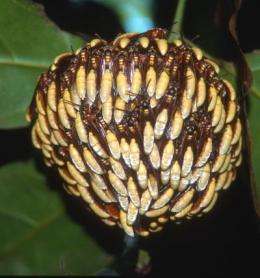
Apoica pallens wasps at their nest in the afternoon. The species is nocturnal -- unusual for social wasps -- and foragers hunt at night. The photo was taken in a tropical rainforest in Corcovado National Park, Costa Rica. Credit: Sean O’Donnell, University of Washington.
Across many groups of animals, species with bigger brains often have better cognitive abilities. But it's been unclear whether overall brain size or the size of specific brain areas is the key.
New findings by neurobiologists at the University of Washington suggest that both patterns are important. The researchers found that bigger-bodied social wasps had larger brains and devoted up to three times more of their brain tissue to regions that coordinate social interactions, learning, memory and other complex behaviors.
Within a species, queens had larger central processing areas the brain regions that manage complex behaviors than did worker wasps.
"As the brain gets larger, there's disproportionately greater investment in the size of brain tissue for higher-order cognitive abilities," said Sean O'Donnell, lead author and UW psychology professor. "As larger wasp brains evolve, natural selection favors investing most heavily in the brain regions involved in learning and memory."
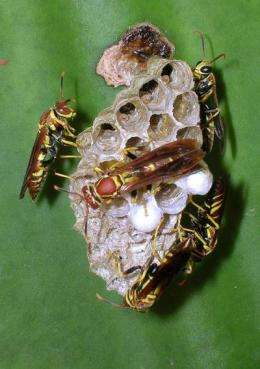
Wasps in the species Polistes instabilis form small, simple colonies of a few dozen adults. The open cells of the nest contain the young brood, mostly larvae. The white-capped nest cells contain pupae inside silken cocoons, and adult wasps will emerge from these. This nest was in a tropical dry forest in Guanacaste, Costa Rica. Credit: Sean O’Donnell, University of Washington.
For smaller-brained species, cognitive power may be limited by their inability to invest in central brain regions. "In many kinds of animals, it's only with a larger brain which is determined by body size that more complex and flexible behaviors are achieved," O'Donnell said.The results appear in the April 11 online edition of the Proceedings of the National Academy of Sciences.
O'Donnell and his co-authors collected samples of 10 types of adult social wasps from four field sites in Costa Rica and Ecuador. As in other studies, they found that the larger the wasp, the larger the overall brain size. But increase of brain size was not uniform across all brain regions.
The researchers dissected the wasp brains and measured the volume of two brain regions. They focused on the central processing region known as the mushroom bodies that, like the cerebral cortex in humans, handles elaborate cognitive functions such as learning, memory and social interactions. They also measured the peripheral processing regions the optic lobes and the antennal lobes that deal with vision and smell and are thought to perform more basic cognitive functions.
Across the 10 species, brain areas that process peripheral sensory information increased only slightly with overall brain size. But the wasps with larger bodies and correspondingly larger-sized brains had disproportionately larger central processing regions.
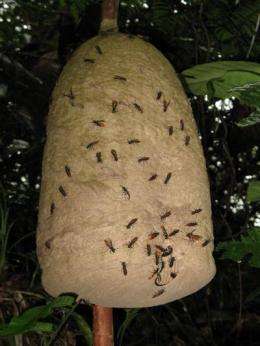
This two-foot tall nest found in Yasuni National Park in Ecuador probably housed thousands of adult wasps in the Polybia dimidiata species. The nest was made of tough, water-resistant paper. Credit: Sean O’Donnell, University of Washington.
"These findings suggest that absolute brain size matters a lot, because it sets limits on central cognitive processing tissue," O'Donnell said.The researchers also found that in nine out of 10 wasp species, the queens had larger central processors than worker wasps. This was surprising to the researchers because, in social wasps, queens seem to not perform complex tasks like food collection. They're relatively inactive, staying in the nest to lay eggs while the workers go out to forage.
But O'Donnell said the greater brain power possessed by social wasp queens may be due to having to defend their social status. "Queens are constantly tested for their potency. They must be up for those social cognitive demands," he said.
The researchers are now testing the prediction that large-brained species will have enhanced cognitive abilities compared with smaller-brained species, which could have ecological payoffs for challenges like invading new habitats and expanding their geographic range.
Provided by
University of Washington
-
From lemons to lemonade: Reaction uses carbon dioxide to make carbon-based semiconductor,
32 comments
-
Thioridazine kills cancer stem cells in human while avoiding toxic side-effects of conventional cancer treatments,
3 comments
-
SpaceX private rocket blasts off for space station (Update),
42 comments
-
Climate scientists say they have solved riddle of rising sea,
31 comments
-
Research team claims to have found evidence Lake Cheko is impact crater for Tunguska Event,
18 comments
-
What would stain as translucent on light-coloured fabric?
12 hours ago
-
How do I identify different bacteria on culture plates?
22 hours ago
-
Why Do Dogs do Strange things...
May 25, 2012
-
What does exophillic and endophillic mean in terms of mosquito and their control?
May 24, 2012
-
Semen stains glows under black lights (uv light)?
May 23, 2012
-
Question on Human Chromosome 2
May 23, 2012
- More from Physics Forums - Biology
More news stories
Scientist: Evolution debate will soon be history
(AP) -- Richard Leakey predicts skepticism over evolution will soon be history. Not that the avowed atheist has any doubts himself.
11 hours ago |
3.5 / 5 (11) |
29
It's in the genes: Research pinpoints how plants know when to flower
Scientists believe they've pinpointed the last crucial piece of the 80-year-old puzzle of how plants "know" when to flower.
May 25, 2012 |
3.9 / 5 (9) |
1
|
Researchers solve structure of human protein critical for silencing genes
In a study published in the journal Cell on May 24, Cold Spring Harbor Laboratory (CSHL) scientists describe the three-dimensional atomic structure of a human protein bound to a piece of RNA that "guides" the pr ...
May 25, 2012 |
4.7 / 5 (7) |
0
|
Thousands of shellfish found dead in Peru
Thousands of crustaceans were found dead off the coast of Lima following the mystery mass death of dolphins and pelicans, the Peruvian Navy said Friday.
21 hours ago |
4.8 / 5 (4) |
6
Copy of the genetic makeup travels in a protein suitcase
Scientists from the Institute for Physical and Theoretical Chemistry at the University of Bonn have succeeded for the first time in the real time filming of the transport of an important information carrier in biological ...
May 25, 2012 |
not rated yet |
0
|
Nvidia trumpets Tegra 3 phone design wins for 2012
(Phys.org) -- Nvidias competitive war paint has a name, Tegra 3. On the heels of Nvidia announcements about lowering costs of its Tegra 3 processors and Nvidia-enabled tablets running Android Ice Cream ...
Browser wars flare in mobile space
The browser wars are heating up again, but this time the fight is for dominance of the mobile Internet.
Dell tablet leak: 10.1-inch display, two-battery choice
(Phys.org) -- Headline after headline talks about vendors tablets in the wings as likely number-one contenders for the iPad. Such claims have justifiably been taken with a grain of salt, considering ...
SpaceX capsule has 'new car' smell, astronauts say (Update)
SpaceX's Dragon cargo vessel smells like a new car, said astronauts at the International Space Station after opening the hatches Saturday following the spacecraft's landmark mission to the orbiting lab.
Of mice and mental models: Neuroscientific implications of risk-optimized behavior in the mouse
(Medical Xpress) -- Regardless of an organism’s biological complexity, every encephalized animal continuously makes under-informed behavioral choices that can have serious consequences. Despite its ubiquity, ...
SpotterRF debuts Radar Backpack Kit (w/ Video)
(Phys.org) -- SpotterRF has announced a special radar backpack kit designed to enhance situational awareness for soldiers on the ground. The company says its special radar is designed for warfighters as part ...


Apr 11, 2011
Rank: not rated yet
Apr 11, 2011
Rank: 5 / 5 (3)
Apr 12, 2011
Rank: not rated yet
This whole premise that body size alone allows a larger central processing area sounds flawed to me. The fact that wasps are so small makes the inference that it takes a larger body to make the central processing area larger wrong or it would not be true for anything bigger than a wasp. Anything bigger than a wasp would automatically have the larger brain to devote more area to the central processor. It seems far more likely to me that the fact that the insects are social is the cause of the larger processing area as well as allowing them to be more successful which allows a larger body size. The larger body size incurs penalties of larger energy and resource requirements which can be met because of their social order. At least that would be my theory.
Apr 16, 2011
Rank: not rated yet