Last Shuttle ride to ISS for ESA astronaut with 'dark matter' hunter
Apr 20, 2011
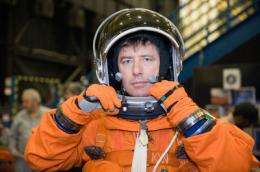
ESA astronaut Roberto Vittori, STS-134 mission specialist, dons a training version of his shuttle launch and entry suit in preparation for a training session in the Space Vehicle Mock-up Facility at NASA's Johnson Space Center. Credits: NASA

(PhysOrg.com) -- ESA astronaut Roberto Vittori and the five other astronauts of the STS-134 mission will be launched to the International Space Station on Space Shuttle Endeavour on 29 April to deliver a pioneering scientific experiment.

This penultimate flight of NASA’s spaceplane will deliver an instrument designed to track elusive antimatter and ‘dark matter’ in the Universe.

Liftoff on the 14-day STS-134 mission is scheduled for 19:47 GMT (21:47 CEST), with the docking to the (ISS) due two days later, on 1 May.  

The last European to fly on a Shuttle, Roberto Vittori will be the first ESA astronaut to make a third visit to the ISS. It will also be his first flight on the Shuttle. On his two previous missions, in 2002 and 2005, he travelled on a Russian Soyuz spacecraft.

Arriving at the ISS, he will meet another Italian ESA astronaut, Paolo Nespoli, who has been aboard since 17 December.

On her last flight before retirement, Endeavour will carry a highly sophisticated European fundamental physics experiment. Mounted on the Station’s main truss, the AMS-02 alpha magnetic spectrometer will probe the little-explored realm of high-energy cosmic rays to look for signs of antimatter and the mysterious dark matter.

Antimatter is believed to have been created on a par with normal matter but it seems to have disappeared from the Universe we know today. Dark matter is estimated to account for around 90% of our Universe’s mass but it has not been detected directly so far. This dark matter element is reflected in the name ‘DAMA’ of Roberto Vittori’s mission.

The AMS-02 observations could be of paramount importance for understanding the origin, nature and evolution of the Universe.

STS-134 marks the end of ESA’s participation in Space Shuttle missions, which started in November 1981 with the first flight of Europe’s Spacelab pallet on the second launch of Columbia. Over three decades, ESA astronauts will have flown on 26 missions and, counting payloads, hardware and experiments, Europe will have been involved in 86 missions by the time of the Shuttle’s final venture, STS-135, in June.

Beginning with the Spacelab agreement in 1973, this historical and close partnership with will live on through the ISS and future international human spaceflight ventures.

This last Shuttle flight of an ESA astronaut will not mean the end of ESA’s presence on the Station, which will continue at least through 2020. Two ESA are training for future 6-month missions on the orbital outpost: André Kuipers will be launched in November this year and Luca Parmitano in December 2013, both in Soyuz spacecraft.

Explore further: Collisions of coronal mass ejections can be super-elastic

add to favorites email to friend print save as pdf

Related Stories

NASA Aims for 4 Shuttle Flights in 2007

Apr 17, 2007

NASA has announced a revised launch schedule for the upcoming Space Shuttle missions. The revised schedule follows a review of repairs to the insulation on the Shuttle's external fuel tank, which was damaged ...

Dark matter detective arrives at ESTEC

Feb 17, 2010

(PhysOrg.com) -- One of the most exciting scientific instruments ever built, the Alpha Magnetic Spectrometer (AMS), arrived at ESA's Test Centre in the Netherlands for testing before being launched on the ...

Recommended for you

Forecast for Titan: Wild weather could be ahead

19 hours ago

(Phys.org) —Saturn's moon Titan might be in for some wild weather as it heads into its spring and summer, if two new models are correct. Scientists think that as the seasons change in Titan's northern hemisphere, ...

SDO observes mid-level solar flare

19 hours ago

UPDATE 16:30 p.m. EDT: The M7-class flare was also associated with a coronal mass ejection or CME, another solar phenomenon that can send billions of tons of particles into space. While this CME was not Ea ...

NASA's IRIS mission readies for a new challenge

May 22, 2013

(Phys.org) —The time draws near. NASA is getting ready to launch a new mission, a mission to observe a largely unexplored region of the solar atmosphere that powers its dynamic million-degree outer atmosphere and drives ...

User comments : 0

More news stories

A hidden population of exotic neutron stars

(Phys.org) —Magnetars – the dense remains of dead stars that erupt sporadically with bursts of high-energy radiation - are some of the most extreme objects known in the Universe. A major campaign using ...

Russia evacuates drifting Arctic research station

Russia has ordered the urgent evacuation of the 16-strong crew of a drifting Arctic research station after ice floe that hosts the floating laboratory began to disintegrate, officials said Thursday.

Century-old science helps confirm global warming

(Phys.org) —Ocean measurements taken more than 135 years ago during the scientific expedition of HMS Challenger have provided further confirmation of human-produced global warming over the past century.

The secret lives, and deaths, of neurons

As the human body fine-tunes its neurological wiring, nerve cells often must fix a faulty connection by amputating an axon—the "business end" of the neuron that sends electrical impulses to tissues or other ...

White tiger mystery solved

White tigers today are only seen in zoos, but they belong in nature, say researchers reporting new evidence about what makes those tigers white. Their spectacular white coats are produced by a single change ...