SETI telescope array suspends operations due to financial constraints
April 26, 2011 by Bob Yirka
(PhysOrg.com) -- SETI, the Search for Extraterrestrial Intelligence group that has been using radio telescopes since the 1960s to "listen" for signals from deep space that could prove the existence of other life in the universe, has had to temporarily suspend operation of its Allen Telescope Array, (ATA) due to a lack of funding.
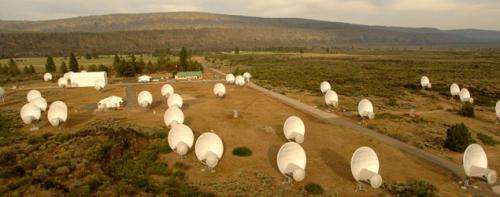
Built in 2007, at a cost of $50 million (half of which came from its namesake, Microsoft co-founder Paul Allen), the array, located north of San Francisco, is comprised of 42 dishes and is connected to 64 quad-core Dell 6100 servers, donated by Dell, Google, and Intel, that sift through 100 to 200TB of data each day in hopes of finding a sign of non-terrestrial signals.
The array has been put into hibernation mode, with a skeleton crew to keep it from deteriorating, while SETI looks for new sources of cash. Until now, its operating funds have come from the state of California (the University of California, Berkeley is responsible for operating the ATA) the National Science Foundation, NASA and other private donors. But as California and the rest of the nation suffered through hard economic times, so too did SETI as donations dwindled and budgets were cut. So, instead of adding more dishes (350 were originally planned) and putting the source code for the data scanning algorithms on the cloud via Amazon, the group is instead scrambling to simply stay alive.
Tom Pierson, CEO of the SETI Institute, which is based in Mountain View, California, broke the news in an open letter to donors, posted April 22; and Franck Marchis, astronomer and a Principal Investigator for SETI, confirmed the mothballing of the ATA on his blog. The news was not unexpected, however, as SETI has seen its donations over the past two years, literally dry up and disappear.
In his blog, Marchis, mentions that the ATA is used for more than just alien searching; its been used to study all sources of intergalactic radio wave sources, for example and has been used to help with the study of black holes and other unexplained phenomena. He also notes that the U.S. Air Force is interested in using the array to help track space debris, and if so, the hope is that some type of sharing arrangement can be worked out, at least until SETI finds another donor with very deep pockets.
More information: http://www.seti.org/ata
© 2010 PhysOrg.com
-
From lemons to lemonade: Reaction uses carbon dioxide to make carbon-based semiconductor,
32 comments
-
Thioridazine kills cancer stem cells in human while avoiding toxic side-effects of conventional cancer treatments,
3 comments
-
SpaceX private rocket blasts off for space station (Update),
42 comments
-
Climate scientists say they have solved riddle of rising sea,
31 comments
-
Research team claims to have found evidence Lake Cheko is impact crater for Tunguska Event,
18 comments
-
revamping general concept and cosmological principle
May 25, 2012
-
Transiting Exoplanet Light Curve
May 25, 2012
-
Math behind Theoretical Physics
May 24, 2012
-
Do we know whats at the center of galaxies yet?
May 23, 2012
-
Structure of the Milky Way?
May 20, 2012
-
What would it take to terraform Pluto and Charon?
May 19, 2012
- More from Physics Forums - General Astronomy
More news stories
SpaceX capsule has 'new car' smell, astronauts say (Update)
SpaceX's Dragon cargo vessel smells like a new car, said astronauts at the International Space Station after opening the hatches Saturday following the spacecraft's landmark mission to the orbiting lab.
Space & Earth / Space Exploration
21 hours ago |
4.5 / 5 (20) |
1
Australia hails surprise super-telescope decision
Australia has hailed a surprise decision giving it a role in a radio telescope project aimed at revolutionising astronomy, vowing to draw on its decades of experience in space science.
21 hours ago |
5 / 5 (4) |
2
Dragon arrives at space station in historic 1st (Update 2)
The privately bankrolled Dragon capsule made a historic arrival at the International Space Station on Friday, triumphantly captured by astronauts wielding a giant robot arm.
Space & Earth / Space Exploration
May 25, 2012 |
5 / 5 (10) |
19
Astronomers seize last chance in lifetime for Venus Transit
Astronomers are gearing for one the rarest events in the Solar System: an alignment of Earth, Venus and the Sun that will not be seen for another 105 years.
21 hours ago |
5 / 5 (3) |
2
Organic carbon from Mars, but not biological
(Phys.org) -- Molecules containing large chains of carbon and hydrogen--the building blocks of all life on Earth--have been the targets of missions to Mars from Viking to the present day. While these molecules ...
Space & Earth / Space Exploration
May 24, 2012 |
4.4 / 5 (5) |
2
|
Nvidia trumpets Tegra 3 phone design wins for 2012
(Phys.org) -- Nvidias competitive war paint has a name, Tegra 3. On the heels of Nvidia announcements about lowering costs of its Tegra 3 processors and Nvidia-enabled tablets running Android Ice Cream ...
Browser wars flare in mobile space
The browser wars are heating up again, but this time the fight is for dominance of the mobile Internet.
Dell tablet leak: 10.1-inch display, two-battery choice
(Phys.org) -- Headline after headline talks about vendors tablets in the wings as likely number-one contenders for the iPad. Such claims have justifiably been taken with a grain of salt, considering ...
Scientist: Evolution debate will soon be history
(AP) -- Richard Leakey predicts skepticism over evolution will soon be history. Not that the avowed atheist has any doubts himself.
Of mice and mental models: Neuroscientific implications of risk-optimized behavior in the mouse
(Medical Xpress) -- Regardless of an organism’s biological complexity, every encephalized animal continuously makes under-informed behavioral choices that can have serious consequences. Despite its ubiquity, ...
SpotterRF debuts Radar Backpack Kit (w/ Video)
(Phys.org) -- SpotterRF has announced a special radar backpack kit designed to enhance situational awareness for soldiers on the ground. The company says its special radar is designed for warfighters as part ...
Apr 26, 2011
Rank: 4.3 / 5 (6)
Seti is the most mathematically incompetent project ever put up by smart people. If alpha centauri had a civilization identical to ours, the signal reaching us would be too weak for Seti to pick up, so what makes them think that other races are sending out super powerful radio pulses anyways? It's a lack of imagination that *if* an interstellar race is communicating between stars, that they'd do it the same inefficient way as we do.
Because of course, a race that is still bound to its home planet knows everything about interstellar communication.
Apr 26, 2011
Rank: 3 / 5 (3)
The idea is that an advanced enough alien civilization would employ many different techniques in order to search for civilized planets. They would be totally aware of the differences in technology between races, so they would send out many different sorts of signals that imply anything unnatural coming from their planet. Since radio waves are physically quite simple when looking at the big picture, they'd likely be included as part of the search.
That's how I see it, anyway.
Apr 26, 2011
Rank: 5 / 5 (1)
Our entire civilization putting it's output just to say hello to the neighbors...
and i know that advanced civilizations will have more energy at their disposal, but why would they put so much effort into yelling for such a short distance when it becomes quantitatively easier and less energy intensive to just send someone in person to say hello? You see where I'm getting at? It is SO inefficient to send a radio signal just to the nearest star, that it would take less energy and effort just to ship the green eyed alien or a robot over to do it in person.
Apr 26, 2011
Rank: not rated yet
I'm not saying that aliens are coming to visit us in person, but I am saying that they would send someone over trying to communicate with us on our current technological terms...Which is why, in the current interstellar space league, it's just not worth it to include poor old earth.
Apr 27, 2011
Rank: 5 / 5 (1)
Apr 27, 2011
Rank: 1 / 5 (8)
Apr 27, 2011
Rank: not rated yet
Apr 27, 2011
Rank: 3 / 5 (3)
This may not be a popular comment - but what did landing on the moon really get us? A few moon rocks, a laser reflector, and an lunarquake detector? It was the PATH to the moon where our real discoveries and advancements were made. Even if (for some silly reason) we never set foot on the moon, the advancement in the Apollo mission's wake would still be relevent.
Apr 27, 2011
Rank: 1 / 5 (1)
And you also never know whether EVERYBODY who is listening will be friendly. Using undirected communication methods (like radio) is a way to broadcast when you don't know where the receiver is AND you have no other way of gettging the message there in an appreciable amount of time in a physical way.
If FTL is possible then no one in the galaxy would be using radio to communicate
If near light speed travel is possible then sending information pods is much better:
a) no one can eavesdrop on it
b) the information density is much higher
c) you can decide upon visiting a new solar system whether you want to deliver the goods or whether the recipient looks too risky
Apr 27, 2011
Rank: 2 / 5 (1)
Apr 27, 2011
Rank: 5 / 5 (1)
GTFO, we're interested in science, not creationism.
Apr 27, 2011
Rank: not rated yet
I bet it would have been popular had you left out the moon landing part :)
Apr 27, 2011
Rank: not rated yet
But yes, they both gave us advances that benefit our lives and science, regardless of their main objectives that make those projects valuable.
Apr 27, 2011
Rank: 5 / 5 (2)
Would that be the same creator that put in his bible:
Slaves, obey your earthly masters with deep respect and fear. Serve them sincerely as you would serve Christ. (Ephesians 6:5)
Apr 27, 2011
Rank: not rated yet
So a single individual from that planet knows any better?
Apr 27, 2011
Rank: not rated yet
Besides, this is a problem of practicality. The inefficiencies and energy requirements of star to star radio communication are ludicrusly high, and rise exponentially the farther you go out. Like I said, it gets to the point where sending a physical object to communicate becomes more efficient.
And No, I am definitely not the only one saying these things...there are quite a few well respected scientists who express their doubts...But most of them are happy that it provides science outside of its main goal, and don't bother badmouthing it for that reason
Apr 27, 2011
Rank: 4 / 5 (1)
Our radio telescopes can detect things billions of light years away. Excellent. But that would be detecting the energy of a pulsar or huge gamma ray burst. Radio waves causes by things the size of our sun at least!!! so yes, a very advanced civilization could harness the power of say, 100 stars, capturing all the power of each and shooting prime number sequences here and there. But why do it if you dont know where its going to reach. Send robotic ships, close to light speed using star power, that can collect energy as they go like destiny from stargate universe. And they can share more info than just prime numbers when they detect radio transmissions weaving through solar systems. The 'Ether' just interacts and absorbs most of the radio transmission's energy. Or they can just send a subspace transmission, what ever the heck that is....
Apr 27, 2011
Rank: not rated yet
May 01, 2011
Rank: not rated yet
Alien, offworld, not from this earth intelligently created and based 'encoded signals' were received immediately after sputnik was launched and began transmitting.
No guff.
look it up.
Yet..no one seems to be noticing that NASA is FLAGGING as hard as they can--- that we knew and received such communications at least that far back in time.
For them to be received immediately after sputnik went up, this means that...the communication source was LOCAL.
May 02, 2011
Rank: 5 / 5 (1)